Attribution Modeling for eCommerce Brands: The 2026 Strategic Playbook

In 2026, Meta Ads suffer an average signal loss of 32 percent while the typical customer journey has expanded to ten distinct touchpoints. Your ROAS reports are likely lying, your top-of-funnel spend feels indefensible, and your data remains trapped in isolated silos. You're flying a high-performance jet with a cracked windshield. Mastering attribution modeling for eCommerce brands is no longer about looking at pretty dashboards. It's about engineering a precise, tactical engine for high-velocity execution.
You already know that inaccurate reporting leads to wasted spend and missed opportunities. It's time to demand clarity, precision, and results. This playbook delivers the tactical framework to eliminate revenue leakage in a privacy-first AI economy. We'll explore how to build a single source of truth, scale winning campaigns with absolute confidence, and leverage agentic workflows to reclaim lost conversion data. Prepare to move beyond passive analytics and into a state of strategic mastery.
Key Takeaways
- Identify, map, and plug revenue leaks by understanding the non-linear journey of the modern high-value customer.
- Master the tactical execution of attribution modeling for eCommerce brands to justify awareness budgets and scale spend with precision.
- Bypass browser blocks and reclaim lost conversion signals through advanced server-side tracking and CAPI implementation.
- Establish a single source of truth by enforcing rigid UTM nomenclature across every marketing channel and storefront touchpoint.
- Transition from passive reporting to automated execution by leveraging agentic media buying to scale winning campaigns in real time.
The 2026 Attribution Crisis: Why Your Data is Leaking Revenue
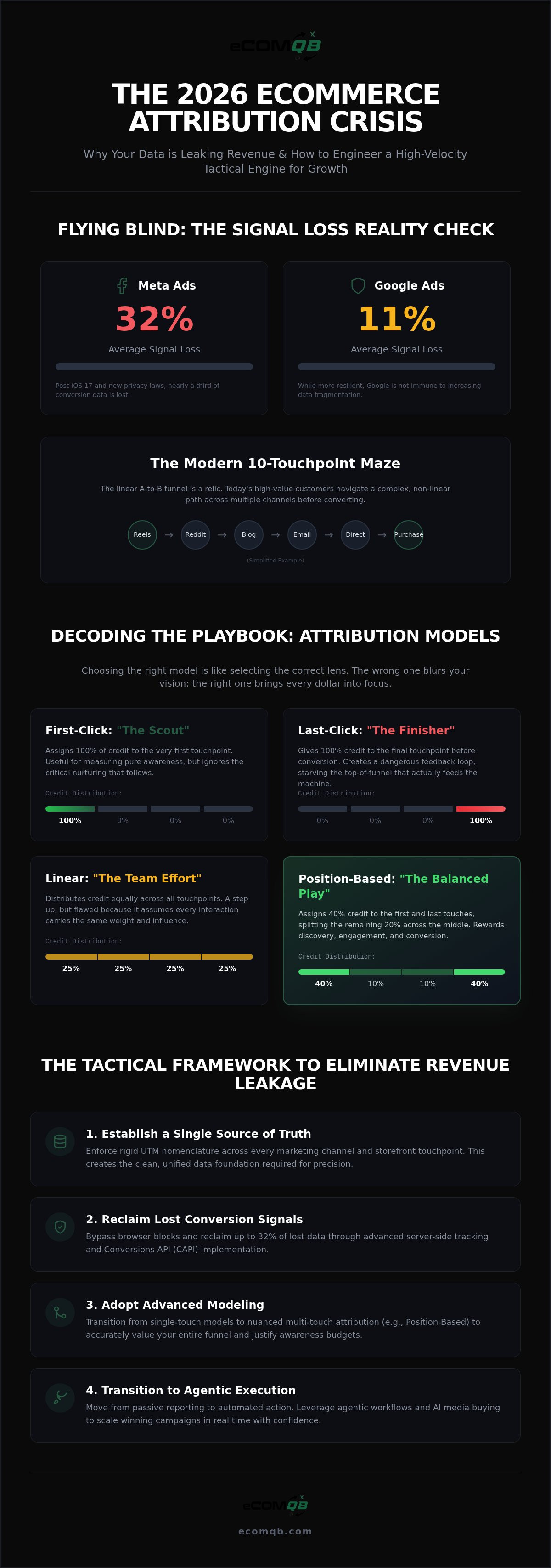
The linear funnel is a relic. By late 2026, customers interact with your brand across an average of 8 to 10 touchpoints before a transaction occurs. Fragmentation defines the current market. Consumers jump from Instagram Reels to Reddit threads, then to email newsletters, before finally converting on a Shopify storefront. Each of these interactions represents a potential point of failure. If you're still relying on basic tracking, you're missing the vast majority of the story. Precise attribution modeling for eCommerce brands has shifted from a luxury metric to a survival-critical tactical requirement. Without it, you are effectively blind in a high-stakes environment.
The Signal Loss Reality Check
Your Shopify dashboard says one thing. Meta says another. Google claims a third. This discrepancy isn't a glitch; it's a structural failure. Post-iOS 17 and the implementation of 2026 privacy laws in states like Indiana, Kentucky, and Rhode Island, Meta experiences an average signal loss of 32 percent. Google Ads isn't immune, losing roughly 11 percent of its visibility. These gaps create a "fog of war" where winners are separated from losers by their ability to see through the noise. These state-level regulations have tightened the noose on traditional cookie-based tracking, forcing a massive increase in "dark traffic" that defies conventional analysis.
Dark Social refers to the untrackable traffic originating from private messaging, Slack, and encrypted apps that masks the true drivers of your brand growth. When a customer shares a product link in a private group, your standard pixel records it as "Direct" traffic. This miscategorization devalues your content marketing and awareness efforts. It forces you to make decisions based on incomplete intel and flawed assumptions.
The Revenue Leak: What You Don't See is Killing Your ROAS
Last-click bias is a silent killer of growth. It assigns 100 percent of the credit to the final interaction, which is usually a retargeting ad or a brand search. This creates a dangerous feedback loop. You over-invest in the bottom of the funnel while starving the top-of-funnel (TOFU) awareness that actually feeds the machine. By studying different Marketing Attribution Models, you can finally see the real value of that initial TikTok view or YouTube discovery. This perspective shift is mandatory for any leader looking to maintain a competitive advantage.
Misattributed sales lead to cutting the very campaigns that drive your long-term velocity. This is the primary "Data Gap" preventing brands from reaching 8-figure scaling. You must move from passive reporting to active tactical intelligence. Advanced attribution modeling for eCommerce brands provides the precision required to scale winning campaigns aggressively. It eliminates the guesswork and replaces it with a clear, action-oriented playbook for revenue capture.
Decoding the Playbook: Standard vs. Advanced Attribution Models
Choosing the right attribution modeling for eCommerce brands is like selecting a lens for a high-precision camera. The wrong setting blurs your vision. The right one brings every dollar into focus. You need to match your model to your specific sales cycle, product complexity, and growth objectives. It is about precision, velocity, and results.
Single-Touch Models: The Tactical Limitations
First-click attribution acts as your "Scout." It identifies the initial spark that brought a stranger into your ecosystem. While useful for measuring pure awareness, it ignores the critical nurturing that follows. Conversely, last-click attribution is the "Finisher." It gives all credit to the final touchpoint, effectively ignoring the entire buildup. It's a narrow view that rewards the closer while forgetting the playmaker.
These models fail for high-ticket items or complex DTC journeys. If your customer requires ten touchpoints, attributing 100 percent of the value to a single click is a strategic blunder. It creates a skewed reality where top-of-funnel efforts look like wasted spend. To fix this, leaders are adopting a new approach to brand strategy that values every stage of the customer lifecycle. You must see the whole field to win the game.
Multi-Touch and AI-Driven Modeling
Advanced modeling requires a more nuanced perspective. Linear attribution treats every interaction as equal. It is a "team effort" approach, but it's flawed because not all touches carry the same weight. Position-based (U-shaped) modeling offers a better balance. It assigns 40 percent of credit to both the first and last touch, while splitting the remaining 20 percent across the middle. This rewards discovery, engagement, and conversion.
For short-cycle impulse purchases, time-decay modeling is often the superior choice. It gives more weight to touchpoints occurring closer to the transaction. However, the 2026 standard is Data-Driven Attribution (DDA). This leverages AI to assign dynamic credit based on incremental lift. It doesn't guess; it calculates. By integrating The Revenue Machine: Deploying AI Growth Systems, you can automate these insights into action. Identify, analyze, and scale with absolute certainty.
Data-driven models provide the precision needed to scale winning ads without the manual overhead. If your current reporting feels like a guessing game, it's time to audit your attribution framework. You need a system that evolves with your data, ensuring every marketing dollar is deployed for maximum impact.
The Tech Stack Showdown: Evaluating Triple Whale, Northbeam, and Rockerbox
Selecting your attribution software is a high-stakes decision. In 2026, the tool you choose functions as the nervous system of your growth engine. It must process millions of data points, filter out the noise, and deliver actionable intel in real time. Your choice determines whether you operate with surgical precision or remain trapped in a fog of guesswork. Effective attribution modeling for eCommerce brands requires a platform that matches your specific scale, complexity, and speed requirements.
Choosing your weapon requires a strategic assessment of three critical levers. First, evaluate your channel diversity and spend volume; a brand spending $2 million monthly across six platforms needs the deterministic modeling of Northbeam. Second, demand real-time creative performance insights. You cannot wait 48 hours to kill a failing ad. Third, acknowledge that Why Your Current Tech Stack is Leaking Revenue often comes down to data latency. In 2026, zero-latency is the only acceptable standard for agentic media buying.
The Pitfalls of Self-Service Attribution
Software alone is never the solution. A tool is only as effective as the strategist wielding it. Many brands fall into the trap of "Analysis Paralysis," drowning in thousands of data points without a clear path to execution. Attribution modeling for eCommerce brands is a technical discipline that requires managed AI transformation to interpret complex signals correctly. You don't need more data; you need better decisions. Managed systems ensure that your tech stack translates into aggressive scaling, improved LTV, and absolute market dominance. Move past the dashboard and focus on the ultimate objective: high-velocity growth.
Engineering the High-Velocity Journey: A Tactical Implementation Guide
Implementation is where strategy meets the pavement. You cannot scale an 8-figure brand on a foundation of shaky data or fragmented reporting. High-performance attribution modeling for eCommerce brands requires a rigid, disciplined workflow that prioritizes accuracy over vanity. It is a process of refinement. You must identify, isolate, and scale your winning campaigns with absolute certainty. This tactical guide outlines the four mandatory steps to secure your data pipeline and eliminate revenue leakage.
- Step 1: Implement server-side tracking to bypass browser-level blocks.
- Step 2: Establish a standardized UTM nomenclature to ensure universal data cleanliness across all platforms.
- Step 3: Shift your focus from standard ROAS to high-leverage metrics like MER and iROAS.
- Step 4: Integrate first-party data from email and SMS to map the full customer lifecycle.
Bypassing the Pixel: The Server-Side Mandate
Client-side pixels are failing in the 2026 privacy landscape. With aggressive browser blocks and cookie restrictions, relying on a browser to report conversions is a losing game. You must implement server-side tracking, specifically the Meta Conversions API (CAPI), to establish a direct link between your Shopify backend and your advertising platforms. Server-side tracking can recover 20 to 40 percent of conversions that are typically missed by traditional pixels. Your Shopify store is the ultimate source of truth; your tracking must reflect that reality.
Integrating your server-side data ensures your attribution engine sees every transaction without latency. This is the foundation of a high-velocity storefront. When combined with a robust SEO and Content Strategy for Shopify, you create a catch-all for high-converting traffic that remains fully trackable. You stop guessing and start knowing.
Defining High-Performance KPIs
Clean data is useless without the right strategic lens. To maintain a competitive advantage, you must move beyond standard ROAS and focus on the metrics that actually drive profit. The Marketing Efficiency Ratio (MER) provides the bird’s-eye view of your total growth, comparing total marketing spend against total revenue. It is your macro-health check. For tactical campaign scaling, you need Incremental ROAS (iROAS).
Incremental lift measures the specific percentage of revenue that would not have occurred without the presence of a specific marketing interaction. In the context of 2026 media buying, this is the only way to prove a campaign is actually moving the needle rather than just claiming credit for an inevitable purchase. Finally, integrate your first-party data from email and SMS channels. This provides a 360-degree view of the customer journey, allowing you to track LTV and journey paths with surgical precision.
Success requires precision, discipline, and the right tactical partner. If you are ready to eliminate data latency and engineer 8-figure velocity, it's time to schedule your strategic technical audit. Build your playbook today.
From Insights to Execution: The Agentic Advantage with eComQB
Data is not the destination; it is the fuel. Most brands treat attribution as a post-game review, looking backward at what happened last week. This is a fatal strategic flaw. In a high-velocity economy, attribution modeling for eCommerce brands must function as a real-time guidance system. Reporting without execution is merely overhead. To win, you must bridge the gap between knowing where your revenue comes from and automatically deploying capital to capture more of it. You need a system that identifies, analyzes, and executes without hesitation.
The eComQB approach transforms your attribution stack into a competitive moat. We specialize in fully managed AI growth systems that eliminate the "Analysis Paralysis" typically found in mid-market brands. By engineering a closed loop between your Shopify storefront and your media buying, we remove the friction that slows down scaling. We don't just provide dashboards; we provide 8-figure velocity. This is about precision, momentum, and results.
The End of Manual Bidding
Manual budget allocation is too slow for 2026. Human latency is the silent killer of ROAS. When your attribution model identifies a winning pocket of traffic, every second spent waiting for a human to adjust a bid is lost profit. Our agentic workflows eliminate this delay by using real-time data to shift budgets instantly. This is the core of Agentic Media Buying: The 2026 Strategic Playbook for High-Velocity Brands. It ensures your capital is always flowing toward the highest incremental lift.
There is a powerful synergy between high-converting Shopify design and precision attribution. When your storefront is engineered for conversion and your tracking is flawless, the AI has the clear signals it needs to scale aggressively. You stop fighting the platform and start commanding it. This level of synchronization is what separates the market leaders from the also-rans.
Scaling with Certainty
Growth should never be a guessing game. It should be an engineering problem. By leveraging the full spectrum of attribution modeling for eCommerce brands, eComQB helps you scale with absolute certainty. We look beyond the initial click to understand how customer journey paths influence long-term value. This allows for aggressive customer acquisition because you finally understand the true math behind your storefront's performance.
The final piece of the puzzle is closing the loop through AI for Shopify Personalization. When your attribution data tells you exactly which creative brought a customer in, your storefront should respond by personalizing their experience in real time. This creates a seamless, high-performance journey that maximizes every dollar of ad spend. Stop looking at reports and start engineering your next move. The game has changed; it's time to play at a higher level.
Command Your Growth Trajectory
The 2026 data landscape doesn't forgive hesitation. You've seen how signal loss and fragmented journeys can cripple a brand's velocity. Success now requires more than just better tracking; it demands a total shift from passive reporting to agentic execution. By mastering attribution modeling for eCommerce brands, you move from guessing to engineering. You reclaim lost conversion data, justify top-of-funnel spend, and scale with absolute precision.
Stop letting revenue leak through outdated pixels and manual bidding. As managed AI transformation specialists, we bridge the gap between insights and action. We combine expert agentic media buying execution with specialized Shopify design and development for 8-figure brands. It's time to stop looking at dashboards and start commanding your market. The tools are ready. The playbook is clear. Your move is next.
Deploy your high-velocity growth system with eComQB and secure your competitive advantage today.
Frequently Asked Questions
What is the most accurate attribution model for eCommerce in 2026?
Data-Driven Attribution (DDA) is the most accurate model because it uses machine learning to assign dynamic credit based on incremental lift. Unlike static models, DDA evaluates every touchpoint's actual contribution to the final sale. This precision is essential for effective attribution modeling for eCommerce brands looking to scale. It eliminates the bias of first or last-click models, providing a tactical advantage in a complex, 10-plus touchpoint customer journey.
How does server-side tracking improve attribution accuracy?
Server-side tracking improves accuracy by establishing a direct link between your Shopify backend and ad platforms, bypassing browser-level blocks. Traditional client-side pixels are frequently blocked by privacy settings or ad blockers. By moving tracking to the server, you can recover 20 to 40 percent of conversions that usually go missing. This creates a more reliable data pipeline, ensuring your agentic media buying workflows have the high-fidelity signals required for automated scaling.
Why do Meta Ads and Google Analytics show different conversion numbers?
These platforms show different numbers because they use conflicting logic and attribution windows. Meta often claims credit for view-through conversions that Google Analytics ignores, while GA typically defaults to a last-click model. Additionally, Meta experiences an average signal loss of 32 percent due to privacy restrictions. This discrepancy highlights why a single source of truth, integrated directly with your storefront, is the only way to maintain strategic command over your performance data.
Is multi-touch attribution (MTA) still viable with current privacy laws?
Multi-touch attribution remains viable but it's evolved into a privacy-first framework. You can no longer rely on third-party cookies to track users across the web. Modern MTA leverages first-party data, server-side signals, and deterministic matching to reconstruct the journey. Successful brands combine MTA with Marketing Mix Modeling (MMM) to gain both granular campaign insights and high-level budget clarity. It's about using sophisticated tech to see what privacy laws attempt to hide.
What is the difference between ROAS and MER in eCommerce reporting?
ROAS measures the direct revenue generated from a specific advertising channel, while MER provides a macro view of total marketing efficiency. ROAS is a tactical metric for optimizing individual campaigns. MER, or Marketing Efficiency Ratio, compares your total marketing spend against total revenue. In 2026, relying solely on ROAS is dangerous due to signal loss. High-velocity brands use MER as their "North Star" to ensure overall business health and sustainable profit margins.
How often should I audit my eCommerce attribution model?
You should conduct a tactical audit of your attribution data monthly and a full strategic review every quarter. Rapid changes in browser restrictions and new 2026 privacy laws in states like Indiana and Kentucky make frequent checks mandatory. A regular audit ensures your UTM nomenclature remains rigid and your server-side connections are optimized. This discipline prevents data decay and ensures your AI growth systems are always operating on the most accurate intelligence available.
Can AI help solve the problem of missing attribution data?
AI is the primary solution for reclaiming missing attribution data. Agentic workflows can analyze vast datasets to identify patterns in "dark social" traffic and private shares that pixels miss. By using predictive modeling, AI fills the gaps created by signal loss, allowing for more aggressive scaling. At eComQB, we integrate these AI tools to transform fragmented data into a clear execution playbook. It turns a reporting crisis into a massive competitive advantage.
What are the best attribution tools for Shopify brands scaling to 8-figures?
Triple Whale is the standard for Shopify-native brands, offering deep integration and autonomous AI agents like Moby 2. For multi-channel giants with massive spend, Northbeam provides advanced deterministic modeling. Rockerbox is the enterprise choice for brands with complex cross-domain journeys or offline signals. Selecting the right stack is critical for attribution modeling for eCommerce brands. The goal is to eliminate data latency and provide the precision required for 8-figure scaling and market dominance.