Applying Machine Learning to eCommerce: Engineering Revenue Velocity in 2026
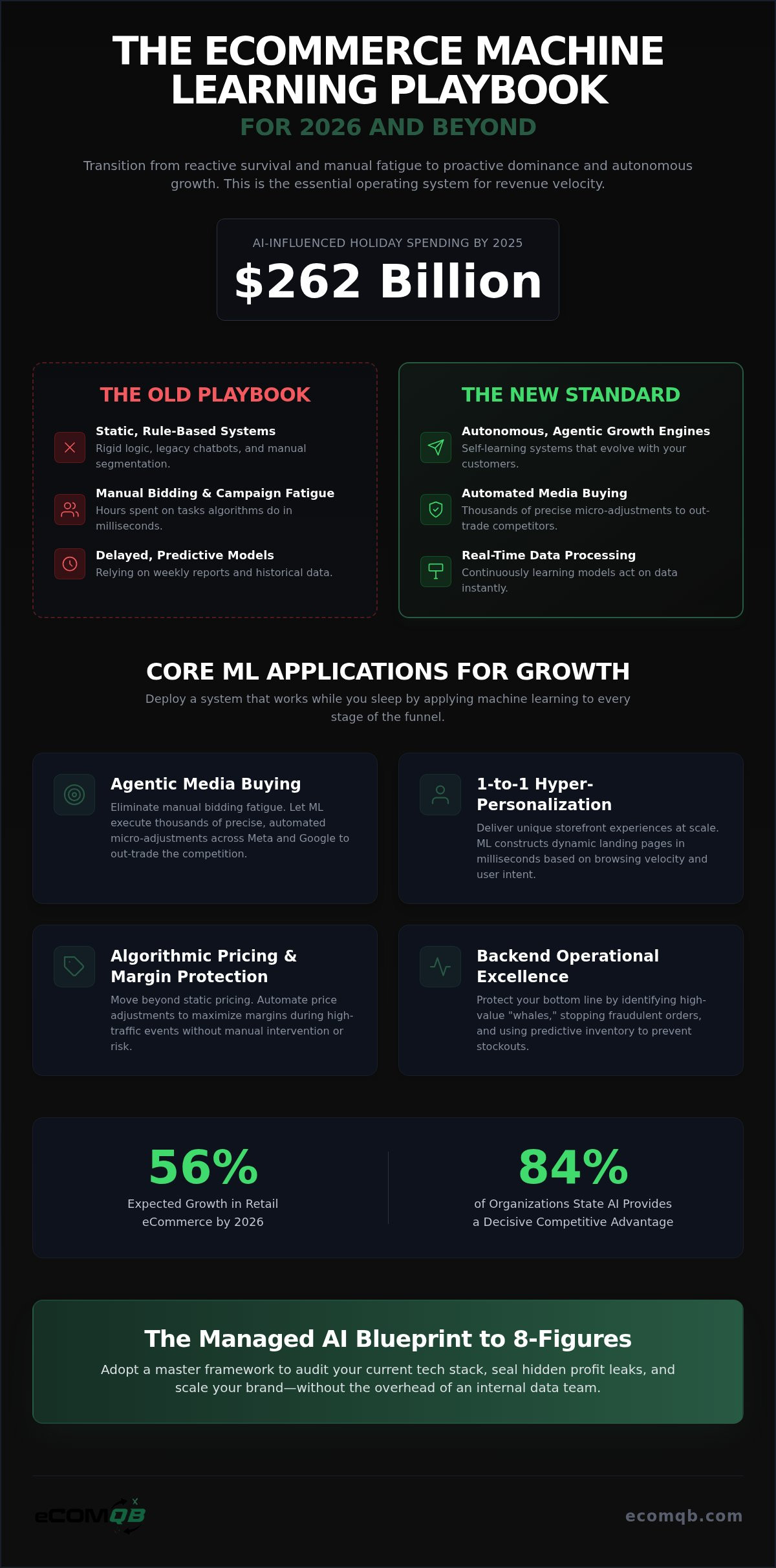
By the close of 2025, AI-influenced holiday spending surged to $262 billion, proving that the digital shelf is no longer governed by human intuition alone. If you're still white-knuckling manual bids in Meta or staring at static product grids that refuse to convert, you're playing a high-stakes game with a broken playbook. Applying machine learning to eCommerce has shifted from a futuristic luxury to the essential operating system for revenue velocity. It's the definitive line between reactive survival and proactive dominance.
You've likely felt the sting of rising Customer Acquisition Costs and the relentless fatigue of manual campaign management. It's frustrating to watch margins thin while your team spends hours on tasks that an algorithm can execute in milliseconds. You recognize that the old methods of scaling are hit-or-miss, expensive, and increasingly obsolete in a world that moves at the speed of data. You need a system that works while you sleep.
This article delivers the master framework for deploying machine learning to eliminate overhead, maximize efficiency, and accelerate brand growth. You'll learn how to transform your store into a self-optimizing revenue machine that converts with surgical precision. We'll explore agentic media buying, hyper-personalization, and the tactical shifts required to outpace the market in 2026.
Key Takeaways
- Shift from static, rule-based systems to autonomous growth engines that evolve in real-time. Move beyond legacy chatbots and adopt modern, agentic revenue systems for 2026.
- Master the strategic framework for applying machine learning to eCommerce to automate dynamic pricing and deliver unique, 1-to-1 storefront experiences at scale.
- Eliminate manual bidding fatigue by leveraging agentic media buying. Out-trade the competition through thousands of precise, automated micro-adjustments across Meta and Google.
- Protect your bottom line with backend ML models. Identify high-value "whales" early and stop fraudulent orders before they impact your fulfillment or margins.
- Adopt a managed AI blueprint to scale your brand to 8-figures. Audit your current tech stack to identify and seal profit leaks without the overhead of an internal data team.
What is Machine Learning in eCommerce for 2026?
In 2026, machine learning is not a feature or a plugin. It is the fundamental architecture of high-performance growth. For years, brands relied on legacy AI: rigid chatbots, basic rules, and static logic. Those days are over. Applying machine learning to eCommerce now means deploying autonomous, self-learning engines that evolve as fast as your customers do. This is the transition from reactive software to proactive intelligence. It is the difference between a tool that waits for your command and a system that anticipates the market.
Think of machine learning as the Field General of your tech stack. It does not just store data; it orchestrates it. It analyzes, optimizes, and executes across every touchpoint of the customer journey. For modern DTC brands, manual optimization has become a critical liability. Human teams cannot process data at the scale required to compete. If you are still adjusting bids by hand or manually segmenting email lists, you are losing ground to competitors who have already automated their revenue velocity. Precision is the new currency.
The Evolution from Predictive to Agentic Systems
Predictive models were the standard of the past decade. They looked at historical data to tell you what might happen next Tuesday. Agentic systems, however, represent the new frontier. These systems don't just predict a dip in conversion; they execute the solution in real-time. By applying machine learning to eCommerce through agentic workflows, brands eliminate the chronic decision fatigue that plagues founders. You stop managing tasks and start managing outcomes. A curated AI tech stack allows your Shopify store to function as a self-correcting organism. It identifies a bottleneck, reallocates the budget, and scales the winner without human intervention.
Why Real-Time Data Processing is the New Standard
Zero-latency revenue is the only benchmark that matters in 2026. Waiting for weekly performance reports is a recipe for failure in an economy that moves at the speed of light. Modern machine learning utilizes continuously learning models to ingest and act on data streams the moment they occur. This allows brands to find hidden profit leaks that traditional analytics simply miss. Whether it is a subtle shift in ad performance or an emerging pattern in customer churn, ML catches it instantly. Retail eCommerce is expected to grow by 56% by 2026, and 84% of organizations already state that AI provides a decisive competitive advantage. Real-time processing is how you claim that advantage. It accelerates your speed-to-market for creative testing and ensures your ad spend is always directed toward the highest possible return.
Precision at Scale: Core ML Applications for Growth
Precision is the difference between a brand that scales and one that stagnates. Applying machine learning to eCommerce allows you to move past broad segments and into individual intent. It’s about being right, every time, for every user. Intelligent search models now understand the nuances of intent rather than just matching keywords; this ensures that high-intent traffic finds the exact solution it needs instantly. Similarly, predictive inventory systems use algorithmic demand forecasting to ensure you never lose a sale to a stockout or bleed cash on overstock. You must identify, capture, and retain value at every stage of the funnel.
The Science of 1-to-1 Personalization
Engineering high-velocity revenue requires more than a simple recommendation widget. You need AI for Shopify personalization that constructs dynamic landing pages in milliseconds. By monitoring browsing velocity and interaction patterns, ML tailors the entire customer journey to the individual. It’s a 1-to-1 storefront experience that feels intuitive, relevant, and inevitable. This level of precision transforms passive browsers into loyal customers by presenting the right offer at the exact moment of highest interest. As MIT Sloan explains machine learning, these systems excel at finding patterns within massive datasets that human eyes simply cannot see.
Algorithmic Pricing and Margin Protection
Margins are the lifeblood of your brand. During high-traffic sales events, manual pricing is a gamble you can't afford to take. Algorithmic pricing models protect your bottom line by adjusting rates based on real-time demand, inventory levels, and competitor movements. This isn't just about discounting; it’s about margin optimization. Price elasticity in an ML context is the algorithmic calculation of how a change in price will specifically impact consumer demand for a product. Deploying these models is a critical component of applying machine learning to eCommerce for brands that refuse to leave money on the table. You can analyze, adapt, and dominate the market without alienating your core base. It’s about tactical flexibility. If you want to see how these systems integrate into an 8-figure growth plan, you can audit your current tech stack with a specialist today.
The Agentic Advantage: Media Buying and Marketing
Manual media buying is an antique. In 2026, if you are still manually adjusting bids in Meta or Google, you are hemorrhaging profit. Machine learning models now manage thousands of micro-adjustments per second, out-trading human buyers with surgical precision. Applying machine learning to eCommerce transforms your advertising from a guessing game into a high-performance revenue engine. By utilizing algorithmic audience synthesis, brands can drastically reduce Customer Acquisition Cost (CAC) while scaling spend. These models don't just find lookalikes; they synthesize intent patterns to identify buyers before they even search for your product.
Creative testing has also undergone a radical shift. Traditional methods take weeks to identify a winning asset. Agentic systems do it in hours. They analyze performance patterns across millions of impressions, identifying the specific visual and copy elements that drive conversion. This speed-to-market is the ultimate competitive advantage. It allows you to double down on winners while the competition is still waiting for their first data refresh. You stop wasting budget on creative that doesn't move the needle and start scaling assets that generate immediate velocity.
Dominating Meta and Google with Agentic Workflows
Integration is the key to mastery. By connecting your Shopify backend directly to your agentic workflows, you achieve real-time ROAS tracking that manual systems cannot touch. This level of synchronization ensures that every dollar spent is backed by live inventory and conversion data. Following an agentic media buying playbook is no longer optional for those aiming for 8-figure scale. Data-driven execution is the only path to sustainable growth in an increasingly crowded digital auction house. It’s about winning the game of inches every single day.
Retention Reinvented: Agentic Email and SMS
Retention is where the real profit lives. Moving from scheduled blasts to zero-latency, behavior-triggered revenue is the 2026 standard. Machine learning models predict the "Next Best Action" for every subscriber, delivering the right message at the exact moment of intent. This isn't just automation; it's intelligence. By implementing agentic email marketing strategies, you eliminate the lag between customer action and brand response. You capture value before it dissipates. It’s about building a system that anticipates needs, solves problems, and generates revenue without a single manual click.
Operational Excellence: ML in the Backend
Growth is vanity; profit is sanity. While front-end innovations capture the headlines, the engine room of an 8-figure brand is built on backend precision. Applying machine learning to eCommerce extends far beyond the storefront. It reaches deep into the mechanics of your fulfillment, security, and customer retention. Supply chain velocity is now a purely mathematical challenge. Algorithmic routing reduces shipping times and slashes costs by selecting the optimal path for every parcel in real-time. This level of systemic optimization ensures that your logistics keep pace with your marketing velocity.
Customer sentiment analysis has also evolved into a critical competitive lever. Modern ML models ingest thousands of support tickets, reviews, and social mentions to identify emerging patterns. They turn raw data into product improvements before your human team even spots the trend. You stop reacting to complaints and start anticipating needs. By the time a competitor notices a flaw, you have already deployed the solution. It is about maintaining a bird’s-eye view of your entire operation to ensure no margin is left unprotected.
Predicting and Maximizing Lifetime Value (LTV)
Most brands collapse because they chase first-click ROAS at the expense of long-term health. High-performance leaders know that not all customers are created equal. ML identifies the specific micro-behaviors, such as browsing velocity or category affinity, that signal the arrival of a "Whale." LTV prediction is the tactical lever that allows a brand to outspend competitors by knowing exactly which customers will pay off over time. Once identified, you can reallocate marketing spend and prioritize high-value support for these segments with absolute certainty. You aren't just buying traffic; you are engineering a fortress of loyal, high-value assets.
Risk Mitigation and Fraud Prevention
Fraud is a silent margin killer that legacy systems often fail to contain. Traditional rule-based security frequently triggers "false positives," which block legitimate revenue and alienate honest customers. Modern machine learning solves this by using pattern recognition to stop high-risk orders before they ever hit the warehouse. These self-learning security layers adapt to new threats the moment they appear. If a dispute occurs, algorithmic evidence gathering automates the response process to maximize your win rate. You protect your brand’s reputation while reclaiming thousands in lost revenue. To see how these backend systems can transform your operational efficiency, book a diagnostic audit with our team today.
Deploying Your Revenue Machine: The eComQB Blueprint
Scaling to 8-figures in the 2026 digital economy is not a matter of luck. It is a matter of engineering. Applying machine learning to eCommerce requires a total departure from the "build it yourself" mentality that slows down most DTC founders. Building an in-house data science team is expensive, sluggish, and often disconnected from the ultimate objective: revenue velocity. You need a managed transformation that places high-performance tools directly into your hands without the operational friction. Our blueprint is designed for speed, precision, and dominance.
- Step 1: Diagnostic Audit. We identify the profit leaks in your current tech stack and pinpoint exactly where manual overhead is killing your margins.
- Step 2: Curating the Stack. We integrate high-performance AI tools into your Shopify environment, ensuring every piece of the puzzle works in total synchronization.
- Step 3: Execution. We deploy agentic workflows across media buying, email marketing, and your storefront to capture value in real-time.
- Step 4: Continuous Optimization. Your revenue machine enters a state of perpetual improvement, analyzing data and adjusting tactics without human intervention.
This systematic approach ensures that applying machine learning to eCommerce isn't just a technical upgrade; it's a strategic overhaul. You stop managing fragmented tools and start orchestrating a unified growth engine. The goal is simple: eliminate the lag between data and action. When your systems can think, learn, and execute autonomously, you reclaim the time needed to focus on high-level brand strategy and market expansion.
The Cost of Staying Legacy
Legacy is a liability. Brands that fail to adopt advanced ML systems by the end of 2026 will find themselves priced out of the market as Customer Acquisition Costs continue to climb. The competitive advantage held by 8-figure brands lies in their ability to out-trade, out-personalize, and out-perform the competition through automated intelligence. If you are still relying on static rules, you are already behind. You can explore the full mechanics of this approach in The eCommerce AI Growth System.
Getting Started with eComQB
We function as your tactical partner in AI transformation. We provide the Revenue Generating AI Tools and the expertise required to scale your brand to 8-figures without adding to your headcount. Our approach strips away the corporate fluff and focuses entirely on the levers that drive growth. We understand the technical complexities so you can focus on the ultimate objective: market leadership. It's time to stop managing software and start leading a machine. Transform your brand with eComQB and secure your growth trajectory today.
Secure Your Strategic Advantage for 2026
The transition toward autonomous, self-learning systems is no longer a trend; it's the new operating standard for brands that refuse to settle. By applying machine learning to eCommerce, you move beyond manual bidding fatigue and static storefronts into a state of perpetual, data-driven optimization. You've seen how agentic media buying and precision LTV modeling provide the tactical edge required to out-trade the competition in a high-stakes market. Precision is the currency of the future. It's about moving fast, staying precise, and winning consistently.
Managed AI stacks eliminate operational overhead while specialized Shopify development ensures your storefront maintains maximum velocity. From dominating Meta and Google to securing your backend with algorithmic fraud prevention, the blueprint for 8-figure growth is now within your reach. You don't need a larger team; you need a smarter system that executes with surgical accuracy. It is time to stop reacting to the market and start dictating its pace.
Now is the moment to transition from a collection of fragmented tools to a unified, high-performance revenue machine. Scale your brand to 8-figures with our Managed AI Growth System and reclaim your competitive lead. The future belongs to the leaders who choose to engineer it today.
Frequently Asked Questions
What is the primary benefit of applying machine learning to eCommerce in 2026?
The primary benefit is the transition from static, manual operations to an autonomous revenue machine. Applying machine learning to eCommerce allows your brand to process data, identify trends, and execute optimizations at a speed humans cannot match. This eliminates the operational friction that stalls growth. You gain a self-correcting system that prioritizes profit margins, accelerates conversion, and scales without increasing your headcount. It's about total market dominance through systemic precision.
How much data do I need to start using machine learning for my Shopify store?
You don't need an enterprise-level data lake to begin. Most high-growth Shopify brands already possess the necessary transaction and behavioral data required to fuel modern models. The key is the quality and structure of that data rather than sheer volume. By utilizing managed AI growth systems, you can leverage your existing history to start identifying profit leaks and high-value customer segments within the first few weeks of deployment.
Can machine learning help reduce my Customer Acquisition Cost (CAC)?
It is the most effective tool for aggressive CAC reduction. Machine learning models use algorithmic audience synthesis to find buyers based on deep intent patterns rather than broad demographic guesses. This level of precision ensures your ad spend is directed only at the highest-probability conversions. You stop wasting budget on cold traffic that won't convert and start out-trading your competition in the digital auction house with surgical bid adjustments.
Is machine learning only for 9-figure enterprise brands?
This is a common misconception that costs brands their competitive edge. While the technology was once exclusive to enterprise giants, managed AI transformation has leveled the playing field. Brands scaling toward 8-figures can now deploy the same high-performance tech stacks without the overhead of an internal data science team. It’s about strategic access. You don't need a massive budget; you need the right playbook and a tactical partner.
What is the difference between AI and machine learning in an eCommerce context?
AI is the broad vision of machines performing human-like tasks, while machine learning is the specific tactical engine that improves through experience. In an eCommerce environment, machine learning is what allows your pricing, recommendations, and ad bids to get smarter with every transaction. It's the difference between a static chatbot and an agentic system that actually learns how to maximize your revenue velocity based on real-time market shifts.
How does agentic media buying differ from traditional agency management?
Traditional agencies are limited by human bandwidth and manual bidding cycles. Agentic media buying replaces manual fatigue with autonomous agents that manage thousands of micro-adjustments every hour. These systems are directly integrated with your Shopify backend, allowing them to shift spend based on live inventory levels and actual ROAS. You aren't just hiring a buyer; you're deploying a high-velocity execution engine that never sleeps or misses a trend.
Will implementing ML require me to change my entire technology stack?
Implementation is a strategic integration, not a total demolition of your current setup. Most high-performance ML tools are designed to function as an intelligent layer on top of your existing Shopify architecture. The goal is to curate a tech stack that eliminates silos and enables seamless data flow across your entire operation. You don't need to start from scratch; you need to optimize the foundation you've already built for maximum impact.
How long does it take to see a return on investment from AI transformation?
Speed-to-market is a core focus of the eComQB blueprint. You'll typically see tactical wins in ad efficiency and fraud detection within the first 30 days. However, the true compounding power of applying machine learning to eCommerce becomes evident over three to six months. This is when LTV prediction models and supply chain optimizations begin to significantly lower your operational costs and widen your profit margins for long-term 8-figure scaling.