AI Strategies to Increase Average Order Value: The 2026 Strategic Playbook

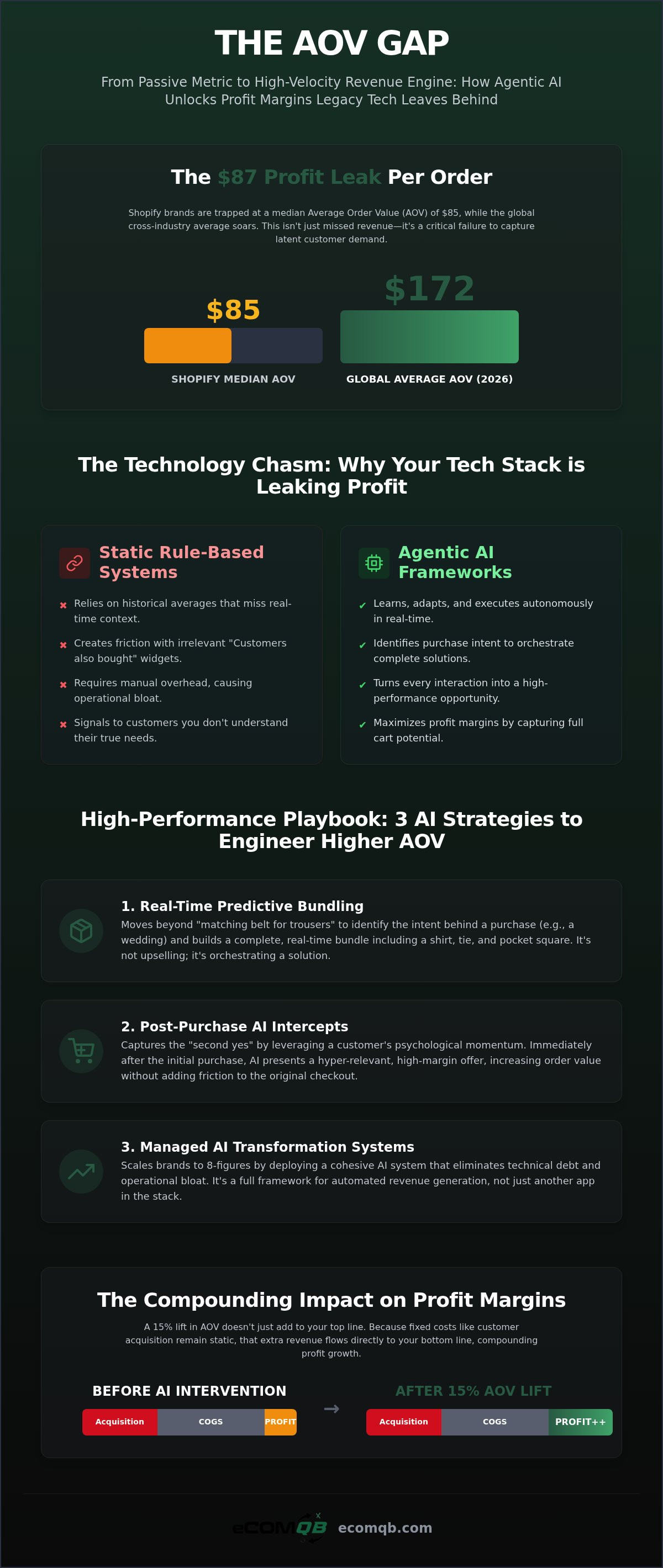
Average Order Value is no longer a marketing metric. It's a data-engineering objective that your current tech stack is likely failing to meet. With the global cross-industry AOV hitting $172 in 2026, many Shopify brands are stuck at a median of $85, watching their margins vanish into the void of rising acquisition costs. You've felt the squeeze of declining ROAS on Meta and Google. Deploying the right AI strategies to increase average order value is the only way to decouple your growth from the volatility of ad platforms. It's time to stop guessing and start orchestrating.
You've likely stacked apps on top of apps only to face stagnant growth and operational bloat. You deserve a system that thinks, adapts, and executes. This strategic playbook will help you master the agentic AI frameworks that turn standard carts into high-velocity revenue engines through precision bundling and predictive intent. We'll move beyond static rules to explore autonomous workflows that prioritize profit, streamline your operations, and deliver the competitive advantage your brand demands. This is your roadmap to higher profit margins per customer and automated revenue generation.
Key Takeaways
- Neutralize rising acquisition costs by transforming AOV from a passive metric into a high-velocity revenue engine.
- Replace leaky, rule-based tech stacks with agentic frameworks that learn, adapt, and execute autonomously.
- Implement high-performance AI strategies to increase average order value through real-time dynamic bundling and predictive intent.
- Capture the second "yes" with post-purchase AI intercepts that leverage psychological momentum for immediate margin growth.
- Scale to 8-figures by deploying managed AI transformation systems that eliminate operational bloat and technical debt.
Beyond the Cart: Why AOV is the Engine of eCommerce Velocity
Average Order Value is the primary lever for neutralizing rising Customer Acquisition Costs. In 2026, the global cross-industry AOV has reached $172, yet many Shopify brands remain trapped at a median of $85. This gap represents more than just missed sales; it represents a fundamental failure to capture latent demand. Ad platforms like Meta and Google are becoming more expensive and less predictable. To survive, you must stop treating upselling as a tactical afterthought. You must view it as strategic revenue engineering. It requires precision, momentum, and authority.
Advanced AI strategies to increase average order value move beyond the reactive "do you want fries with that" approach. They identify intent patterns that humans and static rules miss. While a legacy system might suggest a matching belt for a pair of trousers, agentic AI identifies the specific intent behind the purchase. It recognizes the customer is buying for a specific event, such as a wedding, and builds a real-time bundle that includes a shirt, tie, and pocket square. This isn't just selling. It's orchestrating a solution. Predictive commerce is no longer a luxury; it's the standard for 8-figure brands.
The High-Stakes Math of Profit Margins
Winning in 2026 requires understanding the delta. A 15% increase in AOV doesn't just add 15% to your top line. It compounds. Because your fixed costs, such as customer acquisition and administrative overhead, remain largely static, that extra revenue flows directly into your profit margin. This is the most efficient path to 8-figure velocity. Higher order density also improves logistics efficiency. Shipping three items in one box costs significantly less than shipping three separate orders. You aren't just increasing revenue. You're protecting your bottom line and maximizing every shipment.
The Failure of Legacy Rule-Based Systems
Static "Customers also bought" widgets are relics of the 2010s. They rely on historical averages that don't account for real-time context. This creates friction. Irrelevant recommendations kill conversion rates and signal to the customer that you don't understand their needs. Modern brands are transitioning to AI for Shopify personalization to solve this. Agentic systems learn, adapt, and execute independently. They replace manual overhead with precision. They turn every interaction into a high-performance opportunity that legacy tech simply cannot match.
The AI AOV Impact Calculator: Quantifying Your Strategic Advantage
Before you deploy advanced AI strategies to increase average order value, you must establish your baseline with clinical precision. The calculation is deceptively simple: Gross Revenue divided by Total Orders. However, this raw number only tells you where you are, not where you should be. To find your true potential, you must factor in the "AI Variable." This accounts for the revenue currently left on the table by static, rule-based systems that fail to recognize intent. Identifying this revenue leak is the first step toward strategic revenue engineering. It allows you to set aggressive KPIs that are backed by data rather than guesswork.
Most brands operate with a significant delta between their current AOV and their agentic potential. If your store mirrors the Shopify median of $85 while your industry leaders are pushing toward the global cross-industry average of $172, you aren't just missing sales. You are leaking profit. Quantifying this gap transforms AOV from a passive metric into a high-stakes objective. It forces a shift in mindset. You stop asking how to sell more and start asking how to capture the full value of every session. If you want to see how these numbers apply to your specific SKU architecture, request a strategic audit of your current data.
Step 1: Segmenting Your Order Data
Analyze your order composition by SKU and customer tier. High-performance growth requires knowing which products naturally pull others into the cart and which customer segments are most receptive to agentic intervention. You must identify "high-potential" segments where a slight nudge in order density creates a massive impact on total margin. Establish your AOV baseline as the foundation of any eCommerce AI growth system. This segmentation allows you to deploy resources where they generate the highest velocity and the most immediate returns.
Step 2: Applying the AI Growth Multiplier
Project the lift from agentic landing pages and dynamic content. Unlike static upsells, AI-driven intercepts reduce churn by offering relevance instead of friction. This creates a compounding effect on your bottom line. You aren't just increasing the value of one order; you are increasing the efficiency of your entire acquisition funnel. Quantifying the ROI of AI transformation eCommerce brands requires looking at the reduced cost of cart abandonment and the increased lifetime value of customers who receive a personalized experience. Measure, refine, and scale.
Agentic Personalization vs. Static Rules: Why Your Tech Stack is Leaking Profit
Static rules are a liability in high-stakes eCommerce. They are rigid, predictable, and slow. When you rely on "if-then" logic, you are forcing your customers into a pre-defined box that rarely matches their actual intent. Agentic AI is the replacement for this manual guesswork. These systems don't just follow instructions; they learn, adapt, and execute independently. By deploying advanced AI strategies to increase average order value, you move from reactive selling to proactive revenue engineering. You stop building bundles by hand and start letting your data dictate the play.
Real-time intent mapping allows your storefront to read "digital body language." It tracks hover times, scroll depth, and navigation paths to predict what a customer needs before they even know they need it. This eliminates the manual overhead of seasonal bundle creation. Instead of a team spending weeks preparing for a holiday sale, your AI agent builds unique SKUs in real-time. It identifies the "latent demand" within each session and presents the optimal offer with surgical precision. This is how you reclaim the profit currently leaking through your rule-based bottlenecks.
The Limitations of Standard Shopify Apps
Most Shopify stores suffer from chronic "app bloat." You stack one app for bundles, another for upsells, and a third for loyalty. This fragmentation kills site speed and dilutes your data. Your email tool doesn't talk to your storefront, and your storefront doesn't understand your media buying. This silos your strategy and prevents a unified customer view. To scale at 8-figures, you need a cohesive architecture. This is why high-growth brands partner with a specialized Shopify design and development agency to integrate agentic workflows directly into their core code.
The Power of Agentic Workflows
Agentic workflows deliver zero-latency revenue. They respond to user behavior in milliseconds, ensuring the "next best offer" is always relevant and timely. This level of speed is impossible with manual rules. When you integrate agentic email marketing with onsite behavior, you create a seamless loop of high-performance triggers. If a customer leaves a high-value cart, the AI doesn't just send a generic reminder. It analyzes the session, identifies the friction point, and sends a personalized intercept that solves the problem. These AI strategies to increase average order value ensure that no opportunity is wasted.
High-Performance Playbook: 3 AI Strategies to Engineer Higher Order Values
Execution is the separator. While legacy brands rely on static discounts and hope for the best, elite brands use AI strategies to increase average order value by engineering the offer in real-time. This playbook focuses on precision, timing, and psychological leverage. It moves the needle by aligning your product catalog with the immediate intent of the buyer. When you combine these tactics with agentic media buying, you create a full-funnel engine that optimizes for profit at every touchpoint.
Strategy 1: Dynamic Agentic Bundling
Static bundles are inventory-focused; agentic bundles are intent-focused. Instead of pushing a pre-packaged kit that might not fit the customer's needs, AI agents build unique SKUs in real-time based on session data. The system analyzes browsing history, cart contents, and even local weather data to suggest a "kit" that feels bespoke. Dynamic bundling is the core of modern AOV engineering. By using AI to optimize bundle pricing for maximum margin, you ensure that every addition to the cart is profitable. You aren't just selling more; you're selling smarter. Book a strategy call to deploy dynamic bundling on your storefront.
Strategy 2: Post-Purchase Intercepts
The second "yes" is the most profitable "yes" in eCommerce. Once a customer has entered their credit card details, they are in a state of high dopamine and low friction. Post-purchase AI intercepts leverage this psychological momentum. Through agentic SMS and one-click checkout additions, you can offer highly relevant complementary products without requiring the customer to re-enter their information. This strategy reduces friction and captures revenue that would otherwise be lost to the "thank you" page. It turns a single transaction into a multi-product relationship in seconds.
Strategy 3: Predictive Replenishment Flows
AOV and Lifetime Value (LTV) are deeply connected through timing. Predictive replenishment flows use AI to track the consumption cycle of your products. If a customer buys a 30-day supply of a supplement, the AI agent doesn't wait for them to run out. It triggers a personalized upsell for a 90-day "value pack" exactly when their intent to restock is highest. This increases the value of the repeat order while securing future revenue. It's a proactive move that prevents churn and keeps your brand at the center of the customer's routine. You're no longer just reacting to orders; you're orchestrating them.
Deploying the System: Managed AI Transformation for 8-Figure Brands
Execution defines the elite. While others linger in the planning phase, high-velocity brands move straight to deployment. Strategy without a clear path to execution is just expensive guesswork. For 8-figure brands, the challenge isn't finding tools; it's orchestrating a system that produces results without adding operational bloat. This is where managed AI transformation becomes your primary competitive advantage. It allows you to implement advanced AI strategies to increase average order value without the burden of technical debt or the need for a massive internal engineering team. You buy outcomes, not just software subscriptions.
The roadmap to implementation is methodical. It starts with a diagnostic phase to identify where your current tech stack is failing. We move quickly from analysis to integration, ensuring that your agentic workflows are live and generating revenue in weeks, not months. This isn't about adding more complexity. It's about stripping away the manual overhead that slows you down. You need a system that operates 24/7, identifying opportunities and capturing value while your team focuses on high-level strategy and brand vision. Precision, speed, and profit are the only metrics that matter.
The eComQB Approach to Scaling
We begin by auditing your current stack for revenue leaks. We look for friction points, missed intents, and fragmented data. Once the diagnosis is complete, we deploy curated AI stacks designed for immediate impact. This isn't a one-size-fits-all solution. It's a precision-engineered system tailored to your SKU architecture and customer behavior. We maintain momentum through continuous systemic optimization. We test, refine, and scale. This ensures your revenue engine never stalls and your margins remain protected. You gain the benefit of a dedicated AI engineering team without the overhead of a full-time hire.
Engineering Your Next Growth Phase
The shift from manual management to agentic oversight is the final step in securing your market position. You stop managing apps and start leading a system. This transition has a profound impact on brand valuation and exit readiness. A brand powered by autonomous revenue generation is significantly more valuable than one dependent on manual bidding and rule-based hacks. You are building an asset, not just a store. It's time to stop reacting to the market and start dictating the pace. Book a Strategic Consultation to scale your AOV and secure your tactical briefing today.
Dominate the Digital Shelf with Agentic Precision
Stagnant AOV is a symptom of a legacy mindset. By shifting from reactive rules to predictive intent, you transform your storefront into a high-performance revenue engine. You've mastered the roadmap: segmenting data, deploying agentic bundling, and capturing the second "yes" through post-purchase intercepts. These AI strategies to increase average order value are the only way to insulate your brand against rising acquisition costs and platform volatility. The digital economy moves fast. Every session without agentic intervention is a missed opportunity for margin expansion. High-velocity growth demands precision, momentum, and authority.
Scaling to 8-figures requires more than just better tools. It requires a managed system that executes without friction. As specialists in 8-figure Shopify scaling, we are redefining DTC velocity with agentic technology that removes operational overhead. We identify the leaks, engineer the solutions, and maintain the momentum. Stop guessing and start orchestrating your inevitable expansion. Your competitors are likely still manually managing rules; leave them behind with autonomous execution.
Secure your AI Growth Audit and Book a Call to deploy a fully managed AI growth system today. Your next phase of growth is waiting.
Frequently Asked Questions
What is a good average order value for a Shopify store?
A good AOV depends on your vertical, but benchmarks provide a clear target. In 2026, the median Shopify AOV is approximately $85, while the average sits at $120. If you are in the Home and Furniture sector, you should aim for a median of $200. Electronics brands typically see $180. Compare your current baseline against these industry standards to identify your growth potential. Elite brands target the global cross-industry AOV of $172 as their primary objective.
How does AI actually increase AOV without being pushy?
AI increases AOV by prioritizing relevance over volume. Unlike static popups that interrupt the user, agentic systems map digital body language to predict intent. This allows the system to present a next best offer that feels like a helpful recommendation rather than a sales pitch. By aligning suggestions with the customer's immediate needs, you reduce friction and increase order density. It's about engineering a seamless experience where the upsell feels like a natural extension of the purchase.
Can agentic AI work with my existing Shopify theme?
Yes, agentic AI integrates directly with your existing Shopify architecture. While some implementations require custom development to ensure zero-latency performance, most curated AI technology stacks are designed to sit on top of your current theme. A specialized Shopify design and development agency can optimize this integration to prevent app bloat and maintain site speed. The goal is to enhance your storefront's intelligence without forcing a complete rebuild of your front-end assets. It is a precision upgrade.
How long does it take to see results from an AI AOV strategy?
You can expect to see measurable lift within the first 30 days of deployment. Because agentic workflows learn and adapt in real-time, the system begins optimizing for profit immediately after integration. Initial wins often come from post-purchase intercepts and dynamic bundling. As the AI gathers more session data, the precision of its recommendations improves, leading to a compounding effect on your margins. Speed is a competitive advantage, and managed transformation ensures you move from diagnostic to revenue generation quickly.
What is the difference between a cross-sell and an upsell in an AI context?
In an AI context, an upsell encourages a customer to buy a higher tier version of the same product, while a cross-sell suggests complementary items. Agentic AI takes this further by building real-time kits. For example, an upsell might trigger a predictive replenishment flow for a larger supply. A cross-sell would identify the intent behind a purchase and build a custom bundle. Both are essential AI strategies to increase average order value by maximizing every session.
Is managed AI transformation better than hiring an in-house developer?
Managed AI transformation is often the more efficient choice for 8-figure brands. Hiring in-house requires significant time, management overhead, and a highly specialized skill set that is difficult to source. A managed service model provides access to a curated technology stack and a team of experts who understand the mechanics of growth. This approach eliminates technical debt and allows your team to focus on brand strategy while we handle the complexities of agentic oversight and systemic optimization.
How do I calculate the ROI of an AI growth system?
Calculate ROI by measuring the incremental lift in AOV against the cost of the system. You must look at the delta between your baseline revenue and the growth generated by agentic intercepts. Factor in the reduction in manual overhead and the increase in profit margins per customer. Because AI-driven systems improve logistics efficiency through higher order density, the total impact includes both top-line revenue growth and bottom-line cost savings. It's a comprehensive view of your strategic advantage.
What data does agentic AI need to effectively increase order values?
Agentic AI thrives on session data, SKU architecture, and historical purchase patterns. To effectively deploy AI strategies to increase average order value, the system needs access to real-time signals like hover times, scroll depth, and navigation paths. It also analyzes product relationships and inventory levels to build dynamic bundles. This deep integration allows the AI to move beyond basic demographics and respond to the immediate, high-intent behaviors that drive high-velocity revenue engines. It is data-driven mastery.