Managed AI Growth Systems for eCommerce: Engineering 8-Figure Velocity in 2026

The era of the "Frankenstein" tech stack is officially over. Most eCommerce leaders are currently drowning in a sea of disconnected subscriptions that leak revenue while promising efficiency. In 2026, the only way to bypass the noise and secure a competitive edge is through managed AI growth systems for eCommerce. These aren't just collections of plugins. They are integrated, agentic architectures designed to replace manual bottlenecks with high-velocity precision. If you're still manually tweaking Meta bids or managing generic email sequences, you're not just falling behind; you're handing your market share to competitors who've already automated their entire revenue engine.
You likely feel the pressure of rising CAC eating your margins while your LTV remains stubbornly stagnant. It's an exhausting cycle of managing tools that are fragmented, manual, and slow. This guide promises a way out. You'll learn how to deploy integrated systems that handle agentic media buying and zero-latency personalized journeys. We'll examine how AI-driven personalization generates 40% more revenue and why autonomous platforms are the new standard for 8-figure scaling. We'll break down the roadmap to transition from tactical distractions to a fully managed growth machine that executes, optimizes, and wins.
Key Takeaways
- Understand the shift from the Generative Era to the Agentic Era, where AI systems move beyond simple automation to autonomous business execution.
- Learn why managed AI growth systems for eCommerce outperform fragmented toolsets by closing the integration gap that causes 90% of DIY implementations to fail.
- Master the acquisition engine through agentic media buying strategies that stabilize CAC and allow for aggressive, profitable scaling on Meta and Google.
- Unlock the conversion catalysts required for 8-figure velocity, including dynamic storefronts and AI-driven personalization that drive measurable revenue gains.
- Execute a tactical playbook to audit current revenue leaks and transition from a founder-led bottleneck to a fully managed, high-performance growth machine.
The 2026 Shift: Why Managed AI Growth Systems Outperform Individual Tools
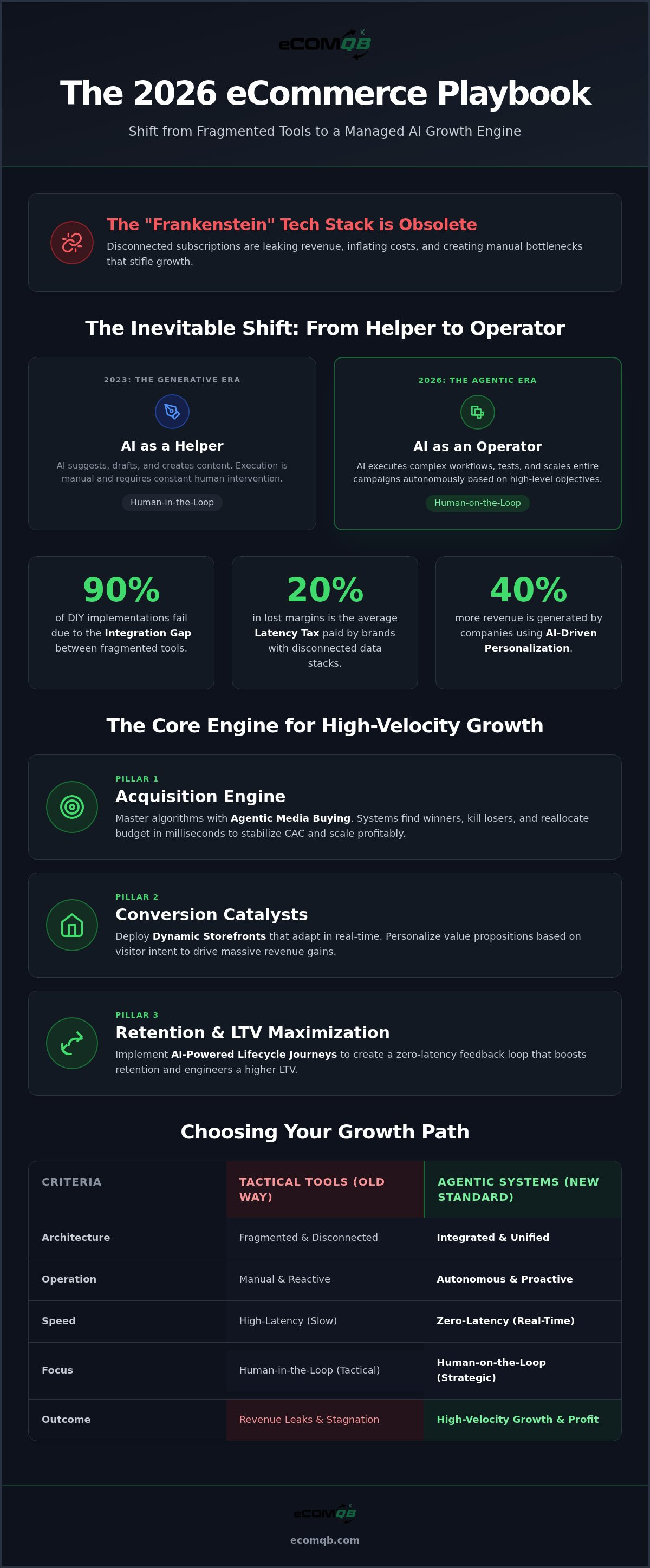
The Generative Era of 2023 was a playground. Brands used AI to write captions, generate images, or draft emails. By 2026, those tactics are baseline table stakes. They no longer drive velocity. High-performance brands have pivoted to managed AI growth systems for eCommerce. These are not individual tools; they are integrated ecosystems that execute business logic autonomously. They don't just suggest a course of action. They take it. Stop managing tools. Start leading systems.
Manual bidding and static content are the primary revenue leaks in the current market. They are too slow, too rigid, and too expensive. When your competitors use autonomous systems to adjust bids every second, your manual daily tweaks are obsolete. You aren't just losing sales; you're losing the data advantage required to win. A managed system plugs these leaks by replacing human hesitation with algorithmic precision.
The Distinction Between Generative and Agentic AI
Generative AI creates content. Agentic AI executes complex business workflows. The shift from 2024 to 2026 represents a move from AI as a helper to AI as an operator. Your brand needs systems that do, not just systems that prompt. This is the transition from human-in-the-loop to human-on-the-loop strategic management. You provide the high-level objective. The agentic system handles the tactical execution. It's the difference between a tool that writes an ad and a system that builds, tests, and scales the entire campaign without intervention.
The Latency Tax: The Cost of Disconnected Tech Stacks
Disconnected tech stacks are silent killers. When your Meta ads don't communicate with your Shopify inventory or your CRM in real time, you pay a latency tax. Data silos kill ROAS. They inflate customer acquisition costs. They stifle growth. Foundational research in Artificial Intelligence in Marketing demonstrates that integrated data analysis is the core of predictive success. Legacy stacks with slow processing can cost brands 20% in margins due to missed opportunities and inefficient bidding. A Managed AI System is a zero-latency revenue engine. It ensures every dollar spent on acquisition is informed by the latest customer behavior and inventory levels. It identifies, targets, and converts with relentless speed. You either integrate your intelligence or you subsidize your competitors' growth through your own inefficiency.
The Core Engine: 3 Pillars of a High-Velocity AI System
Scaling to eight figures isn't a game of luck. It's a game of systems. To achieve high-velocity growth, you must deploy managed AI growth systems for eCommerce that address the entire customer lifecycle. Relying on a single lever like "better ads" or "nicer emails" creates a lopsided business that breaks under pressure. You need a balanced, three-pillar architecture: Acquisition, Conversion, and Retention. This is the only way to engineer a machine that is predictable, scalable, and resilient.
Acquisition: Mastering the Algorithm with Agentic Media Buying
The days of manual audience targeting are over. Manual bidding is an expensive relic of a slower era. Today, agentic workflows handle real-time bidding and creative testing across Meta and Google Ads with superhuman speed. These systems don't just run ads; they find winners, kill losers, and reallocate budget in milliseconds. This is the core of agentic media buying. By removing human hesitation from the bidding process, brands can stabilize CAC and scale spend with surgical precision. You stop guessing and start winning.
Conversion: Storefronts that Adapt in Real-Time
Static storefronts are massive revenue leaks. In 2026, your website must be as dynamic as your ads to maintain momentum. Implementing AI for Shopify personalization allows your store to rewrite its value proposition in real-time based on visitor intent. Verified data shows that AI-driven personalization can generate 40% more revenue for companies by delivering the right message at the exact moment of interest. Whether it's a landing page that adapts to an ad click source or a search engine that understands semantic intent, the goal of these managed AI growth systems for eCommerce is to eliminate friction. Your storefront should analyze, adapt, and accelerate the buyer's journey.
Retention: The Zero-Latency Revenue Strategy
Retention is the heartbeat of 8-figure profitability. If your backend relies on generic flows, you're leaving money on the table. Predictive agentic email marketing anticipates customer needs before they arise. Meanwhile, SMS agents handle objections in real-time to close high-intent sales. Statistics indicate that AI can help recover 35% of abandoned carts through proactive engagement. This creates a feedback loop where every customer acquired becomes a long-term asset rather than a one-time transaction. If your current setup feels like a collection of tools rather than a unified engine, it's time to audit your growth architecture and build for 2026 velocity.
Tactical Tools vs. Agentic Systems: Choosing Your Growth Path
The market is littered with the remains of brands that tried to "AI" their way to success using a pile of disconnected plugins. Most DIY implementations fail to scale because they ignore the Integration Gap. Individual tools demand constant human management; they are hungry for attention. Conversely, managed AI growth systems for eCommerce require strategic oversight. You shouldn't be the one connecting APIs or manually syncing data between your CRM and your ad manager. You should be the one directing the machine's high-level objectives. When your tech stack requires more management than your team, you haven't built a system. You've built a second job.
Choosing a system-first architecture over a tool-first approach is the difference between owning a race car and owning a box of high-end parts. One moves you toward your goal at 200 mph. The other just sits in the garage waiting for you to assemble it. High-performance brands are moving toward managed AI transformation because they value speed over tinkering. They understand that 90% of DIY AI projects fail to reach 8-figure velocity because the founder becomes the bottleneck, trapped in the minutiae of technical troubleshooting.
The Hidden Overhead of DIY AI Stacks
There is a silent Management Tax associated with the DIY approach. Juggling twelve different $50 per month subscriptions feels like a bargain until you calculate the lost strategic time. If a founder spends ten hours a week troubleshooting tool integrations or manually exporting data, that "cheap" stack actually costs thousands in high-level leadership value. Tools are tactical, but systems are strategic. Fragmented tech stacks are a form of technical debt that slows your response time to market changes. You cannot scale a brand when your primary growth driver is a collection of siloed platforms that don't speak the same language.
Engineering Velocity: The 2026 Competitive Advantage
Velocity is the only metric that matters in the 2026 digital economy. Integrated systems allow for the rapid testing and deployment of growth plays that disconnected tools simply cannot match. This is where AI transformation eCommerce brands find their edge. They move faster. They adapt sooner. They win bigger. When algorithms shift on Meta or Google, a managed AI growth systems for eCommerce setup detects the variance and pivots the strategy before a human manager even gets the notification. This agility separates market leaders from also-rans. You can either build a house of cards with individual tools or engineer a fortress with a managed system. The choice determines your revenue ceiling.
The High-Velocity Playbook: Implementing AI for Immediate ROI
Success in 2026 is an engineering requirement, not a creative suggestion. To move the needle, you need a tactical roadmap that prioritizes impact over activity. Deploying managed AI growth systems for eCommerce isn't about adding more tasks to your plate. It's about building an autonomous revenue machine. This playbook is designed to take you from fragmented operations to 8-figure velocity by following a precise, five-step execution sequence. Audit, automate, and accelerate. This is how you win.
Phase 1: Plugging the Revenue Leaks
Stop burning capital on traffic that hits a leaky bucket. Before you scale, you must stabilize the foundation. Use AI diagnostics to identify high-dropoff points in your customer journey that human analysts often overlook. These systems analyze millions of data points to find hidden revenue through micro-optimizations in your Shopify checkout and site speed. Stabilizing your foundation is the non-negotiable prerequisite for aggressive scaling. You can't build a fortress on a swamp. Analyze your current tech stack, identify the friction, and seal the leaks before you even think about increasing your ad spend.
Phase 2: Scaling the Winners
Creative intuition is a liability in a data-driven market. In 2026, the transition from a winning creative to scaled media spend must be automated. Agentic systems detect high-performing assets in real-time and reallocate budget with surgical precision. To reduce the friction of scaling cold audiences, deploy agentic landing pages that rewrite themselves based on the user's specific intent. This ensures that the message matches the moment perfectly. Transitioning to a model driven by data rather than "gut feeling" allows you to scale spend without the typical spike in CAC. You don't just spend more; you spend smarter.
The roadmap doesn't end with acquisition. Once your media buying is stabilized, you must implement a robust SEO and content strategy Shopify to drive organic velocity. This builds a moat around your brand that paid ads alone cannot provide. Layer in agentic retention flows to maximize your LTV and protect your profit margins from rising platform costs. Finally, transition to a managed model where your growth is handled by specialists who live in the mechanics of managed AI growth systems for eCommerce. This shift allows you to focus on high-level strategy while the system handles the tactical execution. If you're ready to stop tinkering and start scaling, schedule your high-velocity growth audit today.
Scaling to 8-Figures: The Managed AI Growth Advantage
The $5M ARR ceiling is a graveyard for ambitious brands. It's the point where the founder's manual oversight becomes the primary bottleneck to growth. You can't personally audit every Meta bid, refine every email trigger, and optimize every landing page while trying to lead a global enterprise. This is where managed AI growth systems for eCommerce transition from a luxury to a survival requirement. Scaling to 8-figures requires a fundamental shift from doing the work to directing the machine. You must analyze, optimize, and dominate.
By leveraging the eCommerce AI growth system, you close the gap between strategic vision and technical execution. Most brands fail here because they lack the specialized leadership to bridge these two worlds. They have the vision, but their tech stack is a fragmented liability. We turn that liability into a high-velocity revenue engine that operates with surgical precision. It's time to stop playing small and start engineering your victory.
The Managed Advantage: Results Without the Operational Overhead
eComQB functions as the Field General for your brand. We don't just offer advice; we own the execution of your AI stack and media strategy. This frees you to focus on the high-level brand vision that only a founder can provide. Building an internal team to manage agentic media buying and AI personalization is slow, expensive, and risky. Professional management provides immediate access to 8-figure expertise without the friction of hiring, training, and managing a technical department. It's about buying back your time while accelerating your results. We handle the complexity. You reap the rewards.
Your Next Strategic Move
The window for early-mover advantage in the agentic era is closing fast. In 2026, waiting to implement these systems is the most expensive decision you can make. Your competitors are already automating their revenue levers and capturing market share with lower acquisition costs. Every day you delay is a day they gain more data, more efficiency, and more momentum. Secure your competitive advantage before the market saturates and the cost of entry sky-rockets. You've seen the roadmap. Now, it's time to execute. Book your tactical briefing with eComQB to engineer your growth system.
Dominate the Agentic Era
The transition from manual oversight to autonomous execution is no longer optional; it's the defining line between market leaders and those left behind. You've seen the roadmap. You understand the pillars of acquisition, conversion, and retention. Most importantly, you recognize that individual tools are tactical distractions without a unified architecture. Success in 2026 requires moving beyond the fragmented tech stack and deploying managed AI growth systems for eCommerce that execute with surgical precision. Stop managing software. Start leading a revenue machine.
As Managed AI Transformation Experts, eComQB provides the 8-Figure Growth Playbooks and Agentic Workflow Specialists needed to bridge the gap between your ambition and your technical reality. We handle the complexity while you own the growth. The window for early-mover advantage is closing. The most expensive decision you can make today is to wait. Secure your competitive edge, stabilize your CAC, and engineer your velocity. Book Your Tactical Briefing with eComQB to claim your position at the top of the market. Your brand is ready for the next level; let's build the system that takes you there.
Frequently Asked Questions
What are managed AI growth systems for eCommerce?
These are end-to-end ecosystems that execute business logic autonomously. Unlike fragmented tools, managed AI growth systems for eCommerce integrate acquisition, conversion, and retention into a single revenue engine. eComQB handles the technical complexity and strategic oversight. This allows brands to scale without increasing their internal headcount or technical debt. It's about moving from manual tinkering to systematic, high-velocity performance.
How does agentic media buying differ from traditional automated bidding?
Traditional automated bidding focuses on rigid, pre-set rules for bid adjustments. Agentic media buying is more sophisticated; it executes complex workflows including creative testing, budget reallocation, and real-time audience pivoting. It acts as an autonomous operator rather than a simple script. This shift allows for faster adaptation to algorithm changes on Meta and Google. It ensures your capital always flows toward the highest-performing assets without manual intervention.
Can AI growth systems actually improve eCommerce profit margins?
Yes, they protect margins by eliminating the "latency tax" of disconnected data. These systems stabilize customer acquisition costs through precise bidding and increase average order value via real-time personalization. Research shows AI-driven personalization can generate 40% more revenue. By automating repetitive tasks and optimizing every touchpoint, you reduce operational overhead and maximize the efficiency of every dollar spent. It's the most direct path to sustainable 8-figure profitability.
How much does it cost to implement a managed AI growth system?
Costs vary based on your current revenue, technical complexity, and scaling objectives. A managed system is an investment in your brand's infrastructure rather than a simple software expense. It replaces the high cost of multiple disconnected subscriptions and the strategic drain of manual management. For a precise assessment of the resources required to engineer your growth machine, a tactical briefing is the necessary first step toward optimization.
Do I need a technical team to manage these AI tools?
No, the managed model is specifically designed to eliminate the need for an expensive internal technical team. eComQB acts as your tactical partner and field general. We handle the integration, optimization, and execution of your managed AI growth systems for eCommerce. This allows you to stay focused on high-level brand vision and product development. You get the competitive advantage of cutting-edge technology without the operational burden of managing it yourself.
Will AI content marketing still work for Shopify SEO in 2026?
AI content marketing remains vital for Shopify SEO in 2026, provided it shifts from simple generation to semantic optimization. Search engines prioritize intent-matching and authoritative data over generic text. Agentic systems analyze search trends in real-time to deploy content that captures organic velocity. This strategy builds a long-term moat around your brand. It ensures you maintain visibility and authority in an increasingly crowded and competitive digital landscape.
How does AI personalization impact LTV for DTC brands?
AI personalization transforms the customer journey from a generic flow into a zero-latency experience. By delivering products and messages that match individual intent, you significantly increase repeat purchase rates and long-term loyalty. Data indicates that AI chat can deliver 4 times higher conversion rates. This level of precision ensures customers feel understood, reducing churn and maximizing the lifetime value of every user in your ecosystem.
What is the first step in an AI transformation for an eCommerce brand?
The first step is a comprehensive audit of your current revenue leaks and tech stack inefficiencies. You must identify where data silos are killing your ROAS and where manual bottlenecks are slowing your growth. This diagnostic phase provides the roadmap for deploying agentic media buying and storefront optimizations. It's about stabilizing your foundation before you attempt to scale. A tactical briefing ensures your transformation is built on data rather than guesswork.