Shopify Website Design and Development: Engineering 8-Figure Velocity in 2026

Is your storefront an asset or a liability? In the high-stakes environment of 2026, a static website is a structural leak in your revenue engine. Most brands are still fighting yesterday's battles with rigid themes, fragmented tech stacks, and soaring customer acquisition costs. You feel the friction every time a campaign fails to scale because your infrastructure can't handle the load. True competitive advantage now requires a shift toward AI-powered Shopify development to ensure your brand remains agile, responsive, and profitable.
You already know that standard catalogs don't convert at the level required to sustain elite growth. This article provides the tactical playbook for transforming your digital presence into a high-performance machine designed for 8-figure velocity. We'll show you how to replace manual processes with autonomous systems that convert, scale, and optimize. You'll discover the precise architecture needed to build a high-converting storefront that delivers predictable growth. We're breaking down the shift toward agentic commerce, the integration of managed AI stacks, and the strategic mastery required to dominate the 2026 market.
Key Takeaways
- Stop treating your storefront as a digital brochure and start viewing it as a high-performance revenue engine built for speed, intelligence, and scale.
- Master the "Science of Yes" by optimizing your UI/UX to align with the specific psychology and reduced attention spans of the 2026 shopper.
- Transition from static product pages to agentic storefronts by leveraging AI-powered Shopify development to deliver real-time, personalized customer journeys.
- Understand why 8-figure scaling requires a tactical growth partner rather than a traditional developer to orchestrate your end-to-end technical and brand strategy.
The Death of the Static Storefront: Why Legacy Design Kills Growth
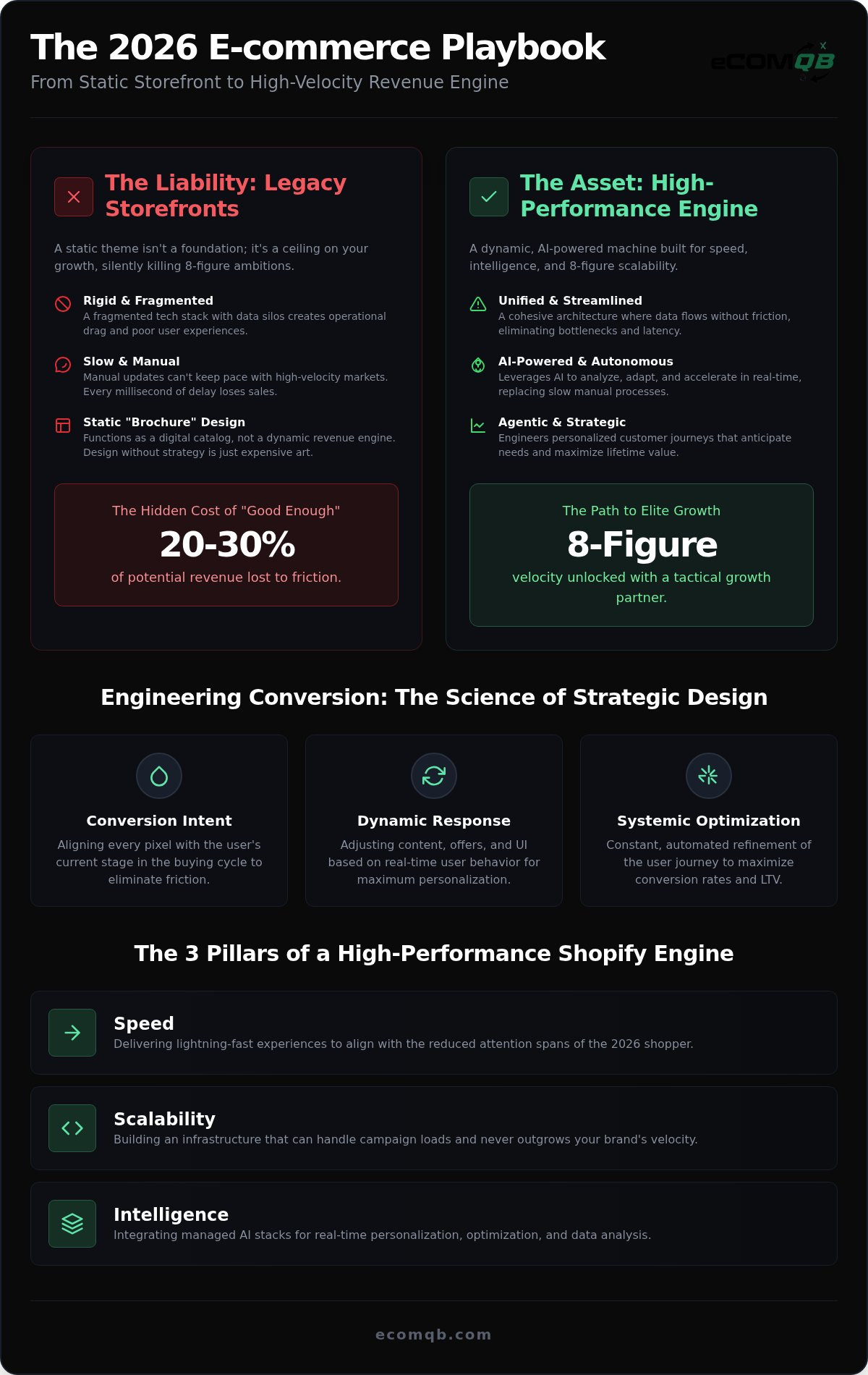
Legacy design is the silent killer of 8-figure ambitions. In 2026, a static theme isn't a foundation; it's a ceiling. Most brands are bleeding 20% to 30% of their potential revenue through friction points they can't even see, which is the ultimate cost of accepting "Good Enough" in a market that demands excellence. If your storefront functions as a digital catalog rather than a dynamic revenue engine, you're not just behind the curve. You're losing ground every hour.
Manual storefront management has become a strategic liability. High-velocity markets move too fast for human-only updates. You need an infrastructure that can analyze, adapt, and accelerate in real time. Transitioning to AI-powered Shopify development isn't a luxury for the future; it's the baseline for survival today. You must shift your mindset from maintaining a website to engineering a high-performance machine that prioritizes revenue velocity over simple aesthetics.
The Hidden Leaks in Your Current Tech Stack
Rigid, fragmented, and slow. These are the hallmarks of a legacy stack that kills conversion. When your apps don't talk to each other, they create data silos that lead to operational drag. This fragmentation results in latency that frustrates the modern shopper. Every millisecond of delay is a hole in your bucket. To scale, you must identify these bottlenecks and replace them with a unified system that supports rapid pivots. AI-powered Shopify development allows for a streamlined architecture where speed and scalability are hardcoded into the storefront, ensuring you never outgrow your own technology.
Why Design Without Strategy is Just Expensive Art
Aesthetic appeal is easy; conversion architecture is difficult. Many brands invest heavily in "expensive art" that looks beautiful but fails to move the needle on key performance metrics. If your design isn't rooted in data-driven strategy, you're likely attracting the wrong customer profile or failing to guide them toward a checkout. True growth requires an AI transformation eCommerce brands can leverage to turn passive visitors into active buyers.
Strategic design in 2026 means moving beyond fixed layouts. You need a framework that utilizes AI-powered personalization engines to tailor the experience to every individual user. This level of precision ensures that your storefront isn't just a static display, but a tactical tool that anticipates needs and eliminates decision friction. To dominate your vertical, you must stop building pages and start engineering experiences that prioritize:
- Conversion Intent: Aligning every pixel with the user's current stage in the buying cycle.
- Dynamic Response: Adjusting content and offers based on real-time behavior.
- Systemic Optimization: Constant, automated refinement of the user journey to maximize lifetime value.
Engineering the High-Performance Shopify Engine: Beyond the Theme
Aesthetics get you on the field, but your engine wins the championship. To achieve 8-figure velocity, you must look beneath the surface of your storefront. A high-performance Shopify engine is defined by three critical pillars: speed, scalability, and intelligence. While a standard theme might suffice for a lifestyle brand, scaling to elite levels requires a deep integration of an eCommerce AI growth system. This isn't just about code; it's about engineering an environment where data flows without friction and every interaction is optimized for revenue.
Headless vs. Liquid: Choosing Your Architecture
Your choice of architecture is your strategic playbook. For many brands, Shopify's native Liquid environment offers maximum stability and a faster time-to-market. It's a reliable choice for maintaining consistent operations. However, 8-figure brands often seek the tactical advantage of headless commerce. By decoupling the front-end from the back-end, you gain total creative freedom and superior technical performance. Headless architecture allows you to deliver lightning-fast experiences across multiple touchpoints without being tethered to theme constraints. You must balance this flexibility with the technical discipline required to manage a more complex stack. Whether you choose Liquid or Headless, the goal remains the same: build, scale, and dominate.
Managed AI Technology Stacks
Intelligence is the fuel for your revenue engine. Modern AI-powered Shopify development focuses on integrating managed technology stacks that automate backend workflows and reduce operational overhead. You don't need more tools; you need the right tools working in perfect synchronicity. Systemic optimization ensures your stack isn't just a collection of apps but a unified force. By leveraging AI personalization at the core of your development, you create a storefront that learns from every visitor. This future-proofs your business for 2027 and beyond, ensuring your infrastructure evolves as quickly as the market does.
Engineering for zero-latency data flow is the final step in securing your competitive advantage. When your backend is optimized, your storefront responds instantly to consumer demand. This precision eliminates the technical debt that often plagues growing brands. If you're ready to move beyond the limitations of standard themes, you can book a tactical briefing to evaluate your current architecture. High-velocity growth isn't an accident. It's the result of a meticulously engineered engine designed to perform under pressure.
Strategic UI/UX: The Science of Conversion and Revenue Velocity
Conversion is a science, not a suggestion. In the high-velocity market of 2026, you cannot rely on best practices that were written three years ago. The modern shopper operates with a precision-focused mindset, driven by micro-moments of attention and a total intolerance for friction. Implementing the Science of Yes across your storefront means every interaction is engineered to remove doubt, build trust, and accelerate the decision-making process. You aren't just designing a website; you're building a tactical environment that prioritizes revenue velocity above all else.
High-performance design uses data-driven insights to optimize profit margins, not just gross sales. By identifying high-margin products and pathing users toward them through strategic UI/UX, you ensure that every conversion contributes maximum value to your bottom line. This requires a shift from static layouts to an architecture supported by AI-powered Shopify development. Your storefront must be agile enough to adapt to the psychology of the 2026 shopper, who demands immediate relevance and zero decision friction.
The Anatomy of a High-Converting Product Page
A high-converting product page must move beyond static imagery and generic descriptions. You need dynamic content that responds to user intent in real time. Social proof, expert endorsements, and trust signals are not decorative elements; they are tactical requirements for establishing immediate authority. Conversion Velocity is the speed at which a visitor becomes a buyer. To maximize this metric, your product pages must provide the exact information needed to trigger a purchase without forcing the user to hunt for details. Every element must be prioritized, organized, and optimized for rapid consumption.
Optimizing the Checkout Experience
The checkout phase is where revenue is either captured or leaked. Shopify's one-page checkout is the definitive gold standard for 2026, but the architecture beneath it must be flawless. Reducing friction requires more than a clean layout. It demands agentic payment and shipping logic that dynamically presents the most relevant options based on user history and geographic data. When your checkout process is invisible, your conversion rates soar.
Integrating AI in retail logic allows you to anticipate customer needs before they even reach the final click. This level of systemic optimization ensures that cart abandonment becomes a relic of the past. Once the transaction is complete, post-purchase triggers should activate immediately to drive lifetime value growth. By presenting curated upsells and loyalty incentives at the moment of peak engagement, you turn a single sale into a long-term revenue stream. This is how 8-figure brands maintain their momentum in a competitive landscape.
Agentic Storefronts: Integrating AI Personalization into the Customer Journey
Static storefronts are dead weight in your growth strategy. In 2026, high-velocity brands are pivoting to agentic storefronts that move beyond fixed layouts to create dynamic, living experiences. This shift marks the definitive end of the one-size-fits-all digital brochure. Through AI-powered Shopify development, you can now engineer a unique storefront for every individual visitor who lands on your site. This is about precision, relevance, and speed. By deploying AI for Shopify personalization at scale, you align your landing pages directly with your media buying strategies. This alignment ensures that the promise made in your ads is immediately fulfilled on the page, drastically reducing your customer acquisition costs (CAC) while protecting your margins.
Agentic storefronts represent a fundamental shift in commerce architecture. They are proactive, adaptive, and autonomous. Instead of forcing a visitor to search for a solution, the storefront anticipates their intent and presents the solution immediately. This level of systemic intelligence is what separates market leaders from the also-rans. It requires a field general's approach to technical execution, ensuring every pixel serves a tactical purpose in the broader revenue engine. You aren't just building a store; you're orchestrating a high-performance sales environment that evolves in real time.
Dynamic Content Injection
Dynamic content injection is the tactical lever for zero-latency personalization. Your store must serve personalized headlines, images, and offers in real time based on the specific intent and behavior of the visitor. This precision eliminates the friction that leads to high bounce rates and abandoned sessions. By integrating your storefront data with agentic email marketing, you create a closed-loop system where every touchpoint reinforces the conversion path. This ensures your messaging remains consistent, persuasive, and effective across the entire customer lifecycle. It is a lean, punchy approach to revenue generation that leaves no room for wasted impressions.
Agentic Workflows for Customer Support and Sales
Autonomous sales agents are replacing the rigid, basic chatbots of the past. These agentic workflows guide users through complex product selections, acting as a high-performance sales team that never sleeps. They don't just answer questions; they drive revenue by identifying upsell opportunities and resolving objections in the moment. By automating routine customer interactions, you reclaim strategic time for your leadership team while ensuring every lead is nurtured with precision. This systemic optimization reduces operational overhead and allows your brand to scale without a linear increase in headcount. It is a decisive move toward peak performance and sustainable growth.
Stop fighting the friction of static design and manual workflows. If you are ready to deploy an autonomous revenue engine that dominates the 2026 market, book your agentic strategy briefing today and take command of your growth trajectory.
Scaling to 8-Figures: The Tactical Playbook for Shopify Development
Scaling to 8 figures is a war of attrition against complexity. At this level, you don't need a vendor who takes orders; you need a tactical partner who understands the mechanics of growth. The gap between your brand strategy and your technical execution is where revenue leaks occur, margins shrink, and momentum dies. To dominate your vertical, you must bridge this gap with a relentless focus on systemic optimization. AI-powered Shopify development is the engine that drives this transformation, turning your technical infrastructure from a cost center into a high-performance revenue machine.
The eComQB approach replaces fragmented development with fully managed eCommerce growth systems. We don't just build; we optimize, scale, and lead. By integrating technical mastery with strategic foresight, we ensure your storefront never becomes a bottleneck for your ambitions. Maintaining a competitive advantage in the 2026 market requires this level of precision. You need an infrastructure that evolves as fast as your media buying strategy, ensuring every dollar spent on acquisition is maximized through a high-velocity conversion environment.
The Managed Service Advantage
Hiring an internal team for high-level technical execution often slows down ambitious brands. Internal resources frequently get bogged down in daily maintenance, reactive troubleshooting, and manual updates. This creates a strategic drag that 8-figure brands cannot afford. A managed service model allows you to bypass the implementation headache and access a curated AI tech stack immediately. This approach prioritizes peak performance and results over simple maintenance. You gain the agility of a startup with the technical power of a global enterprise, allowing your leadership team to focus on high-level strategy while we handle the mechanics of growth.
Your Next Move: Engineering for Velocity
Your trajectory is determined by your next move. Start by assessing your current storefront for revenue leaks that are eating your margins. Every second of latency and every point of friction is a strategic liability that your competitors will exploit. Developing a clear roadmap for AI transformation is the only way to secure your position in a market driven by autonomous systems. You must move from defensive maintenance to offensive scaling.
The market doesn't wait for the unprepared. When you are ready to take command of your technical infrastructure and eliminate the bottlenecks in your growth, you can Execute your Shopify growth strategy with eComQB. We provide the playbook, the tools, and the leadership required to engineer 8-figure velocity. Orchestrate your next move now.
Take Command of Your 2026 Growth Trajectory
The digital economy moves with relentless speed. Your storefront must move faster. You've seen why legacy designs are hidden revenue leaks and how agentic storefronts have become the new standard for elite brands. Success in 2026 isn't about just having a website; it's about owning a precision-engineered revenue engine. By embracing AI-powered Shopify development, you replace manual friction with autonomous velocity and predictable growth. It's a decisive shift from passive maintenance to active market dominance.
eComQB functions as your tactical field general. We deliver fully managed AI growth systems that bridge the gap between bold strategy and technical execution. As specialists in agentic storefronts and landing pages, we provide the revenue-first strategic consulting required to scale at speed. It's time to stop fighting technical debt and start engineering for peak performance. The future belongs to the leaders who act with precision and authority.
Build your high-velocity Shopify revenue machine with eComQB.
Take the first step toward systemic optimization and secure your competitive advantage today.
Frequently Asked Questions
How long does a high-performance Shopify build take in 2026?
High-performance builds typically take 8 to 12 weeks depending on the complexity of the AI integration. This timeline covers architecture design, technical execution, and systemic optimization. We prioritize precision over speed to ensure your revenue engine is fully calibrated before launch. Rapid builds often lead to technical debt that leaks profit. A disciplined approach ensures your storefront is built to scale from day one.
What is the difference between a custom Shopify build and a premium theme?
Premium themes offer speed; custom builds offer dominance. A custom build allows for zero-latency data flow and total control over your conversion architecture. Premium themes are rigid and often include bloated code that slows down your revenue velocity. For 8-figure brands, custom development is a tactical requirement to eliminate the hidden bottlenecks found in off-the-shelf solutions. You need a storefront that adapts to your strategy, not the other way around.
How does AI-driven personalization impact Shopify conversion rates?
AI-driven personalization transforms your store from a static catalog into a proactive sales agent. By tailoring headlines, product recommendations, and offers in real-time, you eliminate decision friction and build immediate trust. This level of systemic intelligence directly accelerates your conversion velocity by meeting the specific intent of every visitor. AI-powered Shopify development ensures these experiences are delivered with zero latency, maximizing the revenue potential of every session.
Is Shopify Plus necessary for brands scaling to 8-figures?
Shopify Plus is the definitive foundation for brands scaling beyond the $10M mark. It provides the advanced API access, checkout extensibility, and security required for complex, high-volume operations. While the lower plans are suitable for early growth, the Plus environment is necessary to deploy fully managed AI growth systems at scale. It offers the structural stability needed to support agentic workflows and high-performance storefronts without compromising on reliability or speed.
Can eComQB migrate my existing store from Magento or WooCommerce?
Yes, eComQB executes comprehensive migrations from legacy platforms like Magento and WooCommerce to Shopify. We treat migration as a strategic pivot rather than a simple data transfer. Our process ensures your SEO equity is protected while your technical infrastructure is upgraded for 2026. We replace fragmented legacy stacks with a unified Shopify environment, allowing you to focus on revenue generation instead of fighting the operational drag of outdated technology.
How do agentic landing pages improve my Meta and Google ad performance?
Agentic landing pages align your storefront with your media buying strategy in real-time. By serving dynamic content that mirrors your Meta and Google ad creative, you create a seamless transition that lowers bounce rates. This precision reduces your customer acquisition cost by ensuring every click lands on a page optimized for that specific user's intent. It turns your advertising spend into a high-performance investment rather than a margin-eating expense.
What is the ROI of an AI-integrated Shopify tech stack?
The ROI of an AI-integrated tech stack is realized through operational efficiency and increased lifetime value. By automating routine workflows and optimizing customer journeys, you reduce the headcount required to manage a complex storefront. AI-powered Shopify development allows your brand to scale revenue without a linear increase in costs. You gain a competitive advantage by operating with a leaner, faster, and more intelligent system that prioritizes profit margins over gross sales.
How does eComQB manage the technical complexity of AI transformation?
We function as your technical field general, managing the entire AI transformation process from strategy to execution. Our team orchestrates the integration of curated AI technology stacks and agentic workflows to ensure a seamless transition. We strip away the traditional corporate fluff and focus on the mechanics of growth. By providing a fully managed solution, we allow your leadership team to remain focused on the ultimate objective while we handle the technical complexities.