High Performance eCommerce Tech Stack: Engineering 8-Figure Velocity in 2026

In 2026, the difference between an 8-figure brand and a struggling mid-market store isn't the product. It is the architecture. Most founders are currently suffocating under a mountain of technical debt, fragmented data, and manual processes that refuse to scale. You've likely felt the weight of high customer acquisition costs driven by inefficient media buying. To win in this environment, you need an AI-powered ecommerce tech stack that functions as a single, cohesive engine. It's time to stop managing tools and start orchestrating systems.
We agree that the current model of stacking disconnected apps is fundamentally broken. It creates silos, increases overhead, and slows your response to market shifts. This article promises to hand you the architectural blueprint used by the world's fastest-growing brands to achieve high-velocity scaling. You will learn how to build a unified, agentic growth system on Shopify that automates revenue generation while keeping your operations lean. We are moving beyond simple automation into a future of strategic mastery, precision execution, and managed velocity.
Key Takeaways
- Identify and eliminate the "Legacy Leak," the silent revenue drain caused by disconnected apps and manual data entry that kills your margins.
- Engineer a high-performance AI-powered ecommerce tech stack that transforms software from a passive tool into an active, agentic teammate.
- Master the "Triad of Velocity" by unifying agentic media buying, hyper-personalization, and automated retention into a single growth engine.
- Execute a strategic infrastructure pivot to audit your Shopify environment and prioritize revenue-generating systems over operational bloat.
- Adopt a managed growth framework to bypass the "build vs. buy" debate and maintain 8-figure velocity with a lean, specialized team.
The Legacy Leak: Why Standard Tech Stacks Fail to Scale
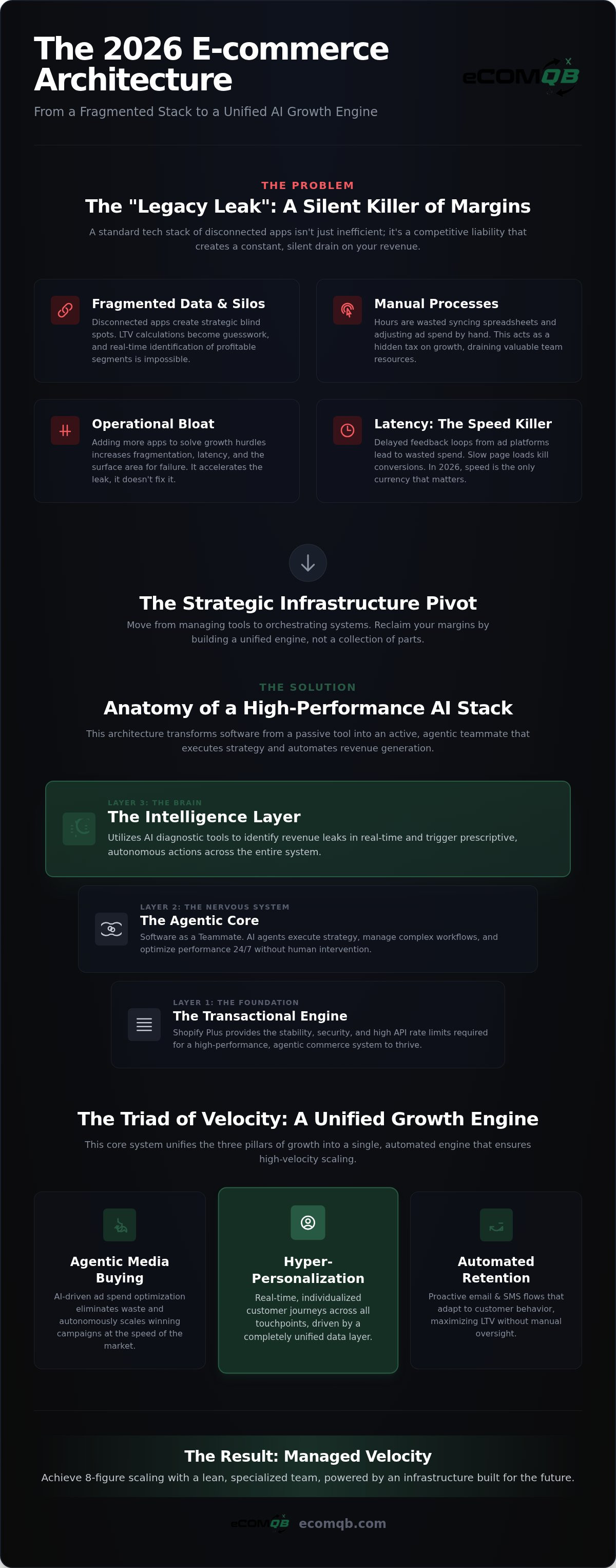
The Legacy Leak is the silent killer of eCommerce margins. It is the cumulative revenue loss generated by disconnected applications, manual data entry, and fragmented workflows. By 2026, the market has evolved beyond simple automation. Static landing pages and manual bidding on Meta or Google are no longer just inefficient; they are competitive liabilities. If your team is spending hours syncing spreadsheets or adjusting ad spend by hand, you aren't scaling. You are just managing rot.
True 8-figure velocity requires a total shift in mindset. Most brands attempt to solve growth hurdles by adding more apps. This is a tactical error. Every new tool increases the surface area for failure. It adds fragmentation, creates latency, and fuels operational bloat. A modern AI-powered ecommerce tech stack is not a collection of parts; it is a unified, high-performance engine designed for precision. You must analyze, optimize, and dominate. Adding more tools to a broken system only accelerates the leak.
The Cost of Fragmentation
Siloed data is a strategic blind spot that prevents decisive leadership. When your CRM doesn't communicate directly with your media buying engine, your Customer Lifetime Value (LTV) calculations are essentially guesswork. This friction prevents you from identifying your most profitable segments in real-time. Manual data syncing acts as a hidden tax on your growth, draining resources that should be focused on market expansion. Without a unified data layer, you are flying blind in a high-stakes game. You lose the ability to pivot, react, and win.
Latency: The Speed Killer
In the 2026 digital economy, speed is the only currency that matters. Latency kills conversion rates on Shopify faster than any competitor could. Beyond page load times, there is the issue of data latency. Delayed feedback loops from ad platforms lead to wasted spend and missed opportunities. High-performance brands utilize a headless commerce architecture to decouple the front-end from the back-end, ensuring lightning-fast performance. This setup allows for real-time, agentic responsiveness. You need a system that thinks, acts, and scales at the speed of the market.
To eliminate the Legacy Leak, you must stop viewing your tech as a support function. It is your primary weapon. A fragmented stack creates friction, while a unified system creates momentum. The choice is between operational bloat or managed velocity. Choose to lead with a system built for the 2026 reality.
Anatomy of a High-Performance Stack: The Agentic Core
The 2026 growth blueprint demands more than simple integration. It requires orchestration. We have moved beyond the era of "Software as a Tool" into the era of "Software as a Teammate." A modern AI-powered ecommerce tech stack is no longer a collection of isolated dashboard logins; it is a unified Agentic Core. In this architecture, AI agents don't just display data. They execute strategy, manage workflows, and optimize performance across your entire ecosystem. They are the digital workforce that never sleeps, ensuring your brand maintains 8-figure velocity while your team remains lean.
Shopify remains the undisputed foundation for high-velocity storefronts in 2026. It provides the stability, security, and API infrastructure necessary for agentic workflows to thrive. When your data is unified within this ecosystem, your agents can perform complex tasks like autonomous media buying or hyper-personalized customer journeys without human intervention. This is where strategic mastery meets technical precision. If your current architecture feels like a burden rather than a weapon, it's time for a strategic infrastructure pivot to reclaim your margins.
The Intelligence Layer
The intelligence layer serves as the brain of your operations. It utilizes AI diagnostic tools to identify revenue leaks in real-time, moving your brand from descriptive analytics to prescriptive, autonomous action. These agentic workflows automate the bridge between marketing and operations. If a specific SKU is trending on Meta, the system adjusts inventory forecasts, updates email flows, and scales ad spend simultaneously. This eliminates the latency inherent in human-led management. It is about speed, precision, and dominance in a crowded market.
The Transactional Engine
For 8-figure scaling, Shopify Plus is the prerequisite. It offers the advanced checkout extensibility and high API rate limits required for a high-performance AI-powered ecommerce tech stack. In 2026, the choice between "Headless" and "Liquid" architectures depends on your specific performance requirements. Headless configurations offer the ultimate flexibility for integrating agentic landing pages that evolve based on visitor intent. These storefronts aren't static catalogs; they are living environments that optimize themselves for every individual user. They learn, adapt, and convert with surgical efficiency.
Building this core is not about chasing the latest trend. It is about engineering a system that creates a sustainable competitive advantage. You need a stack that functions as a single, cohesive revenue machine. By shifting from tools to teammates, you position your brand at the center of a growth trajectory that scales without exploding your overhead.
From Tools to Systems: Choosing Platforms for Strategic Mastery
Strategic mastery begins with a ruthless audit of your current infrastructure. Most brands are cluttered with generic productivity apps that manage tasks but fail to move the needle on the bottom line. You must identify what generates revenue versus what merely consumes time. In 2026, an AI-powered ecommerce tech stack is judged by its API openness and agentic compatibility. If a platform cannot communicate with your intelligence layer, it is a liability. We prioritize Revenue Generating AI Tools because they transform your operations into a high-velocity growth engine. They are built to scale, execute, and dominate.
The "Triad of Velocity" consists of Media Buying, Personalization, and Retention. These are the three critical levers that dictate your market position. By orchestrating these systems as a unified whole, you eliminate the friction that stalls mid-market brands. It is about moving from fragmented tools to a cohesive system of strategic dominance. You need a playbook that prioritizes performance over busywork.
Media Buying: The End of Manual Bidding
Manual bidding is a relic of a slower era. High-volatility markets in 2026 require the precision of agentic media buying for Meta and Google. AI-powered bidding engines analyze millions of data points per second. They outperform human traders who are limited by cognitive load and reaction time. You are no longer managing campaigns; you are orchestrating strategy. This shift allows you to maintain aggressive scaling while keeping your operations lean. It is about maximizing reach, minimizing waste, and accelerating growth.
Retention: Zero-Latency Revenue
Retention is where 8-figure brands secure their dominance. Static SMS flows and generic newsletters are now obsolete. You need agentic email marketing to drive zero-latency revenue. This system builds a closed-loop feedback loop between real-time purchase data and automated retention flows. Your AI-powered ecommerce tech stack ensures every touchpoint is hyper-personalized, predictive, and timely. You aren't just reacting to customer behavior. You are anticipating it. This is how you build an unbreakable bond with your audience and secure long-term LTV.
Choosing the right platforms is a tactical decision with long-term strategic consequences. Don't settle for tools that just "work." Demand systems that win. By focusing on agentic compatibility and revenue generation, you position your brand at the forefront of the digital economy.
The Execution Playbook: Implementing Your Growth Architecture
Execution is the ultimate separator. Strategic mastery means nothing if it isn't deployed with surgical precision. To build a high-performance AI-powered ecommerce tech stack, you must move through a structured, high-stakes deployment. This isn't about trial and error. It is about following a proven playbook that eliminates waste, accelerates momentum, and secures market dominance. We don't just build stores; we engineer revenue machines.
The implementation begins with Phase 1: The AI Diagnostic. We ruthlessly audit your Shopify environment to find the silent leaks killing your margins. Phase 2 is the Infrastructure Pivot. We upgrade your stack to agentic-ready platforms that prioritize API openness over legacy limitations. In Phase 3, we trigger the Automation Surge. By deploying agentic workflows, your team reclaims strategic time, moving from manual task management to high-level system orchestration. You stop being a technician and start being a field general.
Phase 4 focuses on hyper-optimization. We utilize AI for Shopify personalization to crush customer acquisition costs (CAC). This phase turns your storefront into a predictive environment that anticipates needs and resolves objections before they arise. If you're ready to stop guessing and start scaling, it is time to book a high-performance diagnostic call to map your 2026 trajectory.
The SEO and Visibility Layer
Organic visibility is the foundation of a sustainable paid media stack. In 2026, dominance requires AI SEO and content strategy for Shopify that prioritizes speed and precision. We use AI-driven tools to identify high-intent search clusters and deploy content at a scale that human teams can't match. This isn't just about volume; it is about relevance. By capturing high-intent traffic autonomously, you lower your reliance on paid channels and increase your overall ecosystem efficiency.
Personalization at Scale
True behavioral personalization has replaced generic "First Name" tags. High-velocity brands engineer dynamic storefronts that adapt to every user in real-time. Your AI-powered ecommerce tech stack must analyze browsing patterns, purchase history, and real-time intent to serve unique experiences. This level of precision significantly boosts conversion rates and average order value (AOV). You aren't just selling a product; you are orchestrating a personalized journey that feels inevitable to the consumer. This is how you win the 2026 game.
Managed Velocity: Deploying Your Revenue Machine
The "Build vs. Buy" debate is a relic. It's a distraction for leaders who prioritize results over process. In the 2026 digital economy, building an internal team to manage a complex AI-powered ecommerce tech stack is a multi-year project you can't afford. Conversely, buying a disconnected suite of tools leaves you with the "Legacy Leak" we identified earlier. The strategic answer is Managed Growth. You need an architecture that's already engineered, tested, and optimized for 8-figure velocity. This approach allows you to bypass the technical learning curve and move straight to execution.
Our approach centers on a fully managed eCommerce AI growth system. We function as your tactical field general, orchestrating the entire stack while you focus on high-level brand vision. You gain enterprise-grade technology without the enterprise-grade operational bloat. It's about lean operations, aggressive scaling, and managed velocity. By partnering with an expert team that understands the mechanics of growth, you eliminate the friction of implementation. You don't just get software; you get a revenue machine.
The ROI of Managed AI
Internal tech bloat is a silent margin killer. Hiring specialized talent for agentic media buying, AI SEO, and workflow automation is expensive, slow, and risky. A managed growth system replaces high-headcount payroll with high-performance automation. We've seen brands scale from 7 to 8 figures with zero additional headcount by deploying managed agentic workflows. These systems protect your profit margins by executing with a level of precision that humans simply can't replicate. You get more output, higher accuracy, and lower overhead. It's the ultimate lever for capital efficiency.
Securing Your Competitive Advantage
The window for the first-mover advantage is closing fast. Brands that adopt an AI-powered ecommerce tech stack today will own their respective markets by 2027. The compounding benefits of AI-driven media buying and automated content precision mean that late adopters will face insurmountable acquisition costs. This is a game of territory. You must secure your digital footprint now before the cost of entry doubles. The technology exists to automate your revenue generation; the only variable is your willingness to deploy it.
Leadership requires decisive action. You have the blueprint. You understand the architecture. Now, you must choose between managing disconnected tools or orchestrating a unified machine. The path to 8-figure velocity is clear. Analyze your current gaps. Optimize your infrastructure. Dominate your market. If you're ready to deploy a system built for the future, book your strategic briefing today. Let's engineer your velocity.
Orchestrate Your 8-Figure Future
Transitioning from a collection of fragmented tools to a unified growth system is the final hurdle in engineering 8-figure velocity. You've identified the silent revenue drains and seen the architectural blueprint for an AI-powered ecommerce tech stack that functions as a high-performance teammate. By shifting to an agentic core, you eliminate the operational bloat that kills margins and reclaim the strategic time necessary for market dominance. Success in 2026 isn't about working harder. It's about orchestrating more precise, autonomous, and scalable systems.
Strategic mastery requires a partner who understands the high-stakes mechanics of growth. We specialize in Managed AI Growth Systems and Agentic Media Buying Mastery to ensure your brand scales with surgical precision. It's time to stop managing software and start leading a revenue machine. Deploy Your Revenue Machine with eComQB today and secure your competitive advantage. The field is yours to command. Let's build your legacy together.
Frequently Asked Questions
What is a high performance eCommerce tech stack in 2026?
A high performance AI-powered ecommerce tech stack in 2026 is a unified system where AI agents autonomously execute strategy across all channels. It moves beyond a collection of disconnected apps to create a single growth engine. This architecture prioritizes revenue generating AI tools that handle media buying, personalization, and retention without human intervention. It is designed to eliminate the technical debt and data silos that historically stall mid-market brands during aggressive scaling phases.
How does an agentic tech stack differ from a traditional Shopify setup?
A traditional Shopify setup relies on manual input and passive software. An agentic stack operates as an active teammate that executes workflows across your entire business. While a standard store requires you to manually adjust bids or sync data, an agentic system uses AI agents to optimize ad spend, personalize storefronts, and manage customer journeys in real-time. This shift from tools to systems allows for managed velocity and significantly leaner operations.
Can I implement an AI growth system without replacing my entire team?
You can implement an AI growth system to augment your existing team rather than replace it. This transformation shifts your staff from technicians to strategists. AI agents handle high-frequency, repetitive tasks like data syncing and manual bidding, allowing your leaders to focus on brand vision and high-level strategy. It's a force multiplier that lets you scale to 8 figures without the massive headcount typically required for such high-velocity growth.
How long does it take to see ROI from an AI transformation?
ROI from an AI transformation typically manifests in two distinct phases. You'll see immediate operational efficiency gains as manual tasks are automated, reclaiming dozens of hours for your team each week. Revenue impact usually follows within 30 to 90 days as agentic media buying and AI personalization begin to optimize your conversion rates and ad spend precision. This rapid turnaround is essential for maintaining momentum in a high-volatility 2026 market.
Is a managed AI growth system more expensive than hiring an in-house developer?
A managed AI growth system is designed to be far more capital-efficient than maintaining a full in-house development team. Hiring individual experts for AI SEO, media buying, and Shopify development creates massive overhead and management complexity. By opting for a managed solution, you gain access to a curated AI-powered ecommerce tech stack and a team of field generals for a fraction of the total cost of ownership of an internal department.
What are the most critical AI tools for scaling a Shopify brand to 8 figures?
Scaling to 8 figures requires a focus on tools that directly drive revenue. The most critical components include agentic media buying engines for Meta and Google, AI-driven personalization experiences for your storefront, and automated retention systems. These tools work in tandem to maximize lifetime value while crushing acquisition costs. Generic productivity apps are secondary to these high-performance systems that function as the core of your growth architecture and execution.
How does agentic media buying reduce customer acquisition costs (CAC)?
Agentic media buying reduces CAC by eliminating human latency and emotional bias from the bidding process. AI engines analyze millions of real-time data points to adjust bids and creative placements with surgical precision. This ensures your budget is always flowing toward the highest-performing segments. By responding to market shifts in milliseconds, the system minimizes wasted spend and captures high-intent traffic that human traders would likely miss in a fast-paced environment.
Why is Shopify the preferred platform for high-performance eCommerce stacks?
Shopify is the preferred foundation because of its superior API infrastructure and stability. In 2026, its openness allows for seamless integration with advanced AI agents and headless architectures. This flexibility is a prerequisite for building a high-performance stack that can adapt to visitor intent in real-time. Whether you're utilizing Shopify Plus or a headless configuration, the platform provides the secure, scalable environment necessary for engineering 8-figure velocity and strategic dominance.