Audience Segmentation for Meta Ads: The 2026 High-Velocity Playbook

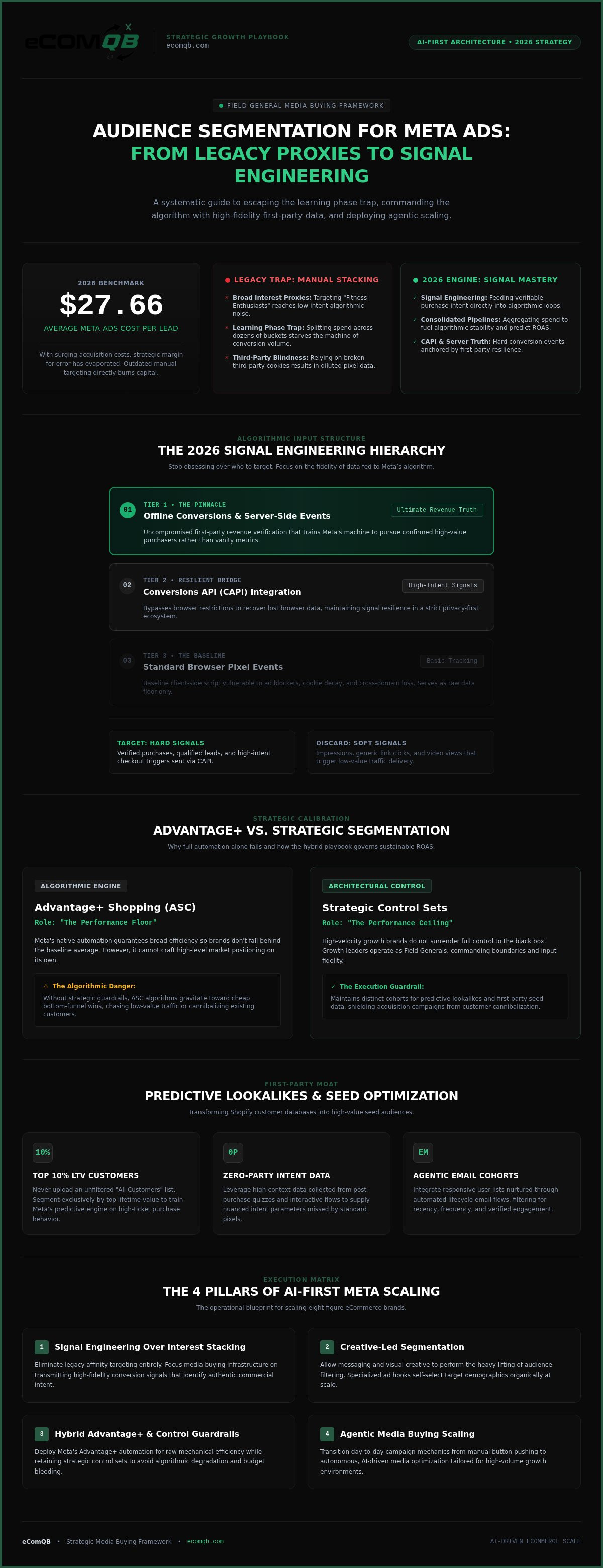
With the average cost per lead on Meta Ads surging to $27.66 in 2026, the margin for strategic error has vanished. You're likely watching your margins compress while your campaigns stall, struggling with an audience segmentation for Meta ads strategy that relies on outdated interest-stacking. It's a high-stakes environment where basic settings lead to wasted spend and volatile results. You need a system that operates with precision, speed, and strategic mastery to stay ahead of the curve.
Mastering high-velocity growth requires a fundamental shift from manual targeting to sophisticated signal engineering. This playbook provides the tactical blueprint to slash your CAC and dominate the AI-first eCommerce landscape. You will learn how to feed the algorithm high-fidelity data, leverage agentic media buying, and achieve predictable ROAS at scale. We're moving beyond legacy traps to build a framework that's bold, assertive, and focused on peak performance. It's time to analyze, optimize, and execute like a field general.
Key Takeaways
- Replace legacy interest-based proxies with high-fidelity signal engineering to ensure Meta’s algorithm identifies true purchase intent rather than mere affinity.
- Implement a creative-led strategy where your messaging and visual assets perform the heavy lifting of audience segmentation for Meta ads.
- Master a hybrid framework that balances Advantage+ automation with strategic control sets to bypass algorithmic instability and the learning phase trap.
- Transition from manual execution to agentic media buying to build a systemic, AI-driven growth engine capable of scaling eight-figure eCommerce brands.
Why Interest-Based Segmentation is a Legacy Trap in 2026
The era of manual interest stacking is over. In 2026, relying on broad affinity categories is like bringing a map to a GPS fight. Traditional market segmentation was built on static assumptions, but Meta’s current ecosystem moves at a speed that renders these proxies obsolete. When you target "Fitness Enthusiasts," you aren't reaching buyers; you're reaching noise. These interests have become low-fidelity signals that dilute your pixel data and force your campaigns into a perpetual state of inefficiency. Precision, momentum, and scale are the only metrics that matter now.
High-velocity growth requires a fundamental shift from selecting audiences to engineering signals. Over-segmenting your ad sets triggers the dreaded "learning phase" trap, where the algorithm lacks the volume to optimize. By splitting budgets across dozens of interest-based buckets, you starve the machine of the critical conversion data it needs to stabilize. The 2026 winner isn't the brand with the cleverest "hidden" interests. It's the brand with the cleanest data pipeline. You must analyze, refine, and scale based on hard evidence, not algorithmic suggestions.
The Death of Third-Party Cookies and the Signal Crisis
The post-cookie landscape has fundamentally changed the rules of engagement. Meta's algorithm no longer relies on the crumbling infrastructure of third-party tracking. Instead, it demands "Hard Signals," specifically verified conversions and high-intent events, over "Soft Signals" like clicks or views. A Field General approach requires you to command the algorithm with precision inputs via the Conversions API (CAPI). You must provide the high-fidelity data Meta needs to hunt for profit. Without these hard signals, your audience segmentation for Meta ads is just expensive guesswork.
Why Advantage+ Shopping Alone Isn't a Strategy
Meta’s automated tools are powerful, but they aren't a panacea. Advantage+ Shopping Campaigns (ASC) provide a performance floor, ensuring you don't fall behind the average. However, they don't provide the ceiling. Relying solely on "out-of-the-box" automation turns your brand into a commodity. You need strategic guardrails to prevent the AI from chasing low-value traffic or cannibalizing your existing customers. True mastery of audience segmentation for Meta ads involves using automation as a tactical engine while you remain the architect of the growth trajectory. You don't just follow the machine; you lead it.
The 2026 Segmentation Framework: From Selection to Signal Engineering
Stop obsessing over who you want to reach. Start focusing on what data Meta needs to find them. In the current AI-first environment, audience segmentation for Meta ads has evolved from a creative guessing game into a rigorous engineering discipline. You aren't just picking categories; you're building a high-fidelity feedback loop. This strategic alignment is vital to your digital marketing plan if you intend to move beyond basic results and achieve true scale.
The hierarchy of signals determines your ultimate success. At the base, you have standard pixel events which offer basic tracking. Above that, the Conversions API (CAPI) provides the necessary bridge for lost browser data, ensuring signal resilience in a privacy-first world. At the pinnacle, offline conversions and server-side events offer the ultimate truth of your revenue. By feeding these high-priority data points back into the system, you train the algorithm to hunt for high-value purchasers rather than cheap clicks. This is how you win the high-stakes game of audience segmentation for Meta ads.
First-Party Data Mastery: The Only Moat Left
Your Shopify customer list is your most valuable asset. It's the only data moat that competitors can't replicate. By segmenting this list into specific behavioral cohorts, you create seed audiences that are rich in context. Don't just upload every email you've ever collected. Focus on those who have engaged with Agentic Email Marketing flows or completed post-purchase quizzes. This zero-party data provides the granular intent signals that Meta's standard tracking often misses. It’s about quality, frequency, and recency.
Predictive Lookalikes and AI Seed Lists
Scaling requires looking forward, not just backward. Predictive segmentation uses AI to identify high-LTV cohorts before they even finish their first transaction. Instead of building lookalikes from your "All Customers" list, you must isolate your top 10% LTV customers. Seed List Optimization is the process of refining the data Meta uses to find new customers. It ensures the machine is learning from your champions, not your outliers. You want the algorithm to replicate your best buyers, not your one-time bargain hunters.
Managing these complex data streams manually is a bottleneck for 8-figure brands. eComQB’s AI transformation services automate the refinement of these seed lists, ensuring your signal stays sharp as your brand grows. If you're ready to stop guessing and start engineering, you can optimize your data strategy today. Precision wins. Speed scales. Data dominates.
Advantage+ vs. Strategic Segmentation: The Hybrid Playbook
Mastery requires balance. In the high-stakes arena of digital growth, relying solely on Meta’s fully automated Advantage+ campaigns is a gamble. While the algorithm is a powerful engine, it lacks the strategic vision of a field general. You need a hybrid playbook. Contrast your automated scale with manually segmented control campaigns to ensure your brand maintains its trajectory, precision, and profitability. This dual-track approach is the only way to achieve consistent, eight-figure results.
The core of modern audience segmentation for Meta ads has shifted toward creative resonance. Your ad copy is no longer just a message; it's a targeting filter. By deploying Dynamic Creative, you allow the machine to test multiple hooks and match them to specific psychological profiles in real-time. The ad itself performs the segmentation, filtering out low-intent traffic while pulling in high-value cohorts through specific emotional triggers. It’s an elegant, systemic solution to the complexity of the 2026 landscape. In tandem with creative hooks, cultivating strategic social proof on your social profiles ensures prospective buyers convert when validating your brand; you can learn more about Greedier Social Media to see how tailored engagement helps build that credibility.
High-volume accounts with over 50 conversions per week per ad set can afford to give the algorithm more leash. However, low-volume setups require active leadership. You must establish an "Intervention Threshold." If your CPA drifts 20% beyond your target for 72 hours, it's time to pull back on broad targeting and reintroduce manual constraints. Use strategic exclusions to protect your margins. Don't let the machine waste spend on recent buyers or low-value traffic; keep the focus on net-new revenue and high-LTV acquisition. Precision, discipline, and oversight are non-negotiable.
Segmenting by Creative Resonance
Psychological triggers are the new zip codes. Hook-based segmentation involves deploying different creative assets designed for specific personas, such as utility-focused for the pragmatist, status-focused for the achiever, and urgency-focused for the impulse buyer. This level of AI for Shopify Personalization creates infinite, automated audience segments that adapt to user behavior instantly. You aren't just running ads; you're engineering a personalized storefront for every individual user. The eComQB playbook demands this level of precision. Analyze, adapt, and accelerate your audience segmentation for Meta ads to dominate the competition.
Building the High-Velocity Audience Stack: A Tactical Execution Guide
Execution is where strategy meets reality. To dominate in 2026, you need a high-velocity stack that eliminates latency and maximizes signal fidelity. This isn't a "set and forget" operation. It's a relentless 5-step cycle: Signal Setup, Seed Refinement, Creative Testing, Scaling, and Retention. This loop ensures your audience segmentation for Meta ads remains razor-sharp while your competitors drift into irrelevance. Structure your account to minimize overlap, consolidate your ad sets, and maximize liquidity. Minimum friction leads to maximum velocity.
Funnel-stage segmentation must target zero-latency revenue. You can't wait for the algorithm to catch up; you must lead it with decisive action. Agentic workflows now handle the heavy lifting of audience maintenance, rotating creative assets and adjusting bids based on real-time performance shifts. This systemic optimization allows your team to focus on the high-level game: strategic direction and creative innovation. You're building an engine, not just running a campaign.
Cross-Channel Signal Syncing
A siloed strategy is a failing strategy. You must synchronize your Meta audiences with your SMS and Email segments in real-time to maintain a cohesive growth trajectory. This "Full-Court Press" approach ensures that a user who engages with an email sees a reinforcing ad on Instagram within seconds. By coordinating Meta ads with agentic media buying, you slash CAC through precise, multi-touch orchestration. It’s about being everywhere your customer is, with a message that evolves as they move through the funnel.
The 8-Figure Scaling Blueprint
Scaling to eight figures requires a delicate balance between budget and signal integrity. If you increase spend too aggressively, you break the machine's learning process. Vertical scaling is your primary lever when the creative is winning, while horizontal scaling allows you to capture new territory without diluting your core segments. In 2026, audience fatigue is a creative failure, not a targeting limit. When performance dips, don't blame the audience; blame the asset. You must constantly feed the machine new hooks to maintain systemic momentum and competitive advantage.
The transition from manual management to systemic dominance requires a tactical partner who understands the mechanics of growth. If you are ready to deploy a high-velocity stack and leave legacy methods behind, you can scale your revenue with agentic precision today. Precision wins. Speed scales. Results endure.
Scaling with eComQB: From Manual Management to Agentic Mastery
Manual media buying is a legacy bottleneck. If you're managing eight-figure accounts with spreadsheets and manual tweaks, you're already losing the war for attention. Every millisecond of latency in your audience segmentation for Meta ads costs thousands in lost ROAS. You can't scale systemic growth on the back of a single media buyer clicking buttons in Ads Manager. You need a system that thinks, acts, and optimizes at the speed of the digital economy. Precision, speed, and scale are your only paths to victory.
Agentic Media Buying represents the next evolution of performance marketing. At eComQB, we move beyond basic automation to deploy fully managed AI growth systems. These agents don't just follow rigid rules; they execute complex strategies across your entire funnel. They identify high-LTV signals, refine seed lists, and rotate creative assets with surgical precision. This transition turns you from a tactical media buyer into a strategic architect. You stop fighting the platform. You start commanding it.
The eComQB Advantage: Beyond the Platform
We look beyond platform limitations to engineer the entire eCommerce AI growth system. Most agencies focus on surface-level metrics, but we solve the underlying data gaps that kill profit margins. We build high-fidelity signal pipelines that ensure Meta’s algorithm never loses the scent of a high-value conversion. If you're ready to stop guessing and start dominating, book your high-performance strategy call today. Analysis. Optimization. Dominance.
Your Tactical Next Move
Your 30-day roadmap to signal mastery begins with a ruthless audit of your current data infrastructure. Waiting for the algorithm to "fix itself" is a losing game played by brands destined for stagnation. You must analyze your signal-to-noise ratio, optimize your CAPI integration, and accelerate your creative testing cycles immediately. The digital economy rewards the fast, the precise, and the decisive. Don't just participate in the market. Lead it. Command your data. Dominate the auction.
Command the Auction and Secure Your Growth
The digital economy doesn't pause for hesitant brands. Winning in 2026 requires moving past legacy interest traps and embracing a framework built on absolute data integrity. By transforming your approach to audience segmentation for Meta ads, you shift from passive platform reliance to active signal engineering. You must leverage creative resonance, synchronize cross-channel data, and maintain a hybrid playbook that balances automated scale with human precision.
This is where basic execution ends and strategic mastery begins. Specialized in 8-figure scaling, eComQB deploys managed Agentic Media Buying systems designed for systemic optimization. We eliminate data gaps, maximize velocity, and protect your margins. Stop letting out-of-the-box settings dictate your trajectory. Secure your competitive advantage-Book your AI Growth Call. Lead your market with confidence and execute with absolute certainty.
Frequently Asked Questions
Is audience segmentation still necessary with Meta Advantage+?
Yes, audience segmentation for Meta ads remains critical, but the methodology has shifted. While Advantage+ automates delivery, you must still provide strategic guardrails to prevent the algorithm from chasing low-value traffic. You act as the architect, using segments to feed high-fidelity signals that Advantage+ uses to optimize. Relying solely on automation gives you the performance floor, but strategic intervention is what builds the performance ceiling for 8-figure brands.
How many audience segments should I have in my Meta ad account?
Less is more in the AI era. You should aim for a consolidated structure with three to five high-volume ad sets to maximize liquidity. Over-segmenting your account triggers the learning phase trap, which kills algorithmic momentum and increases your CAC. Focus on broad targeting combined with high-quality seed lists. This approach provides the volume Meta needs to analyze signals and stabilize delivery at scale.
What is the best way to use first-party data for Meta ads in 2026?
Leverage your Shopify data to build high-fidelity seed lists. In 2026, the best way to use first-party data is through the Conversions API (CAPI) to bridge the gap left by crumbling third-party cookies. You should segment your lists by purchase frequency and recency rather than just uploading a generic email list. This ensures the algorithm learns from your highest-value customers, creating a significant competitive advantage for your brand.
How do I prevent audience overlap in my Meta campaigns?
Use a clean account hierarchy and aggressive exclusions to maintain performance. You must exclude recent purchasers and high-intent website visitors from your prospecting ad sets to ensure your budget focuses on net-new acquisition. Audience overlap occurs when your segments are too granular or poorly defined. Consolidating your ad sets and using broad targeting allows the algorithm to sort users efficiently without internal competition for the same auction space.
What is 'Agentic Media Buying' and how does it affect segmentation?
Agentic Media Buying is a systemic approach where AI agents manage entire advertising workflows rather than just adjusting bids. It impacts audience segmentation for Meta ads by automating the refinement of seed lists and creative testing cycles in real-time. These systems identify performance shifts faster than any human media buyer, allowing for zero-latency optimization. It moves you from a tactical button-pusher to a strategic architect of your brand's growth.
Can I segment Meta audiences by LTV (Lifetime Value)?
Absolutely. You should isolate your top 10% LTV customers to create predictive seed lists. By feeding Meta specific data on your most profitable cohorts, you train the machine to hunt for long-term value rather than one-time bargain hunters. This requires deep integration between your Shopify backend and Meta’s CAPI. It’s a high-stakes move that separates eight-figure leaders from brands struggling with rising customer acquisition costs.
How does creative-led targeting work in 2026?
In 2026, your creative assets perform the heavy lifting of segmentation. Different hooks and psychological triggers attract different user cohorts, acting as a natural filter for the algorithm. Meta analyzes the engagement patterns of specific ad variations to determine which users are most likely to convert. By deploying multiple creative angles, you allow the AI to automatically segment your audience based on real-time resonance and intent signals.
What is the minimum audience size for a Meta seed list?
While Meta’s technical minimum is 100 people, high-performance scaling requires a much larger base. You should aim for a seed list of at least 1,000 high-quality conversion events from the last 60 days to ensure signal fidelity. Smaller lists often lead to algorithmic instability and poor lookalike performance. Quality matters as much as quantity; ensure your seed data represents your best purchasers to avoid training the machine on outliers.