Shopify Personalization Strategy: The Tactical Execution Playbook for 2026

Most direct-to-consumer brands treat personalization as a cosmetic coat of paint, cluttering their theme with third-party widgets that quietly tank storefront speed. That approach is obsolete. If you're frustrated by watching app bloat degrade mobile conversions while rising acquisition costs chew through gross margins, you aren't alone. Stacking disconnected tools across isolated email, SMS, and analytics channels creates massive operational drag without moving the needle. Building a high-impact Shopify personalization strategy isn't about bolting on another generic carousel; it's about engineering an integrated data engine built for raw performance.
In this playbook, you'll master the architectural framework to deploy dynamic storefronts, behavioral AI merchandising, and zero-latency omnichannel workflows that accelerate Shopify revenue velocity. You'll discover how to forge seamless continuity between paid ads, dynamic landing pages, and retention loops to systematically lift average order value and drive repeat purchases. Here is your tactical execution guide to rolling out enterprise-grade AI personalization that dominates the competition.
Key Takeaways
- Transform your Shopify personalization strategy from sluggish cosmetic widgets into an active, behavioral revenue engine that accelerates conversion velocity.
- Eliminate third-party script bloat and latency by deploying dynamic storefront architectures that preserve lightning-fast mobile speeds.
- Capture high-intent zero-party data with interactive discovery flows to eliminate decision fatigue and fuel real-time AI merchandising.
- Establish seamless omnichannel continuity by synchronizing paid Meta and Google ad messaging directly with dynamic landing pages and agentic retention workflows.
- Audit technical debt and operational drag to scale average order value and customer lifetime value without expanding internal overhead.
The Architecture of an Elite Shopify Personalization Strategy in 2026
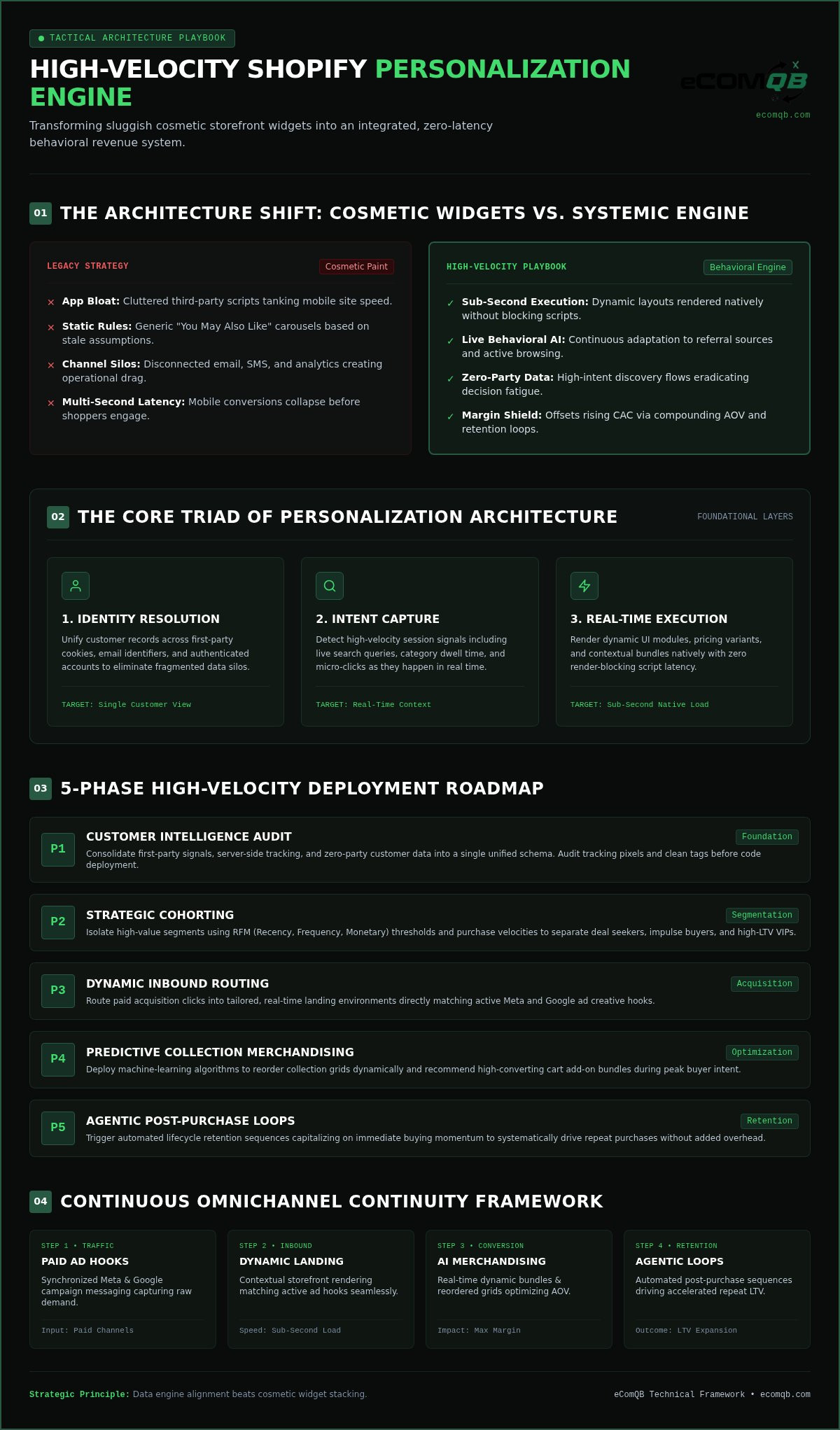
An elite Shopify personalization strategy isn't a patchwork of cosmetic widgets; it's an active, behavioral revenue optimization engine. Legacy brands still rely on static collection pages, hoping shoppers eventually stumble onto what they want. High-growth operators build real-time dynamic storefront merchandising that adapts instantly based on visitor context, historical touchpoints, and live interactions. This systematic alignment serves as your ultimate shield against rising customer acquisition costs, converting expensive top-of-funnel traffic into compounding margin expansion across the entire buyer journey.
Execution speed determines your conversion ceiling. When an unoptimized store takes multiple seconds to render personalized assets, mobile conversions collapse before the visitor even engages. High-velocity storefront architectures demand sub-second rendering speeds where layout variations, dynamic pricing, and contextual product bundles load immediately. Precision targeting and zero-latency infrastructure must move together.
Cosmetic Tactics vs. Systemic Personalization Engines
Basic "you may also like" carousels create artificial revenue plateaus. Static rule sets operate on historical assumptions rather than real-time behavior, routinely serving irrelevant recommendations that shoppers skip right past. A high-performance recommender system continuously adjusts to live campaign parameters, referral sources, and active browsing patterns. It eliminates decision fatigue, streamlines product discovery, and secures order value when customer intent is highest.
The Core Triad: Identity, Intent, and Real-Time Execution
Scaling an architectural Shopify personalization strategy requires mastering three distinct tactical layers:
- Identity Resolution: Unify customer records across first-party cookies, email identifiers, and authenticated accounts to eradicate disconnected data silos.
- Intent Capture: Detect high-velocity session signals including real-time search queries, category dwell time, and micro-clicks as they happen.
- Real-Time Execution: Render personalized interface modules and smart bundles natively without injecting render-blocking scripts that slow down your theme.
When identity, intent, and execution align, your storefront stops functioning as a static digital catalog and transforms into a responsive, high-converting growth engine.
Five Tactical Phases to Deploy a High-Velocity Personalization Engine
High-growth operators do not rely on bloated apps or multi-month agency retainers to tailor customer experiences. Scaling brand margins requires a battle-tested roadmap that connects backend infrastructure directly to the visual layer. Implementing a resilient Shopify personalization strategy demands an agile five-phase deployment model built for continuous revenue acceleration.
- Phase 1: Customer Intelligence Audit: Consolidate first-party signals, server-side tracking, and zero-party customer data into a unified schema.
- Phase 2: Strategic Cohorting: Isolate high-value customer segments using RFM (recency, frequency, monetary) thresholds and purchase velocities.
- Phase 3: Dynamic Inbound Routing: Route paid acquisition clicks into tailored, real-time landing environments matching active creative hooks.
- Phase 4: Predictive Collection Merchandising: Deploy machine-learning algorithms to reorder collection grids and recommend cart add-ons dynamically.
- Phase 5: Agentic Post-Purchase Loops: Trigger automated lifecycle sequences that capitalize on fresh buying momentum to accelerate repeat orders.
Phases 1 & 2: Data Consolidation and Strategic Cohorting
Garbage data creates broken customer journeys. Before writing a single line of frontend code, audit tracking pixels, clean customer tags, and reconcile lifetime order values. Group your customer base into clear behavioral segments: price-sensitive deal seekers, impulse buyers, and high-LTV VIPs. As detailed in the landmark analysis Personalized: Customer Strategy in the Age of AI, effective modern systems depend entirely on clean input signals feeding intelligent decision layers.
Phase 3: Building Dynamic Inbound Landing Experiences
Disconnecting ad messaging from storefront destinations burns cash. When a shopper clicks a specific paid creative hook, the landing page hero banner, value propositions, and featured collections must echo that angle instantly. Contextual elements should shift based on geographic IP and traffic origin. Discovering how AI for Shopify personalization drives high-velocity revenue shows you how to eliminate friction on the initial click.
Phases 4 & 5: Predictive Merchandising and Post-Purchase Loops
True merchandising changes dynamically with every added item. Compute cross-sells based on real-time cart weight, product affinities, and historical margin contribution. Streamline the checkout step by surfacing regional preferred payment channels instantly. The moment the sale registers, launch agentic retention loops via email and SMS that target replenishment cycles based on individual consumption rates.
Executing this architecture at scale requires precision engineering. If you want to streamline your stack and deploy a fully unified revenue engine, book a strategic briefing to audit your roadmap.
Core Levers: Dynamic Storefronts, AI Merchandising, and Zero-Party Data
Executing an elite Shopify personalization strategy requires turning passive digital window shopping into active product discovery. Traditional storefronts present identical product grids to every user, forcing potential buyers to hunt through extensive catalogs. High-performance eCommerce brands deploy intelligent storefront systems that reorganize visual hierarchies based on immediate margin profile, available inventory tiers, and live buyer actions. This approach transforms standard catalog pages into agile conversion channels.
Personalization must never come at the expense of customer trust or operational clarity. While some brands experiment aggressively with segmented incentives or algorithmic dynamic pricing, leading operators focus their architectural levers on relevance, immediate utility, and reduced friction. By synchronizing edge computing, deliberate customer inquiries, and optimized checkout pathways, you unlock compounding gains in average order value.
Architecting Contextual Storefronts Without Theme Bloat
Dynamic experiences fall flat if they induce layout shifts or drag down mobile response times. Top merchants utilize edge rendering and lightweight native Liquid modifications to alter collection layouts without client-side lag. When a repeat purchaser lands on a category page, the catalog suppresses items they already own, instantly elevating restock items or high-affinity cross-sells. Speed remains intact; relevance spikes immediately.
Weaponizing Zero-Party Data via Interactive Discovery
Third-party cookies no longer provide dependable consumer profiling. Interactive diagnostic quizzes solve this problem by collecting direct consumer preferences while curing decision fatigue. Every response instantly tags the customer profile within Shopify, feeding automated segmentation rules. Instead of guessing skin types, fitness goals, or design tastes, the storefront immediately surfaces curated starter bundles engineered around the customer's self-reported requirements.
Algorithmic Upselling Across the In-Cart Journey
Cart slide-outs should actively drive transactional profitability. Replace passive cart screens with intelligent slide-out drawers that dynamically calculate rewards thresholds:
- Dynamic Threshold Progress Bars: Incentivize higher basket sizes by tracking distance to free shipping or tiered gifts with single-click bundle add-ons.
- High-Margin Consumables: Recommend relevant care kits, refills, or warranties directly aligned with cart items.
- Out-of-Stock Safeguards: Suppress backordered suggestions automatically, instantly serving in-stock alternatives to protect fulfillment timelines.
Integrating these three core levers ensures every user touchpoint actively protects gross margins while accelerating cart completion rates.
Omnichannel Personalization: Unifying Shopify, Agentic Retention, and Paid Media
Fragmented marketing stacks bleed cash. When your paid ads, on-site journey, and retention campaigns operate in silos, you force buyers to restart their discovery path on every channel. A modern Shopify personalization strategy demands complete, continuous message synchronization across your entire growth ecosystem. Aligning paid acquisition directly with adaptive storefronts and intelligent retention workflows compresses customer payback windows while driving radical improvements in operational efficiency.
Personalization breaks down the second a customer experiences disconnected messaging. Treating media buying as an isolated tactic separate from theme architecture leaves revenue on the table. High-growth operators build connected flywheels where every on-site interaction immediately updates marketing triggers across all channels.
Harmonizing Paid Acquisition with Storefront Messaging
Paid traffic converted at scale requires strict visual and contextual continuity. When a prospect clicks an ad highlighting a specific problem or discount offer, the destination page must reflect that exact narrative. Dynamic URL parameters make this possible instantly:
- Dynamic Creative Mirroring: Match the hero headline, imagery, and primary CTA to the specific hook used in Meta or Google ads.
- Parameter-Driven Pricing: Pass localized currency, promotional bundles, or targeted discount codes directly into the cart session without manual code entry.
- Intelligent Route Forwarding: Direct traffic automatically to curated sub-collections matched to the campaign's exact intent signals.
Agentic Email and SMS Workflows for Retention
Static post-purchase email blasts produce diminishing returns. Modern retention systems deploy agentic email marketing to send dynamic, real-time communications based on live consumption rates and on-site behavioral triggers. If a customer views a complementary accessory three times within forty-eight hours of an order fulfillment event, the system dispatches a personalized SMS restock alert or time-sensitive add-on incentive, securing high-margin repeat revenue automatically.
Unifying Data Streams for Total Omnichannel Clarity
Siloed customer records result in annoying, budget-wasting ad touches. Real-time omnichannel data orchestration synchronizes Shopify order histories directly back to ad platform APIs. The moment a transaction completes, exclusion lists suppress top-of-funnel prospecting ads immediately, preserving ad spend for high-intent new prospects. Reviewing how an eCommerce AI growth system unifies these cross-channel loops reveals the compound impact of treating retention and acquisition as a singular machine.
Eliminate channel disconnects and capture higher lifetime value. Schedule a strategy call today to align your paid media, Shopify architecture, and retention channels into one unified growth system.
Auditing Technical Debt, Measuring Revenue Velocity, and Scaling with eComQB
Every third-party script injected into your theme extracts a measurable speed penalty. Without disciplined measurement, dynamic personalization initiatives quietly accumulate technical debt, masking conversion decay under misleading engagement metrics. An aggressive Shopify personalization strategy requires continuous auditing of theme architecture, data taxonomy, and true financial velocity. You don't optimize for vanity impressions; you optimize for rapid cash conversion cycles and compound margin growth.
The Core Metrics of Personalization Success
Vanity clicks mean nothing if terminal unit economics don't improve. Measure the true lift of your deployment against three decisive operational benchmarks:
- Revenue Per Visitor (RPV): Evaluate lift across personalized cohorts versus clean control groups to verify genuine incremental profit across device categories.
- Basket Value Expansion: Quantify the average order value increase generated exclusively by automated in-cart and post-checkout recommendation modules.
- 60-Day Repurchase Velocity: Track how rapidly initial customer acquisition events mature into secondary transactions via automated retention triggers.
The Shopify Personalization Tech Stack Audit
Unvetted app installations leave orphaned tracking tags, bloated libraries, and heavy execution waterfalls long after you uninstall them. Benchmark page speed and render timing before and after deploying any new behavioral script. Purge fragmented widgets immediately if they don't produce a verifiable, compounding revenue lift. Exploring how systematic AI transformation for eCommerce brands modernizes backend infrastructure reveals how to eliminate code bloat while unifying your customer intelligence.
Engineering Predictable Scale with eComQB
Building, tuning, and maintaining an enterprise-grade personalization machine internally creates massive operational drag. It burns engineering hours, fragments focus, and drains executive resources away from strategic category leadership. That's where eComQB steps in.
We operate as your high-stakes tactical partner, designing high-converting storefront architectures, rolling out specialized AI personalization experiences, and deploying agentic media execution. We construct fully managed growth systems that help ambitious direct-to-consumer brands unlock eight-figure scale without adding internal overhead. If you're ready to modernize your stack and dominate your market, book a call with eComQB to engineer your Shopify personalization strategy today.
Deploy Your High-Velocity Revenue Engine
The era of cosmetic recommendation carousels is finished. Dominating direct-to-consumer commerce demands a high-performance framework that unites zero-latency dynamic storefronts, behavioral AI merchandising, and automated omnichannel continuity. When you purge technical debt, capture zero-party intelligence, and harmonize paid acquisition directly with agentic retention loops, you turn passive site traffic into compounding gross margin.
Scaling an enterprise-grade engine doesn't require ballooning your brand headcount or burning engineering cycles. eComQB operates as your high-stakes tactical partner, delivering elite engineering for conversion-optimized Shopify storefronts, dynamic landing pages, and fully managed AI growth systems built to accelerate eight-figure scale. Stop letting rising customer acquisition costs dictate your growth ceiling. Take decisive command of your unit economics, eliminate operational drag, and build an enduring competitive advantage. Book a call with eComQB to engineer your Shopify personalization strategy and unlock your true revenue velocity today.
Frequently Asked Questions
What is a Shopify personalization strategy?
A Shopify personalization strategy is an architectural system that customizes the shopping experience in real time using behavioral signals, customer identity, and inventory data. Instead of relying on static collection grids, it dynamically alters storefront layouts, navigation paths, and product offerings to match individual user intent. This active framework bridges the gap between top-of-funnel acquisition, on-site conversion, and post-purchase retention.
How does dynamic personalization impact Shopify page load speed?
Unvetted third-party apps degrade load times by loading bulky, render-blocking JavaScript files. Elite implementations avoid this drag by utilizing edge computing, server-side data fetching, and native Shopify theme architectures. When you engineer personalized modules cleanly, you deliver dynamic content with sub-second execution speeds, eliminating cumulative layout shifts and protecting vital mobile conversion rates.
What is the difference between zero-party and first-party data on Shopify?
First-party data reflects passive behavioral tracking, including session duration, visited product categories, and transaction histories captured directly through your store. Zero-party data is information that customers intentionally share with your brand, such as quiz responses, personal preferences, and sizing requirements. Combining both streams gives your targeting engine absolute clarity without relying on unstable third-party tracking cookies.
Can high-performing personalization be implemented without going headless?
Yes. Modern Shopify architectures built on Online Store 2.0 provide deep extensibility without the technical debt of a detached headless build. By combining optimized Liquid code, lightweight edge functions, and clean data connections, merchants execute real-time behavioral merchandising and targeted landing experiences natively. You achieve enterprise-grade responsiveness while keeping operational maintenance lean.
How does AI merchandising increase Shopify average order value?
AI merchandising evaluates live basket contents, purchase affinities, and real-time inventory levels to recommend the most profitable add-ons at critical transaction moments. By introducing automated threshold rewards, dynamic bundle pairings, and high-margin consumable upsells directly inside the cart drawer, the storefront systematically nudges basket sizes higher without introducing checkout friction.
Which metrics prove that a Shopify personalization strategy is generating ROI?
Revenue per visitor (RPV) is the definitive KPI, measured by splitting traffic between personalized journeys and baseline control cohorts. In addition, growth operators evaluate average order value expansion, 60-day repeat purchase rates, and payback velocity on paid acquisition. A properly deployed Shopify personalization strategy consistently produces compounding lift across these core financial benchmarks.
How do agentic workflows improve email and SMS retention for Shopify stores?
Standard retention calendars rely on blunt batch-and-blast campaigns that ignore individual buying patterns. Agentic email and SMS workflows analyze real-time replenishment cycles, customer consumption habits, and browsing triggers autonomously. They deploy hyper-targeted outreach the moment purchase intent peaks, accelerating second-order velocity and eliminating wasted messaging touches.