Automated Ad Budget Allocation: Profit-First Guide 2026

A faster budget shift can still be a bad business decision. Automated ad budget allocation moves spend between campaigns in response to performance signals, but platform-reported ROAS does not always show whether those shifts improve contribution margin or overall business profit.
When you manage campaigns across platforms, manual adjustments can be slow, while automated decisions may be hard to audit or control. The answer is not to hand over the budget and hope for the best. Make sure each change is guided by reliable measurement, a profit-focused objective, and clear limits.
This guide explains how automated allocation works and how it differs from basic budget pacing. You will learn how to choose objectives and signals, set guardrails, and review decisions without losing strategic control. We also compare rules-based, platform-native, and cross-channel approaches, including when coordinated execution across Meta and Google may be more useful than isolated automation. The goal is to automate budget moves only when business performance and measurement quality support them.
Key Takeaways
- Automated ad budget allocation shifts spend based on goals, rules, and performance signals. Understand how it differs from pacing before choosing an approach.
- Choose objectives that reflect profitable growth, then assess platform ROAS alongside contribution margin, customer acquisition cost, and blended efficiency.
- Compare rules-based, platform-native, and cross-channel methods by their control, data access, explainability, and operational demands.
- Protect performance with clear limits, evidence thresholds, and review checkpoints before expanding automation.
- When campaigns need coordinated strategy and execution across Meta and Google, a managed eCommerce growth system can provide a broader operating framework.
What Is Automated Ad Budget Allocation, and What Does It Actually Automate?
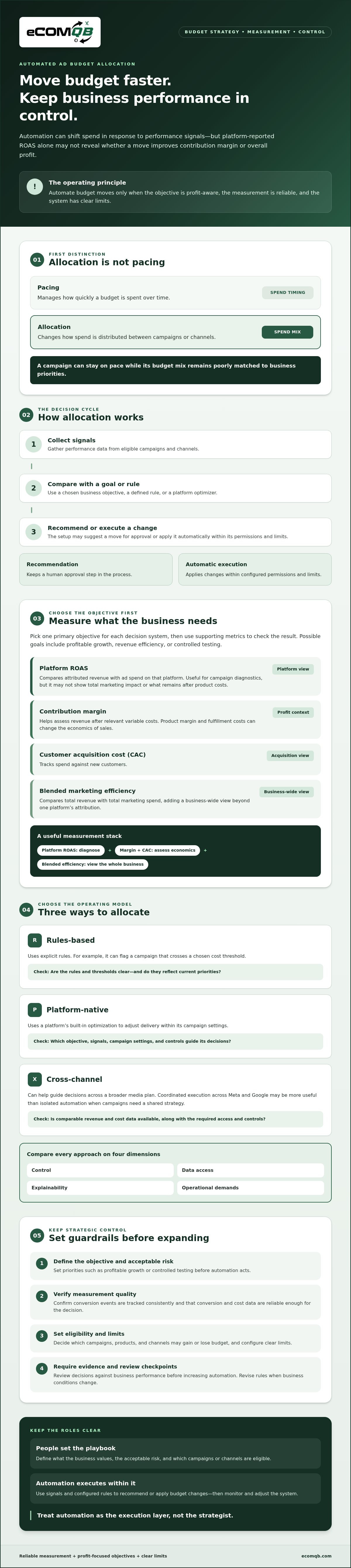
Automated ad budget allocation is software shifting advertising spend among campaigns based on defined goals, rules, and performance signals. Depending on the setup, it may work within one advertising platform or help guide decisions across a broader media plan. The aim is to direct more budget toward opportunities that fit the chosen objective, not simply to spend faster.
That distinction matters. Pacing manages how quickly a budget is spent over time; allocation changes how spend is distributed between campaigns or channels. A campaign can stay on pace while its budget mix remains poorly matched to business priorities. For background on how automated buying fits into online advertising, see this overview of programmatic advertising.
Automation can follow simple rules, rely on a platform’s built-in optimization, or use AI-driven workflows. None guarantees better outcomes. Decisions are only as useful as the data, objective, and constraints behind them. For example, a system optimizing for platform-reported conversions may not account for all the factors that determine whether those sales are profitable.
How automated budget allocation works in practice
The process is a cycle: collect performance signals, compare results against a goal or rule, then recommend or execute a budget change. A rules-based setup might flag a campaign that crosses a chosen cost threshold. A platform optimizer may adjust delivery within its campaign settings. A broader workflow may inform shifts across campaigns if it has access to the required data and controls.
Before enabling a system, check whether it recommends a move or makes it automatically. Recommendations preserve a human approval step. Automatic execution applies changes within the permissions and limits configured for the system. Also confirm which campaigns are eligible to gain or lose budget, so spend does not move into a campaign that is not aligned with current priorities.
Which decisions can automation make, and which remain strategic?
Depending on its configuration, automation can manage spend pacing, shift budget between campaigns, or adjust budgets within preset limits. It can help teams act on signals consistently, but it cannot decide what the business should value without direction.
People still define the objective, acceptable risk, and business constraints. Set priorities such as profitable growth or controlled testing, then decide which products, campaigns, and channels are eligible for budget changes. Treat automation as the execution layer, not the strategist: set the playbook, monitor the moves, and revise the rules when business conditions change.
Which Data and Objectives Should Automated Allocation Use?
Set the business objective before choosing the metrics. Automated ad budget allocation can optimize toward profitable growth, revenue efficiency, or controlled testing, but those goals require different signals. Pick one primary objective for each decision system, then use supporting metrics to check the result. Without that hierarchy, automation can chase a rising platform ROAS while acquisition costs or margins move in the wrong direction.
Choose signals that reflect business performance
Platform ROAS compares attributed revenue with ad spend on that platform. It is useful for campaign diagnostics, but it may not show total marketing impact or what remains after product costs. Pair it with contribution margin, which helps assess revenue after relevant variable costs, and customer acquisition cost (CAC), which tracks spend against new customers. Blended marketing efficiency, often assessed by comparing total revenue with total marketing spend, adds a business-wide view that is not limited to one platform’s attribution.
Reported revenue alone can mislead. Two products may generate the same sales value but contribute different margins, and fulfillment costs can also change the economics. Choose the signal that matches the decision. For a cross-channel plan, comparable revenue and cost data matter. Research on how advertisers can globally optimize their budget allocation examines the challenge of coordinating spend across channels.
Allocation needs reliable conversion and cost data to distinguish real performance from measurement noise.
Set measurement rules before handing over budget decisions
Audit the foundations first: confirm that conversion events are tracked consistently, channel and campaign names follow a shared structure, and each team uses the same conversion definition. Agree on reporting windows, too. Platform attribution windows can credit conversions differently, and customers may convert after a delay. Comparing channels on mismatched windows can produce misleading signals.
Then define what evidence is needed before a change. A brief performance swing may reflect timing, attribution changes, or ordinary variation rather than incremental impact. Do not let a short-lived result trigger a lasting budget shift. Review results over a window suited to your conversion cycle, and compare platform reports with blended business outcomes.
- Primary objective: The outcome automation is expected to optimize.
- Supporting metrics: Margin, CAC, and blended efficiency checks that expose trade-offs.
- Reporting rules: Shared conversion definitions, attribution windows, and review periods.
For eCommerce teams aligning measurement with campaign decisions across Meta and Google, review your advertising approach as part of a broader growth system.
Rules-Based, Platform-Native, or Cross-Channel Allocation: How Do You Choose?
The right system depends on where decisions need to happen and what evidence the system can access. Rules-based controls offer direct, explainable limits. Platform-native optimization can make campaign decisions using signals within that platform. Cross-channel allocation aims to coordinate spend against shared business goals. None is automatically best. Match the method to your channel mix, data maturity, and need for control.
Use four checks to compare your options:
- Data access: Can the system use the conversion and cost signals that matter to the objective?
- Decision speed: Does it act quickly enough for the decision without overreacting to noisy results?
- Explainability: Can your team understand why a budget change was recommended or made?
- Operational complexity: Can you maintain the rules, reporting, and oversight it requires?
Rules-based allocation suits teams that prioritize control and can define clear conditions. A team might set a spending ceiling or require review before a campaign exceeds a defined limit. The logic is easy to inspect, but rules need maintenance and may not adapt well when performance changes in ways the team did not anticipate.
When platform-native optimization is enough
Platform-native optimization may suit campaigns with clear objectives and reliable conversion signals within the platform. Meta Ads and Google Ads each report performance in their own platform context, so results and attribution views may not align perfectly. That does not make native tools inferior; they can be practical when the decision is channel-specific. Keep in mind that their reports may not represent blended business performance across all marketing activity.
When cross-channel allocation adds a useful view
Cross-channel allocation becomes relevant when teams need to coordinate platforms against a shared business objective rather than optimize each channel in isolation. Before adopting it, check which data it can access, how it handles attribution differences, and whether its recommendations are transparent enough to review. A unified view can support coordination, but it is only as dependable as its inputs and decision logic.
Choose by operating context, not by the most advanced-sounding label. A focused campaign setup may need platform-native tools and clear rules; a broader media plan may call for cross-channel oversight. For teams exploring how strategy and execution connect, eComQB’s agentic media buying approach offers context for thinking about coordinated campaign decisions.
In practice, automated ad budget allocation can combine approaches: use platform optimization for channel-level delivery, with business-defined rules and human review governing larger budget shifts. Start with the least complex setup that gives you sufficient data access and control. Expand only when your measurement and oversight can support the added complexity.
How to Launch Automated Ad Budget Allocation Without Losing Control
Roll out automation in stages, not across the entire account at once. A controlled launch gives you room to catch tracking errors, test decision logic, and measure changes against a known baseline. Use this sequence: audit data, define objectives, establish limits, pilot, review, then expand. Automated ad budget allocation should earn more autonomy through evidence, not receive it by default.
- Audit the inputs. Check conversion tracking, cost data, campaign naming, and reporting consistency.
- Define the objective. Choose one primary outcome and supporting metrics that will flag trade-offs.
- Set limits. Establish spending caps, minimum evidence thresholds, change limits, and escalation rules.
- Run a pilot. Choose a defined campaign scope and document the baseline before activation.
- Review and expand. Compare results with the baseline, resolve issues, and widen the scope only when controls hold.
Keep the pilot contained. For example, test one campaign group rather than allowing the system to shift budgets across every channel immediately. Record the starting budget, objective, reporting window, and decision rules. This gives your team a fair comparison and a clear audit trail.
Build budget guardrails and approval rules
Set maximum daily or campaign-level changes according to business risk and the system’s scope. Specify which adjustments automation can execute and which require human approval. For example, routine changes within a defined range might proceed automatically, while a major reallocation or strategic exception goes to a reviewer.
Decide in advance what triggers a pause or rollback. Tracking failures, unexpected changes in conversion reporting, or sustained deterioration in business outcomes should prompt investigation before further budget shifts. Guardrails make the system’s authority explicit.
Review performance with the right cadence
Review timing should fit conversion volume, the sales cycle, and reporting delays. Frequent checks can help catch tracking anomalies, but do not treat every short-term fluctuation as proof that a change worked or failed. Separate expected learning volatility from persistent movement in business outcomes, and compare results with the documented baseline.
Use the same discipline when assessing eCommerce ROAS improvement: interpret platform results alongside business performance, not in isolation. If the pilot meets your decision criteria and tracking remains reliable, expand gradually. If evidence is mixed, keep the scope contained and investigate before granting more autonomy.
For a structured approach to campaign oversight and rollout, explore eComQB’s advertising execution services.
Make Automated Allocation Part of a Managed eCommerce Growth System
Automation can move budget. It cannot decide what your business should prioritize, which trade-offs are acceptable, or how advertising fits into the wider growth plan. Those decisions require strategy and accountability. For eCommerce brands running campaigns across Meta and Google, automated allocation works best as one part of a system that connects business goals, campaign execution, measurement, and human oversight.
This matters when channel complexity outpaces your team’s capacity or ad decisions need to align with wider growth priorities. A tool can surface signals and support budget decisions, but your business strategy should set the objective, define the limits, and determine what counts as a meaningful result. Treat automation as part of the operating model, not a standalone fix.
What to evaluate in a managed allocation partner
Ask how the partner connects account-level signals to business outcomes and handles gaps between platform reporting and blended performance. Clarify who approves material budget changes, monitors tracking quality, and responds when data looks inconsistent or a strategic exception arises. Reporting should explain why a decision was made and what evidence informed it, not just display a dashboard of metrics.
- Decision logic: What goals and signals guide allocation?
- Governance: Which changes can happen automatically, and which need approval?
- Accountability: How are performance reviews and exceptions handled?
These questions help reveal whether the approach gives your team useful oversight or simply adds another layer of automation to monitor.
When to move from experimentation to a managed system
Experimentation can be useful while your campaign structure is simple and your team has the capacity to review decisions. Consider a managed approach when coordinating channels, measurement, and budget changes consumes more attention than your team can give, or when isolated campaign decisions need to align with broader eCommerce growth priorities.
eComQB provides managed eCommerce growth systems, including Meta and Google advertising execution, agentic media buying, and AI transformation for eCommerce brands. The aim is to connect strategy with execution and oversight while keeping business objectives in the lead. Automated ad budget allocation can support that work, but the system still needs clear goals, reliable inputs, and accountable decision-making.
If your team is weighing how to manage allocation across campaigns and channels, discuss your allocation challenges with eComQB.
Make Your Next Budget Move Count
Automation can make budget decisions faster, but speed alone does not create profitable growth. The strongest approach starts with a clear business objective, trustworthy measurement, and guardrails that keep decisions accountable. Choose the allocation method that fits your channels and team, then pilot, review, and expand based on evidence.
For eCommerce brands, automated ad budget allocation works best as part of a connected growth system, not as a standalone fix. eComQB combines strategic consulting with curated AI technology stacks and advertising execution across Meta and Google to help align campaign decisions with broader business priorities.
To bring strategy, technology, and execution into sharper focus, talk with eComQB about your growth system. Build an allocation approach that keeps profit in view and gives your team clear oversight.
Frequently Asked Questions
What is automated ad budget allocation?
Automated ad budget allocation is software shifting advertising spend among campaigns or channels according to goals, rules, and performance signals. It may recommend changes for a person to approve or execute them within configured limits. It differs from pacing, which manages how quickly a budget is spent over time. Allocation changes where that budget goes. The system’s value depends on reliable data, an appropriate objective, and guardrails that reflect business priorities.
How does automated ad budget allocation work across campaigns?
Across campaigns, a system gathers available performance and cost signals, compares them with a defined objective, then recommends or makes budget adjustments. For example, it might shift spend between eligible campaigns based on their performance against a target. Cross-campaign decisions require comparable data and clear rules about which campaigns can receive or lose budget. Attribution differences, delayed conversions, and inconsistent tracking can distort the comparison, so review the evidence before expanding automation.
Can AI allocate ad budgets across Meta Ads and Google Ads?
AI can support cross-channel budget decisions across Meta Ads and Google Ads when the tools and workflows have appropriate data access and controls. That does not mean every platform-native optimizer can move budget between platforms. Each platform reports performance in its own context, so verify how any cross-channel system combines attribution, cost, and conversion data. Check what changes it can make, what requires approval, and how decisions are explained before relying on it.
Is automated budget allocation better than manual campaign management?
Not in every situation. Automation can apply defined rules or respond to signals consistently, while manual management gives people direct judgment over changes and exceptions. The better fit depends on campaign complexity, data quality, team capacity, and the control the business needs. A practical setup can combine both: automate bounded, routine adjustments, then keep human review for major shifts, unusual results, and strategic decisions. Automation is a tool for execution, not a substitute for business direction.
How much data does an automated budget allocation system need?
There is no universal data threshold that suits every campaign or system. The useful amount depends on conversion volume, tracking reliability, sales-cycle length, and how frequently decisions are made. Sparse or delayed conversion data can make short-term comparisons unstable. Before launching, check whether the system can access consistent cost and conversion signals, and set a minimum evidence threshold for changes. If evidence is limited, use recommendations or manual approval rather than allowing broad automatic shifts.
What metrics should automated ad budget allocation optimize for?
Choose metrics based on the commercial objective, such as profitable growth, revenue efficiency, or controlled testing. Use one primary objective and supporting measures to reveal trade-offs. Platform ROAS can help assess attributed revenue against ad spend, but it does not necessarily show contribution margin or total marketing efficiency. Consider customer acquisition cost and blended revenue-to-marketing-spend measures alongside platform reporting. The right mix depends on your economics and should use consistent conversion definitions and reporting windows.
How can I keep automated ad budget changes under control?
Set the system’s authority before it starts making changes. Define spending caps, maximum budget adjustments, minimum evidence thresholds, and which actions require approval. Pilot on a limited campaign scope against a documented baseline, then review results on a schedule suited to conversion delays and the sales cycle. Specify pause or rollback conditions for tracking failures or sustained performance deterioration. Keep people responsible for major reallocations, strategic exceptions, and interpreting business outcomes beyond platform metrics.