Breaking Through an eCommerce Sales Plateau: A 2026 Growth Playbook

What if your next growth move isn’t more marketing spend, but finding the constraint already holding your store back? If breaking through eCommerce sales plateau is the goal, increasing your budget before you know what’s limiting revenue can make a tough situation more expensive. You may already be running campaigns, improving your storefront, and sending customer emails, yet growth remains flat. Before investing more, get a clearer picture of what’s working and what isn’t.
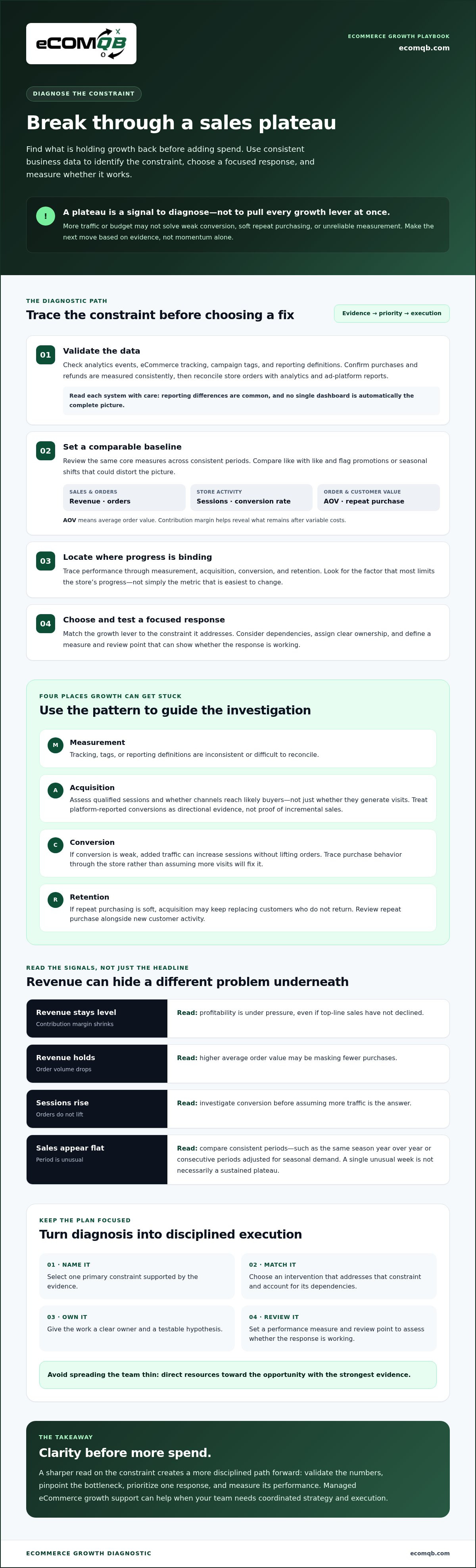
A plateau is a signal to diagnose, not a reason to pull every growth lever at once. Use consistent business data to determine whether acquisition, conversion, retention, or measurement is the main constraint. Then compare focused interventions and direct resources toward the opportunity with the strongest evidence.
This playbook offers a practical framework for evaluating the numbers, prioritizing your next move, and building an execution plan with clear ownership and performance measures. The goal is a sharper read on what’s slowing growth and a disciplined path to move revenue forward.
Key Takeaways
- Separate a sustained sales plateau from a short-term fluctuation by reviewing consistent time periods and core store metrics.
- Check data quality first, then assess acquisition, conversion, and retention to pinpoint where growth is getting stuck.
- Choose a growth lever based on the constraint it addresses, its dependencies, and a measure that can show whether it’s working.
- Turn your diagnosis into a focused plan with one primary constraint, a clear owner, a testable hypothesis, and a review point.
- Breaking through eCommerce sales plateau starts with disciplined prioritization. Bring in managed support when your team needs coordinated strategy and execution.
Breaking through an eCommerce sales plateau starts with diagnosing the constraint
Sales can stay flat even when your product is strong and marketing is active. Campaigns are running, traffic is coming in, and the team is making changes, but revenue hasn’t moved. That doesn’t automatically mean demand is gone or the budget is too small. Make the next move based on evidence, not momentum alone.
Breaking through an eCommerce sales plateau begins with identifying what’s actually stalled. Revenue is the headline, but order volume and average order value help explain what’s driving it, while contribution margin shows what remains after variable costs. Repeat purchasing adds another perspective. Revenue might hold steady while fewer customers return, or order volume may rise while lower-value purchases weaken order quality. These patterns call for different responses.
This diagnostic mindset aligns with the Theory of Constraints, which focuses on finding the factor that most limits a system’s performance. For an eCommerce store, the goal is to locate that constraint before changing budgets, channels, or tactics.
What counts as an eCommerce sales plateau?
An eCommerce sales plateau is a sustained period of stalled growth across comparable business periods, not a single unusual week. Compare like with like, such as the same season year over year or consecutive periods adjusted for seasonal demand. A promotion, product launch, or holiday spike can distort a short comparison, so look for a pattern that persists across a meaningful timeframe.
Then separate flat top-line revenue from weakening profitability. If sales are level but contribution margin is shrinking, the business has a margin problem even if revenue hasn’t declined. If revenue holds while order volume drops, higher average order value may be masking fewer purchases. Define the plateau using the metric that’s actually under pressure.
Why more traffic or ad spend may not solve it
More visitors create growth only when enough of them buy and return. If conversion is weak, added traffic can increase sessions without lifting orders. If repeat purchasing is soft, acquisition may keep replacing customers who don’t come back. In either case, traffic growth can hide the underlying leak rather than fix it.
Raising spend without evidence that the added investment creates incremental sales can make results harder to interpret. Attributed revenue may rise while total business revenue stays flat, or new customers may simply shift from another channel. More budget is not automatically the next move.
Ask which measure changed first and whether the pattern holds across comparable periods. That helps distinguish a traffic problem from a conversion, retention, or profitability constraint, so you can choose the next move with purpose.
How to find the bottleneck behind stalled eCommerce sales
Start with a clean baseline, then trace performance through the customer journey. This sequence helps identify the strongest constraint before you commit to a fix. It also reflects the logic behind the Millennium Challenge Corporation’s growth diagnostic methodology: examine the evidence, locate what binds progress, and prioritize accordingly.
- Validate the data. Review analytics events, eCommerce tracking, campaign tags, and reporting definitions. Confirm that key actions, such as purchases and refunds, are measured consistently. Reconcile store orders against analytics and advertising-platform reports. Differences are common, so understand what each system counts before treating any dashboard as the full picture.
- Set a comparable baseline. Track revenue, orders, sessions, conversion rate, average order value (AOV), and repeat purchase using consistent periods. Compare like with like and note promotions or seasonal shifts that could affect results. A stable baseline helps show whether the plateau sits in traffic, purchase behavior, basket value, or returning customers.
- Inspect acquisition. Break down qualified sessions by channel and campaign where tracking supports it. Ask whether a channel reaches likely buyers, not simply whether it generates visits. Treat platform-reported conversions as directional evidence, not complete proof of incremental impact. Attribution models can assign credit differently, and a reported conversion alone doesn’t establish that an ad caused an additional sale.
- Trace conversion through the store. Compare product-page engagement, cart activity, and checkout completion. Segment by device, product, and channel when the data is reliable. Look for the largest meaningful drop-off rather than trying to optimize every page or step at once.
- Check retention and customer cohorts. Compare repeat orders across customer groups and purchase periods. If first-time orders are steady but returning purchases weaken, acquiring more visitors may not address the binding issue.
Diagnose the journey before intervening. The biggest meaningful drop-off points toward the constraint, while the data helps determine what to test next. For broader system context, explore the eCommerce AI growth system.
Use this sequence to work toward breaking through an eCommerce sales plateau without confusing reported activity with real business impact. Once the evidence points to a constraint, assess whether your team has the capacity to act on it. If coordinated strategy and execution are the gap, you can discuss your eCommerce growth priorities.
Which growth lever should you use to break through an eCommerce sales plateau?
The right intervention depends on what the evidence shows. More acquisition won’t repair a checkout problem, and a redesigned storefront won’t fix weak customer retention on its own. Use the diagnosed constraint to select a lever, confirm its dependencies, then measure it against the problem you’re trying to solve. A comprehensive e-commerce plan can connect these decisions to the wider business strategy, but your first move should address the clearest constraint.
| Growth lever | Signal it addresses | Key dependency | Evaluation measure |
|---|---|---|---|
| Acquisition | Too few qualified visitors from relevant channels | Reliable channel tagging and a clear audience or offer | Qualified sessions, new-customer orders, and contribution margin by channel |
| Conversion | Visitors engage, but few complete a purchase | Usable journey data and a specific friction point to test | Conversion rate and checkout completion for the affected segment |
| Retention | Customers don’t return or purchase again as expected | Accurate customer records and relevant lifecycle communication | Repeat purchase by cohort and revenue from returning customers |
| Personalization | Different customer needs or behaviors are treated the same | Useful customer and product data, plus a clear experience objective | Compare engagement or conversion for the personalized experience against a suitable baseline |
| Storefront improvements | Product discovery, usability, or journey friction limits buying | Evidence identifying the page, device, or step to improve | Relevant product-page engagement, cart progression, or purchase completion |
When to prioritize acquisition, conversion, or retention
Weak qualified traffic points to an acquisition review, not simply broader reach. If shoppers arrive but stall at product pages, carts, or checkout, investigate the customer journey and storefront before buying more visits. If repeat purchasing is the weak link, assess lifecycle messaging and the customer experience after the first order. These levers aren’t interchangeable. Each needs different evidence, capabilities, and success measures.
How AI and automation fit the growth decision
AI can support analysis, personalization, media execution, and marketing workflows. It doesn’t remove the need for clear objectives, usable data, or human oversight. For example, agentic media buying and agentic email marketing relate to distinct growth levers. Each still needs measurement tied to the diagnosed constraint.
Breaking through an eCommerce sales plateau means matching the intervention to the signal, not deploying every available tactic. If your team needs coordinated strategy and execution for a specific constraint, you can discuss your growth priorities.
How to prioritize a plateau-breaking plan without spreading the team thin
A diagnosis creates value only when it changes what the team does next. Turn your findings into a ranked backlog, then commit to one primary constraint. Score each opportunity against four questions:
- Likely impact: If the issue is resolved, how directly could it affect the business outcome you care about?
- Evidence: Do store, customer, and channel data support the diagnosis, or is it still an assumption?
- Effort: What people, budget, and tools would the intervention require?
- Dependencies: Does it rely on clean tracking, a storefront change, or another task being completed first?
Prioritize opportunities with strong evidence and a clear path to impact. A high-potential idea may need to wait if its measurement or technical dependencies aren’t ready. This keeps the plan focused instead of launching multiple channel changes that compete for the same team and make results harder to interpret.
Build a focused test and measurement plan
Write a hypothesis that connects one intervention to one primary business outcome. For example: “If we simplify the mobile product-page experience, more qualified visitors will complete purchases.” Set the baseline first, name an owner, and agree on the review point before work begins. Supporting indicators, such as product-page engagement or cart progression, can help explain movement, but they shouldn’t replace the main success measure.
Keep the test record simple: capture what changed, which audience or channel was affected, what the data showed, and any known limitations. A short-term lift can be a useful signal, but it doesn’t prove the intervention caused the change. Seasonality, promotions, traffic mix, and other concurrent updates can affect results. Note those factors before drawing a conclusion.
Decide what to keep, change, or stop
Set decision criteria before the test starts. Keep an intervention when the evidence supports its intended outcome and the result fits your business priorities. If the result is inconclusive, check whether you had enough reliable data or whether another factor obscured the signal, then revise the approach. Stop activity that lacks a clear rationale or measurable connection to the constraint.
Before increasing spend or adding another tool, reassess whether the original constraint still holds. Breaking through an eCommerce sales plateau takes disciplined iteration: test, learn, and redirect effort based on what the evidence supports. Discuss your growth constraints with eComQB if you need support turning diagnosis into a coordinated execution plan.
When managed eCommerce growth support can help move sales forward
Outside support can make sense when your team has identified a likely constraint but lacks the capacity to diagnose it fully, execute the right intervention, or measure what changes. The goal isn’t to add another layer of activity. It’s to connect the problem to a focused plan across strategy, channels, storefront, and measurement, with clear roles for your team and any partner.
eComQB supports eCommerce brands with managed AI systems and workflows, Meta and Google advertising execution, email and SMS marketing, AI personalization, AI visibility and SEO, and Shopify design and development. These capabilities aren’t a checklist every store needs. The right fit depends on the constraint: an acquisition gap may call for advertising execution, while a storefront friction point may point toward Shopify development. Retention challenges may make lifecycle marketing more relevant.
What to evaluate in a growth partner
Before engaging a partner, ask how they’ll diagnose the bottleneck before recommending channels, tools, or more spend. Clarify how strategy connects to execution, what reporting you’ll use to judge progress, and who owns each decision and task. Ask what assumptions support the proposed plan and how its primary outcome will be measured. A credible partner should explain the limits of the evidence, not promise an outcome they can’t substantiate.
Check that the proposed work fits your current operating reality. A recommendation that depends on data you don’t collect or resources your team can’t provide may need a different sequence. Strong collaboration makes responsibilities, dependencies, and review points visible from the start.
Choose the next move for your eCommerce business
Keep the sequence tight: validate the data, locate the constraint, select a matching lever, measure the result, then scale only when the evidence supports it. That discipline helps prevent more spend or new tools from becoming substitutes for a clear diagnosis. Breaking through an eCommerce sales plateau is a process of making informed moves, learning from them, and adjusting the plan as the business changes.
Bring your current goals, key metrics, and operational challenges to a conversation with eComQB. Book a call with eComQB to discuss where growth is getting stuck and what a focused next step could look like.
Make your next growth move with confidence
A plateau doesn’t mean you need to change everything. It means you need a sharper read on what’s limiting growth. Validate the data, identify the constraint, and choose a focused intervention with a clear measure of success. That disciplined sequence is the foundation for breaking through an eCommerce sales plateau without letting activity or spend outrun the evidence.
When your team needs support turning the diagnosis into coordinated execution, eComQB can connect relevant capabilities to your priorities. That may include managed AI transformation and growth systems, advertising execution across Meta and Google, Shopify development, or AI-enhanced marketing capabilities. The right combination depends on your business and the constraint you’ve identified.
Bring your goals, current metrics, and operational challenges to the next conversation. Book a call with eComQB to discuss a focused path forward. You don’t need a dozen new tactics. You need the right next move, clearly owned and measured. Start there, learn from the result, and build momentum one deliberate step at a time.
Frequently Asked Questions
What causes an eCommerce sales plateau?
An eCommerce sales plateau can stem from weak qualified traffic, friction in the buying journey, fewer repeat purchases, limited product demand, or unreliable measurement. To work toward breaking through an eCommerce sales plateau, identify which explanation fits your store’s data before choosing a tactic. Compare consistent periods and relevant segments, then trace performance through the customer journey to find where results changed. The same symptom can have different causes, so diagnose before acting.
How do I know whether my eCommerce business has stopped growing?
Look for stalled progress across comparable periods, not one unusually strong or weak week. Review revenue, orders, conversion rate, average order value, and repeat purchasing together. Account for seasonality, promotions, channel mix, and product availability, since each can distort a comparison. A plateau is more likely when several consistent periods show limited progress against your intended growth direction. Also check profitability and order quality, because steady revenue can hide a weakening business underneath.
Should I increase ad spend to break through a sales plateau?
Not automatically. More spend may help extend an acquisition channel that brings qualified customers, but it won’t necessarily fix weak conversion, low repeat purchasing, unreliable measurement, or an uncompetitive offer. First confirm that the channel attracts relevant buyers and that resulting orders support your business economics. Compare platform-reported conversions with store performance and consider whether added investment is generating incremental sales. Increase spend only when the evidence supports the decision.
How can I find the biggest growth bottleneck in my online store?
Start by validating analytics and order data, then map results across acquisition, product discovery, cart activity, checkout completion, and repeat purchasing. Segment by channel, device, customer cohort, and product where tracking is reliable. Look for the most consequential drop-off, then confirm it with supporting evidence before changing the system. For example, steady product-page visits paired with weaker cart progression may point toward journey friction, but verify the pattern before choosing an intervention.
Can AI help an eCommerce business overcome a sales plateau?
Yes, AI can support pattern analysis, personalized experiences, marketing workflows, and media execution. It isn’t a substitute for reliable data, clear objectives, or sound measurement. Identify the constraint first, then decide whether an AI-enabled workflow can address it. For example, personalization may be worth evaluating when customer behavior supports relevant differences in the shopping experience. Keep human oversight in place and assess performance against a defined business measure, not activity alone.
How long does it take to break through an eCommerce sales plateau?
There’s no reliable universal timeline. The time required depends on the underlying cause, data quality, implementation complexity, seasonality, and how quickly your team can evaluate a change. Establish a baseline and decision criteria before acting. Review results over a period that fits the test and your sales cycle, while accounting for other changes that may affect performance. Avoid fixed turnaround promises; use evidence to determine whether to continue, adjust, or stop.
When should I hire an eCommerce growth agency or consultant?
Consider outside support when your team lacks the capacity to diagnose the constraint, coordinate execution, or measure results confidently. Ask how a potential partner investigates the business, ties recommendations to evidence, defines ownership, and reports limitations. eComQB provides managed AI growth systems, Meta and Google advertising execution, email and SMS marketing, AI personalization, SEO, and Shopify development. Choose capabilities that fit your diagnosed need, not a broad package by default.