Avoiding Common eCommerce Growth Pitfalls With Better Choices

A viable eCommerce niche brings together clear customer demand, a defined audience, and a product you can compete on. Avoiding common eCommerce growth pitfalls starts with researching customer needs, competitors, and product-market fit before committing to a product line. Don’t choose a niche on enthusiasm alone. Test whether the audience has a reason to buy and whether your offer can stand apart.
Choosing a niche is a balancing act. You want a focused market with room to grow, not a crowded category built on assumptions or a narrow idea with too little demand.
This guide offers a practical playbook for making stronger choices: validate a niche and understand your audience, reduce returns with clearer product information and policies, and remove checkout friction. You’ll also learn how to build an SEO and content strategy that helps shoppers discover your products and supports growth beyond paid advertising.
Key Takeaways
- Validate demand, competition, and product-market fit before committing to a niche or expanding your product range.
- Use customer feedback and clearer product information to reduce confusion, returns, and avoidable support requests.
- Streamline checkout with simple forms, trusted payment options, and a mobile-friendly buying experience.
- Choose an eCommerce platform that fits your business model, product catalogue, and growth plans.
- Build an SEO content strategy around useful product pages and relevant search intent to strengthen discovery beyond paid ads.
1. Market research and target audience definition
E-commerce’s projected expansion creates opportunity, not proof of demand. The market is projected to grow from $6 trillion in 2024 to $8 trillion by 2027, at a compound annual growth rate of 10.05%. Forbes reports that 90% of e-commerce brands fail within their first four months of operation. That contrast makes validation a launch requirement, not a research extra.
Model profitability before choosing products or setting prices. A gross margin below 50% is a red flag for e-commerce businesses. A 10% net profit margin is considered average, while 5% is low and 20% is high. Calculate product costs, fulfilment expenses, marketing, and expected returns together. A product that attracts attention but leaves too little margin cannot support durable growth.
Define your audience through observable needs, not broad demographic labels. Write down the problem your target customer wants to solve, what they currently buy, and why existing options fall short. Then look for repeated language in reviews, customer questions, and search behaviour. For example, “easy-to-clean” may matter more than a premium finish to parents shopping for reusable lunch containers.
Compare competitors who address the same customer problem. Review their product descriptions, price positioning, reviews, shipping promises, and content. Note where brands make identical claims, then identify a credible point of distinction. If competitors sell similar skincare, a focused offer might explain ingredient sourcing or routines for sensitive skin. The goal isn’t to copy their storefront, but to meet an underserved customer need.
Test product-market fit before building a wide catalogue. Start with a small set of core products and track product-page visits, add-to-cart activity, purchases, returns, and customer feedback in your analytics. Look for signs that the intended audience understands the offer and completes purchases. If shoppers repeatedly ask what a product does, revise the positioning or descriptions before expanding.
Set prices to match your audience’s expectations and purchasing behaviour. Compare how customers evaluate alternatives, which features influence their choices, and where your offer creates clear value. Use that evidence to support your margins without relying on discounts to explain the product. Revisit pricing when feedback, conversion patterns, or competitor offers point to a meaningful change.
Build a multi-channel plan around how your audience discovers and evaluates products. Use search content to answer early-stage questions, social media to demonstrate products, and email or SMS to follow up with interested shoppers. Track each channel’s contribution in analytics instead of judging performance by reach alone. For brands seeking external guidance, collaborating with an evidence-led agency like Fresh Faced can help structure these campaigns, giving you a stronger basis for avoiding common eCommerce growth pitfalls and choosing the next test.
2. Returns management and customer-friendly policies
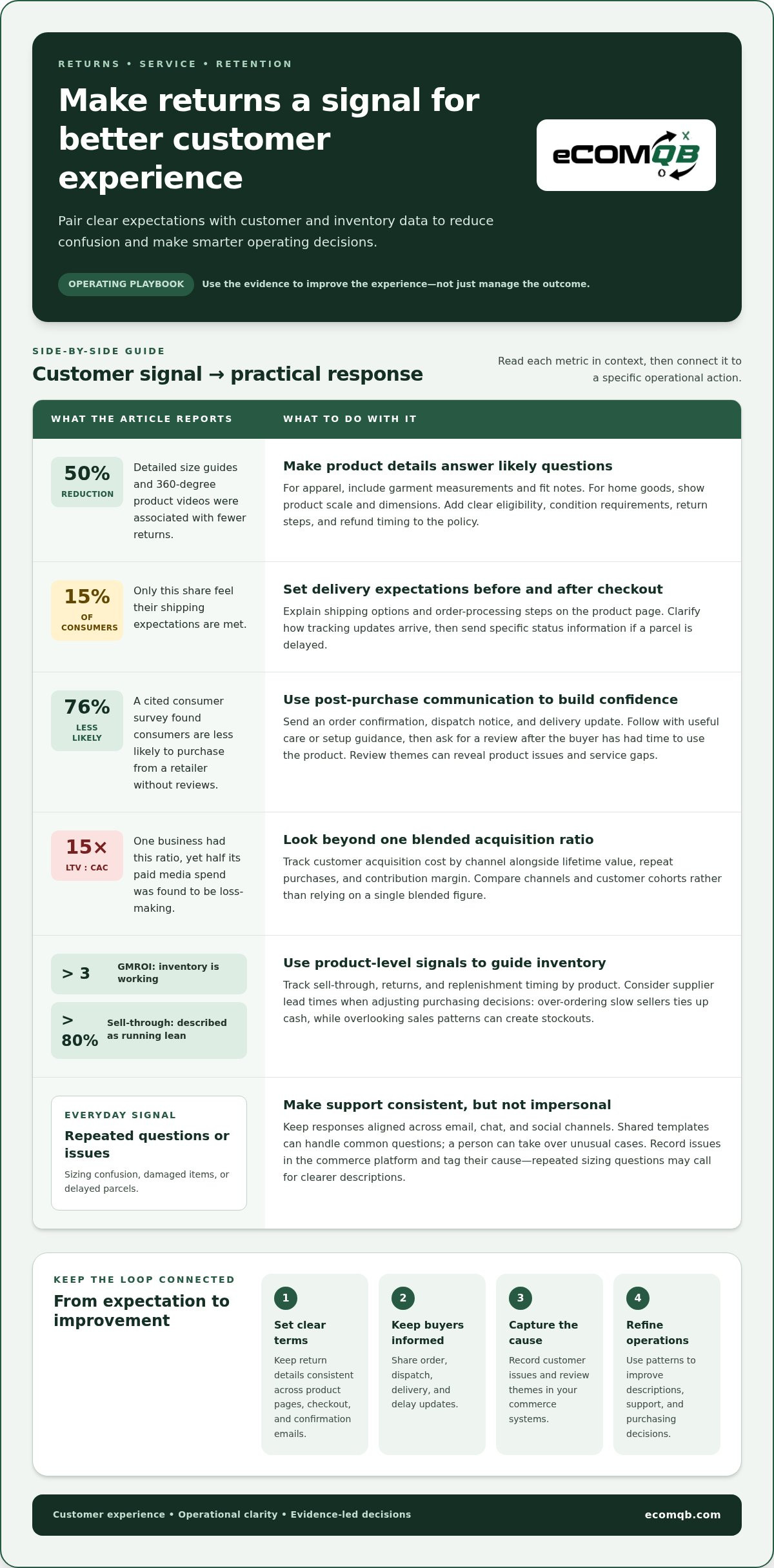
Returns become easier to manage when shoppers know what to expect before purchase. Publish a clear policy that explains eligible items, condition requirements, return steps, and refund timing. Keep the same terms on product pages, checkout, and confirmation emails. Detailed size guides and 360-degree product videos were associated with a 50% reduction in returns. For apparel, include garment measurements and fit notes; for home goods, show product scale and dimensions.
Keep support consistent across email, chat, and social channels. Use shared templates for common questions, while giving staff room to resolve unusual cases. A chatbot can handle routine queries, with a person stepping in when a buyer needs help with a damaged item or delayed parcel. Record each issue in your commerce platform and tag its cause. Repeated questions about sizing may call for clearer product descriptions, not more support scripts.
Set shipping expectations at the product page and reinforce them after checkout. Only 15% of consumers feel their shipping expectations are met, so vague delivery language can create avoidable frustration. Explain available shipping options, order-processing steps, and how buyers receive tracking updates. If a parcel is delayed, send a specific status update rather than leaving customers to search for information. Clear communication helps reduce uncertainty even when a delivery takes longer than expected.
Turn the post-purchase period into a retention opportunity. Send an order confirmation, dispatch notice, and delivery update, then follow up with useful care instructions or setup guidance. Ask for a review after the buyer has had time to use the product. A cited consumer survey found that 76% of consumers are less likely to purchase from a retailer without reviews. Review themes can reveal product issues, confusing descriptions, and service gaps.
Track customer acquisition cost (CAC) by channel alongside customer lifetime value (LTV), repeat purchases, and contribution margin. One e-commerce business had a 15x LTV-CAC ratio, yet analysis found that half its paid media spend was loss-making. Compare channel and customer cohorts instead of relying on a single blended ratio.
Inventory mistakes often start with weak demand forecasts: over-ordering slow sellers ties up cash, while ignoring sales patterns creates stockouts. Track sell-through, returns, and replenishment timing by product. A GMROI greater than 3 means inventory is working, while sell-through above 80% is described as running lean. Use those signals with supplier lead times to adjust purchasing decisions.
When returns, service, and retention data sit in separate systems, patterns are harder to act on. A focused eCommerce growth discussion can help connect customer experience priorities with a wider growth strategy.
3. Reducing checkout friction and building payment trust
Every extra step gives a ready buyer another reason to leave. Digital shopping carts have an average abandonment rate of 69.2 percent. According to Baymard Institute, 88% of online shoppers had abandoned a cart because of poor user experience. Treat checkout as a conversion system: make the next action obvious, reduce avoidable effort, and show shoppers what happens after payment.
Start by testing the purchase flow on mobile and desktop. Remove fields that don’t help process an order, allow guest checkout, and make errors easy to correct. Keep shipping costs, delivery information, and required policies visible before payment. A one-second delay in page load time has been shown to cause a 7 percent loss in conversion. Measure page speed and form completion, then fix the slowest or most confusing step first.
Keep the path short. Guide shoppers to checkout in 3 clicks, and avoid forcing account creation before purchase. Let buyers review their items, quantities, shipping details, and total before they confirm. After payment, show a clear confirmation page and send an order receipt. If an order fails, explain what happened and offer a direct way to retry without making the shopper rebuild the cart.
Choose payment methods to suit your audience and the markets your store serves. Consider cards, bank links, and mobile wallets, as well as relevant regional options such as BLIK. Cash on delivery (COD) may suit shoppers who prefer to pay when an order arrives, but relying on COD can complicate confirmation and delivery workflows. If you offer it, explain the terms, confirm order details, and track completed and refused deliveries. Use that data to assess whether COD supports profitable sales.
Build trust at payment with visible security cues, accurate totals, and accessible support details. Show accepted payment methods before checkout, not as a last-minute surprise. Explain refund and shipping policies in plain language, and avoid claims your store can’t support. Shoppers should recognize the business, understand the charge, and know where to turn with an order question.
Track abandonment by device, traffic source, and checkout step. A high exit rate after shipping details points to a different problem than payment declines. Compare completed orders with checkout starts after each change. Average checkout page load times improved by 40% after platform changes, showing that technical performance can be part of the fix. Change one friction point at a time, then monitor conversion and revenue before rolling out further edits.
4. How can I ensure I don’t choose the wrong niche?
A platform can support a viable niche, but it can’t create demand. Choose technology based on how customers buy, how products are delivered, and what your business needs to manage. A store selling customizable goods needs clear product options; a subscription model needs recurring-order tools. Map those requirements before comparing platform features.
Start by mapping your operating model. List your product types, catalogue structure, payment options, shipping workflows, and sales channels. Then identify which tasks need to connect: orders to inventory, customer records to email, and site activity to analytics. An integrated setup reduces duplicate data entry and makes performance easier to assess. Add tools only when they solve a defined workflow problem.
Treat mobile capability as a core selection criterion, not an upgrade for later. More than half of all ecommerce traffic comes from mobile devices. Test product discovery, filters, descriptions, and checkout on a phone. For example, a homeware store needs category navigation that helps shoppers compare sizes and materials without endless scrolling. Clear categories, subcategories, and search filters make that journey easier.
Review the platform’s analytics before committing. You should be able to assess product performance, traffic sources, conversion activity, and order trends in a usable format. Make sure the data supports decisions across your commerce channels. If your team needs a separate export for every basic question, reporting friction can hide ecommerce mistakes and delay corrective action.
For US eCommerce businesses, compliance review should cover privacy and security practices, payment handling, and accurate consumer-facing information. Applicable requirements depend on the data you collect, payment setup, customer locations, and the claims or policies shown in your store.
Expansion adds another layer of complexity. Before entering a new country, assess local payment preferences, language needs, taxes and duties, delivery coverage, returns, and customer support. When dealing with cross-border compliance and regional tax obligations across markets like the EU, UK, or US, specialized advisors such as cidatax.it can help structure operations correctly. Confirm that your platform can handle the required currencies, regional content, and order workflows. Pilot one market and measure fulfilment issues and customer response before expanding further.
Finally, pressure-test the platform against your next stage, not just launch day. Ask whether it can support a larger catalogue, new channels, and more complex reporting without a disruptive rebuild. Avoid paying for features your model won’t use, but don’t overlook capabilities that directly affect customer experience. The right platform fits the business you’re building and keeps routine operations clear, connected, and measurable.
5. SEO and content strategy
SEO gives an eCommerce business a discovery channel that continues beyond an ad campaign. Build your strategy around what shoppers search before choosing a product, not just product names. Someone shopping for a standing desk may first search for ergonomic setup advice. Create content that answers that need, then connect it to relevant product pages. This turns search intent into a clear path to conversion.
Start with a keyword map. Group searches by intent, such as learning, comparing, or purchasing, then assign each group to one useful page. A guide to choosing running shoes should answer questions about fit and use; a product page should focus on a specific model. Distinct targets help prevent pages from competing with one another. Review the map as your catalogue, audience needs, and search patterns change.
Make product pages genuinely useful. Write unique, benefit-focused descriptions that explain what the item does, who it suits, and how it differs. Add descriptive titles, meta descriptions, and image alt text so shoppers and search engines can understand each page. For a cookware store, explain which cooking tasks a pan supports instead of repeating generic claims across products.
Support product claims with varied content. Original photography can show scale, finish, and details that standard descriptions miss. Video reviews can demonstrate how a product works in real use. Organize these assets around buyer questions, then share useful content on social media to bring shoppers back to relevant pages. Each format should add information, not simply repeat the same sales message.
Technical foundations matter too. Slow-loading ecommerce sites or sites that confuse search engines can fall from page one to page three in search results. Check page speed, mobile usability, crawlable navigation, and duplicate content. Use clear categories and descriptive internal links to guide shoppers from advice to products. Fix technical barriers before expanding your content calendar, or new pages may struggle to gain visibility.
Measure more than rankings. Track organic visits, product-page engagement, assisted conversions, and revenue by landing page. If a guide attracts traffic but doesn’t lead to product discovery, improve its calls to action and related links. If a product page ranks but converts poorly, compare its content with buyer questions and competing offers. Combine SEO with email and social media to reduce dependence on paid advertising.
Build the system around a repeatable cycle: research intent, publish a useful solution, connect it to products, and review performance. For a focused plan that links search content with conversion goals, discuss an SEO and content strategy.
EComQB: Revenue Generating AI Tools
eComQB helps eCommerce brands connect growth strategy with practical technology and marketing execution. Its Revenue Generating AI Tools and AI transformation for eCommerce Brands support teams applying AI across their growth systems. For brands reviewing paid acquisition, Agentic Media Buying and Meta Advertising Execution are relevant options.
Turn to these capabilities when your next growth move requires more than another isolated campaign. Start by identifying the bottleneck: media buying, advertising execution, or the role of AI in your eCommerce operations. A clear priority gives the work a sharper strategic focus.
If you’re ready to explore a more connected growth approach, contact eComQB or visit ecomqb.com.
Make Your Next Growth Move Deliberate
Your next advantage may come from fixing one constraint, not adding another initiative. Choose the bottleneck with the clearest effect on customer experience or commercial performance. Set a baseline, assign ownership, and agree on the signal that will show whether the change is working. That discipline turns avoiding common eCommerce growth pitfalls into an operating habit, not a one-time exercise.
When the challenge calls for a more connected growth system, eComQB offers Revenue Generating AI Tools, AI transformation for eCommerce Brands, and Agentic Media Buying. These capabilities support brands assessing how AI and paid acquisition fit their priorities. The right next move starts with a defined business need and a focused plan to address it.
Contact eComQB to discuss your growth and identify a practical next step. Keep testing, keep learning, and build momentum with choices your team can measure and act on.
Frequently Asked Questions
How can I ensure I don’t choose the wrong niche?
Test purchase intent before building a full store. Create a simple concept page for one product angle, then share it with people who match your intended audience. Notice whether they ask practical buying questions, join an interest list, or compare alternatives. Pair that response with review analysis: recurring complaints about existing products can reveal unmet needs. Strong interest matters most when customers can explain why they would choose your offer.
How much money do I need to avoid beginner mistakes?
There’s no single budget for every business model. That figure doesn’t represent every launch cost or apply to businesses holding inventory. Before committing funds, map platform, product, marketing, fulfilment, and operating expenses. Keep a reserve for testing and unexpected adjustments, and base spending on the model you’re actually building.
What are the most common eCommerce growth pitfalls for small and midsize businesses?
Common pitfalls include expanding the catalogue before identifying strong sellers, increasing advertising before validating campaign performance, and treating traffic as proof of profitable demand. Another frequent mistake is adding disconnected tools that fragment customer and sales data. For example, a store may attract visitors through promotions but fail to understand repeat purchases. Assign an owner to each growth priority, then connect the relevant performance signals before scaling the next initiative.
How can eCommerce businesses grow revenue without sacrificing profitability?
Grow from profitable customer and product segments instead of chasing topline sales alone. Compare contribution after product, fulfilment, promotion, and return costs across customer cohorts. Then prioritize actions that deepen value, such as relevant cross-sells or useful replenishment reminders. For example, if one product attracts first-time buyers but follow-on purchases remain weak, test complementary products before increasing acquisition spend. Review results by cohort to see whether growth strengthens or dilutes unit economics.
How can eCommerce stores reduce cart abandonment and improve conversion rates?
Diagnose abandonment by step, device, and traffic source before changing the whole storefront. A shopper who leaves after seeing delivery terms presents a different issue from a failed payment or confusing product choice. Use session recordings or funnel analytics to locate the hesitation, then test one focused adjustment. For instance, clarify a product’s compatibility near its purchase button. Compare completed orders and checkout starts after the change, not just page engagement.
How do shipping costs, delivery times, and returns affect eCommerce growth?
Shipping terms shape purchase confidence and the work required after checkout. Unexpected charges can weaken conversion, while unclear delivery estimates generate support requests and frustration. Returns also affect margin through reverse shipping, inspection, and possible product markdowns. Review these effects by product type: bulky items may need different delivery information than lightweight accessories. Use customer questions and return reasons to improve product information, set realistic expectations, and refine the offer.
When should an eCommerce business expand to new sales channels or marketplaces?
Expand when your current operation can handle added demand and you can measure each channel separately. First confirm that product availability, fulfilment workflows, customer support, and brand presentation remain consistent. Then pilot a channel with a limited product selection. A marketplace may introduce a product to new shoppers, but its fees, customer-data access, and promotional rules affect the economics. Scale only after channel-level reporting shows incremental, sustainable value.
What metrics should eCommerce businesses monitor to identify growth problems early?
Build a compact dashboard around acquisition efficiency, conversion, repeat purchasing, contribution margin, return rate, stock availability, and fulfilment issues. Read the metrics together: rising traffic alongside falling conversion may point to mismatched targeting or landing-page expectations. A decline in repeat orders can signal product or post-purchase friction. Segment results by product, channel, and customer cohort, then investigate meaningful changes before they become entrenched operating patterns.