Budget allocation for eCommerce marketing across channels and revenue stages
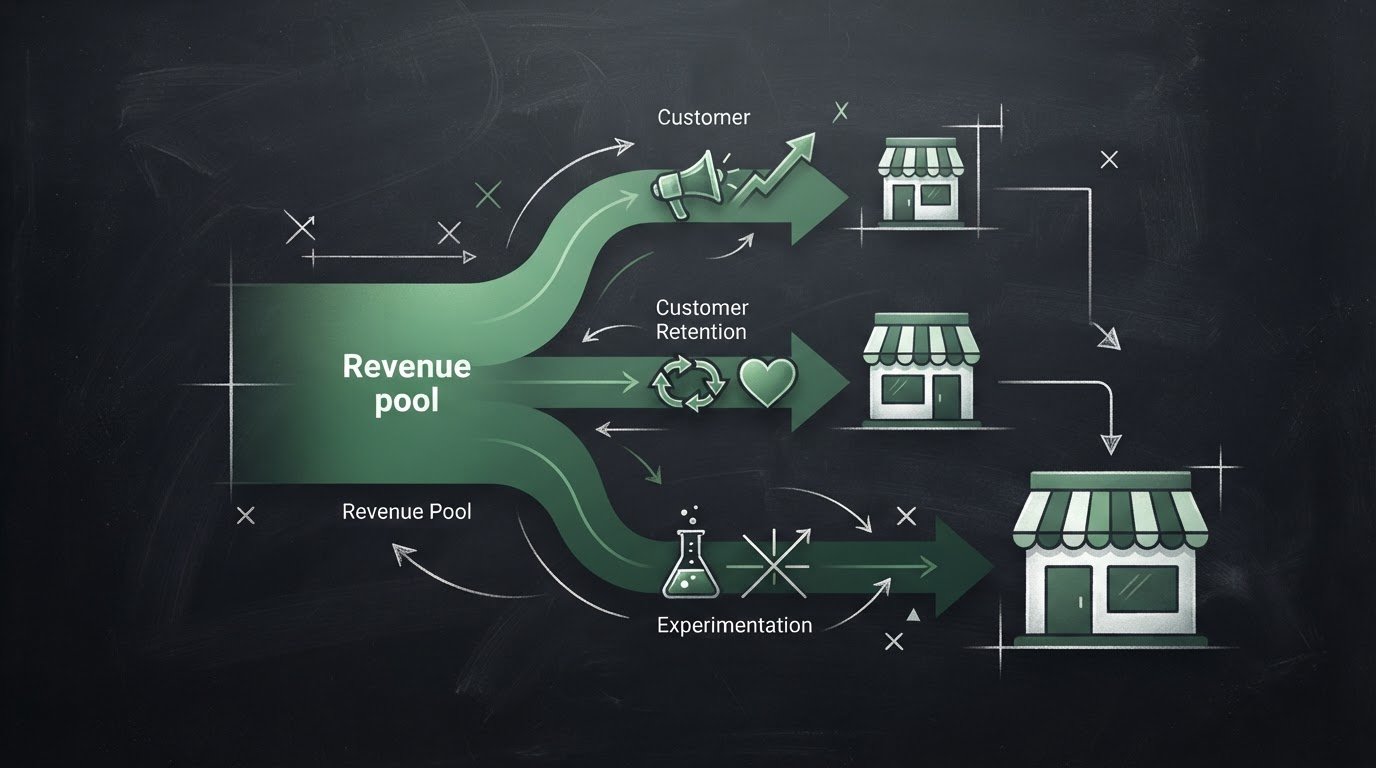
More revenue doesn’t automatically mean a bigger share of revenue should go to marketing. A practical budget allocation for eCommerce marketing starts at 15–25% of annual revenue for brands under $500,000, 12–18% for brands earning $500,000–$2 million, 10–15% for those earning $2 million–$10 million, and 8–12% at $10 million or more. Treat these as starting ranges, then shape the spend around your growth goals and business economics.
It’s easy to focus on the total budget and miss the harder decision: where each dollar can work hardest. This guide explains how to estimate a revenue-based budget, divide it among acquisition, retention, and testing, and adapt the plan as your brand moves from early growth to scale. You’ll see why the right channel mix changes with revenue and how to keep spending tied to performance rather than spreading it thin. The goal is a clear, flexible plan that supports growth without losing sight of profitability.
Key Takeaways
- Set marketing spend against growth goals, margins, and cash flow, not revenue alone.
- Balance acquisition, retention, and experimentation so each channel has a clear role.
- Use customer lifetime value and acquisition cost together to assess whether growth is economically sustainable.
- Separate advertising from the wider marketing budget, then review performance and shift spend toward what works.
1. How much should an eCommerce brand spend on marketing as a percentage of revenue?
Use annual revenue as a starting point, then adjust spending to your growth target and margins. A practical eCommerce range is 15–25% for annual revenue under $500,000, 12–18% from $500,000 to $2 million, 10–15% from $2 million to $10 million, and 8–12% at $10 million or more. These are starting allocations, not automatic rules. A newer commerce brand may need heavier investment to build awareness and acquire customers. An established, profitable brand may prioritize efficiency and retention.
Percentage-of-revenue budgeting sets a clear spending range as sales change. Objective-based budgeting starts with a target, such as acquiring customers or increasing repeat purchases, then estimates the investment needed to pursue it. Use both: set a revenue-based range, then allocate funds to objectives with measurable outcomes. A percentage alone can’t tell you whether a campaign is supporting profitable growth.
How much should a small eCommerce business allocate to marketing each month? Divide projected annual revenue by twelve, then multiply by the appropriate stage percentage. For a business under $500,000 in annual revenue, use 15–25% as the annual starting range and convert that amount into monthly spending.
Account for costs beyond media spend, including creative production, marketing technology, analytics, and campaign management. These expenses affect how much of your total budget is available for advertising.
Build measurement into the plan. Track customer acquisition cost (CAC) alongside customer lifetime value (LTV), using consistent revenue and order data. If CAC rises while repeat purchases remain weak, increasing acquisition spend may deepen the problem. Review attribution across channels so one platform doesn’t claim credit for sales influenced elsewhere. Compare campaign results with actual revenue, not clicks alone, and revisit the allocation as customer behavior, margins, and business stage change. This turns a percentage into a decision system: set guardrails, fund objectives, and adjust spending based on performance.
2. How should you split your eCommerce marketing budget across channels?
Give each channel a defined job in the customer journey. A retail and e-commerce funnel benchmark assigns 35% to awareness, 20% to consideration, 30% to decision, and 15% to retention. Use awareness channels to build qualified traffic, consideration activity to explain value, and decision campaigns to convert intent. Retention spending supports repeat purchases. A budget allocation for eCommerce marketing works best when every channel has a clear role and measurable objective.
A 70-20-10 framework can organize spending across proven channels, growth opportunities, and experiments. Treat it as a planning template, not a universal benchmark. Prioritize channels against your objective, customer behavior, margins, and competitive position. A brand with strong repeat orders may direct more investment toward retention than a business still building its customer base. The budget allocation for eCommerce marketing should reflect those differences.
How much should eCommerce brands budget for Google Ads and Meta Ads? There’s no fixed split that fits every store. Set each channel’s share according to its role and measured contribution; paid search commonly receives 10–15% of the marketing budget. Meta’s allocation depends on audience response, creative performance, and acquisition economics.
Protect room to learn. Reserve 10% of the total marketing budget for testing, and assess a new channel over at least 90 days. Define success before launch, using metrics such as CAC, conversion rate, and incremental revenue. Keep a separate contingency reserve of 5–10% for unexpected shifts, rather than pulling funds from campaigns mid-test.
Review results monthly, then shift spending toward channels that meet their objective. Compare attribution with actual sales and repeat purchase behavior; traffic alone doesn’t prove a channel is profitable. If a channel’s CAC changes by 25% or more over 30 days, an off-cycle reallocation can be warranted. For a channel mix tied to clear performance goals, discuss your eCommerce marketing strategy.
3. What's a Realistic Ecommerce Marketing Budget by Revenue Stage?
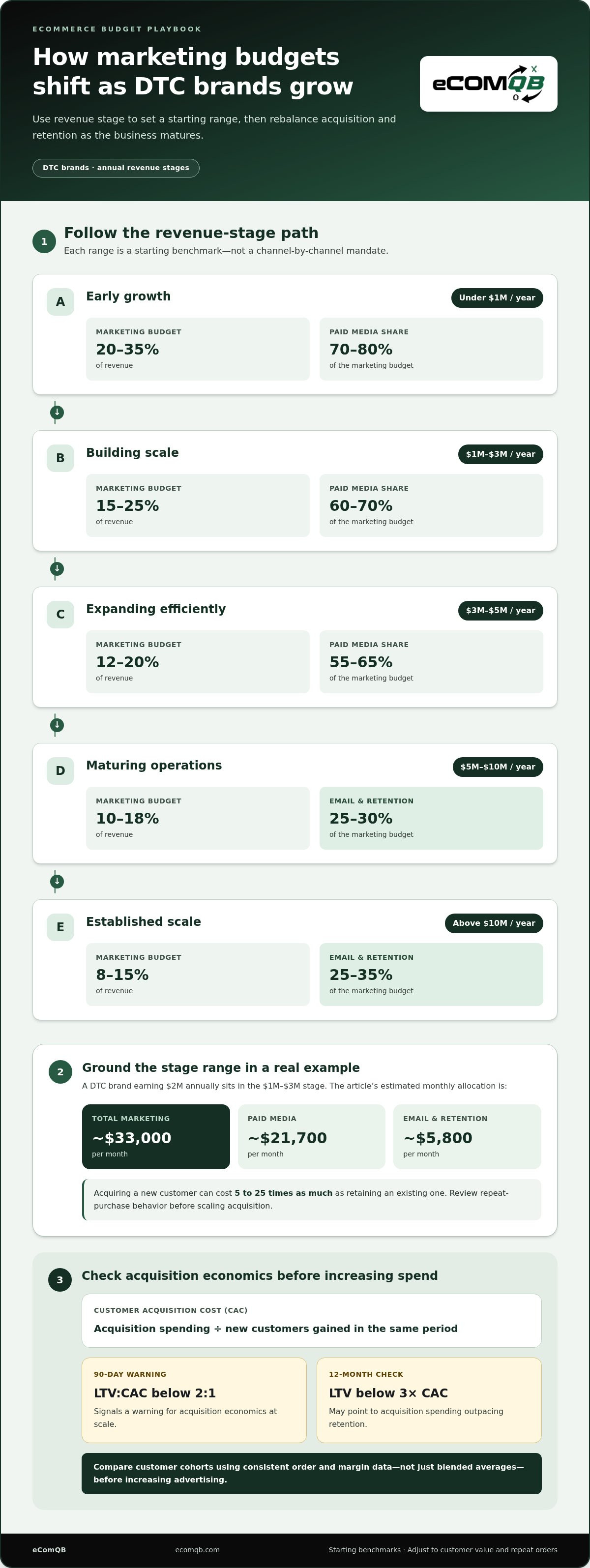
Revenue stage changes the balance between acquisition and retention. DTC brands under $1 million in annual revenue typically spend 20–35% of revenue on marketing. At $1 million–$3 million, the typical range is 15–25%; at $3 million–$5 million, it’s 12–20%. Brands earning $5 million–$10 million typically spend 10–18%, while those above $10 million spend 8–15%. These stage benchmarks help establish a starting point, not a channel-by-channel mandate.
Paid media’s share usually declines as brands mature. Brands under $1 million allocate 70–80% of marketing budgets to paid media. The share is 60–70% at $1 million–$3 million, then 55–65% at $3 million–$5 million. At $5 million–$10 million, email and retention receive 25–30% of the marketing budget; above $10 million, they receive 25–35%. Adjust the mix as repeat orders and customer value grow.
Calculate customer acquisition cost (CAC) by dividing acquisition spending by new customers gained in the same period. Compare that result with customer lifetime value (LTV), using consistent order and margin data. A 90-day LTV:CAC ratio below 2:1 signals a warning for acquisition economics at scale. LTV below 3× CAC over 12 months may point to acquisition spending outpacing retention. Check cohorts, not just blended averages, before increasing advertising.
For a concrete reference, a DTC brand earning $2 million annually has an estimated marketing budget of about $33,000 per month. That estimate includes about $21,700 for paid media and $5,800 for email and retention. Acquiring a new customer can cost five to 25 times as much as retaining an existing one, so don’t scale acquisition without examining repeat-purchase behavior. Set channel targets, compare CAC with LTV, then adjust the allocation as cohort performance develops. Strong budget decisions connect new-customer growth with the revenue existing customers generate over time.
4. Ecommerce marketing and advertising budgets
Separate the full marketing budget from advertising spend. Marketing can include content, email, creators, technology, and paid campaigns. A 2026 benchmark places marketing at 7.7% of revenue, while stage-based plans may call for more. Treat any industry benchmark as a reference point, then build a strategy around margin, growth targets, and conversion economics. The key distinction: advertising is one investment line, not the whole plan.
A sample eCommerce and DTC allocation can distribute the marketing budget across content and SEO, email, paid social, video, marketing technology and AI tools, and influencer marketing. These percentages total 82%, leaving room for other channel needs and campaign costs. Use this as a channel map, not a fixed formula. Product category, creative capacity, and customer behavior should shape the final mix.
Next, split platform spend by business stage. Brands under $1 million in annual revenue allocate 70–80% of their marketing budget to paid media; those earning $1 million–$3 million allocate 60–70%. For a mid-stage eCommerce brand, paid advertising may take 40–50% of the marketing budget. Reserve the remaining allocation for retention, content, measurement, and channel development. This prevents every new dollar from defaulting to ads.
Track spend against outcomes beyond platform-reported return. Compare campaign cost with attributable revenue, conversion rate, customer quality, and repeat purchases. Review the budget monthly and reallocate quarterly, unless a channel’s CAC changes by 25% or more over 30 days. Make each adjustment deliberate, with a clear reason and measurement window. This keeps analysis tied to business results, not dashboard swings. If your advertising mix needs a sharper performance strategy, plan your next budget move.
EComQB: Revenue Generating AI Tools
eComQB helps eCommerce brands connect marketing investment with execution through Revenue Generating AI Tools and AI transformation. When channel performance is difficult to manage or media buying needs a more integrated approach, Agentic Media Buying and Meta Advertising Execution can support a clearer operating strategy. These services are relevant when you’re ready to improve how campaigns are planned and managed, not simply increase spend. Start with your current channel mix, business objectives, and performance data to identify where technology and execution can address friction in your growth system. To discuss your eCommerce marketing priorities, book a free consultation with eComQB.
Turn Your Marketing Plan Into a Growth System
The next step is operational: decide how your team will turn budget decisions into consistent execution. Assign ownership for channel choices, performance signals, and the conditions that trigger a change. This discipline keeps budget allocation for eCommerce marketing tied to business priorities as customer behavior and opportunities shift.
When your system needs stronger execution, eComQB brings together Revenue Generating AI Tools, AI transformation for eCommerce Brands, and Agentic Media Buying. These services connect technology and media execution to the strategy behind your investment. Start by defining the challenge you want to solve, such as improving campaign management or making better use of performance data. A clear objective gives the conversation focus.
Discuss your eCommerce marketing budget with eComQB and identify a practical next step. Build the system, sharpen the decisions, and keep moving toward sustainable growth.
Frequently Asked Questions
What's a Realistic Ecommerce Marketing Budget by Revenue Stage?
It depends on revenue, growth goals, and the balance between paid acquisition and retention. As additional reference points, a DTC brand earning $4 million annually is estimated to spend about $53,000 per month on marketing, while a brand earning $7.5 million is estimated at about $87,500 per month. These examples show how budgets can differ even within established revenue stages; use your own margins and channel performance to set priorities.
How much should I budget for creative production?
Plan creative production as a defined share of paid media spending: a recommended starting range is 10–15%. This covers the creative investment associated with advertising, rather than the entire marketing budget. For example, estimate your paid media allocation first, then reserve a portion for producing and refining campaign assets. Track creative performance against conversion and acquisition outcomes so your next production decisions reflect what audiences respond to.
How much should an eCommerce brand spend on marketing as a percentage of revenue?
A useful general benchmark is 7–12% of revenue, but the appropriate share depends on your growth target and business stage. A brand prioritizing customer acquisition may need a different plan from one focused on repeat purchases. Calculate the percentage using projected revenue, then check whether the resulting budget supports your goals without undermining profitability. Review the allocation as revenue and margins change.
How should you split your eCommerce marketing budget across channels?
Allocate funds according to the job each channel needs to do, rather than dividing the budget evenly. For example, a store with reliable organic traffic but weak repeat purchases could prioritize lifecycle messaging, while a brand with low awareness may need more acquisition activity. Give each channel a measurable objective, then assess its contribution through revenue, conversion, and customer quality. Shift investment when the evidence points to a better opportunity.
Why is a marketing budget essential for businesses?
A budget turns growth goals into spending limits, priorities, and accountability. Without one, a team might fund a new campaign while overlooking the creative, technology, or retention work needed to make it effective. Connect each investment to an objective, such as acquiring new customers or improving repeat purchases. This gives decision-makers a shared basis for evaluating results and adjusting commitments.
How do I know if I'm overspending on paid acquisition?
Paid acquisition may be consuming too much of the budget if customer acquisition costs rise while order value, repeat purchases, and contribution margins fail to keep pace. Compare results by campaign and customer cohort, not just the platform’s headline return. Check whether newly acquired customers make another purchase. If acquisition is weakening overall economics, pause expansion, identify the cause, and redirect investment toward the strongest opportunities.