First-Party Data Strategy for eCommerce That Builds Trust
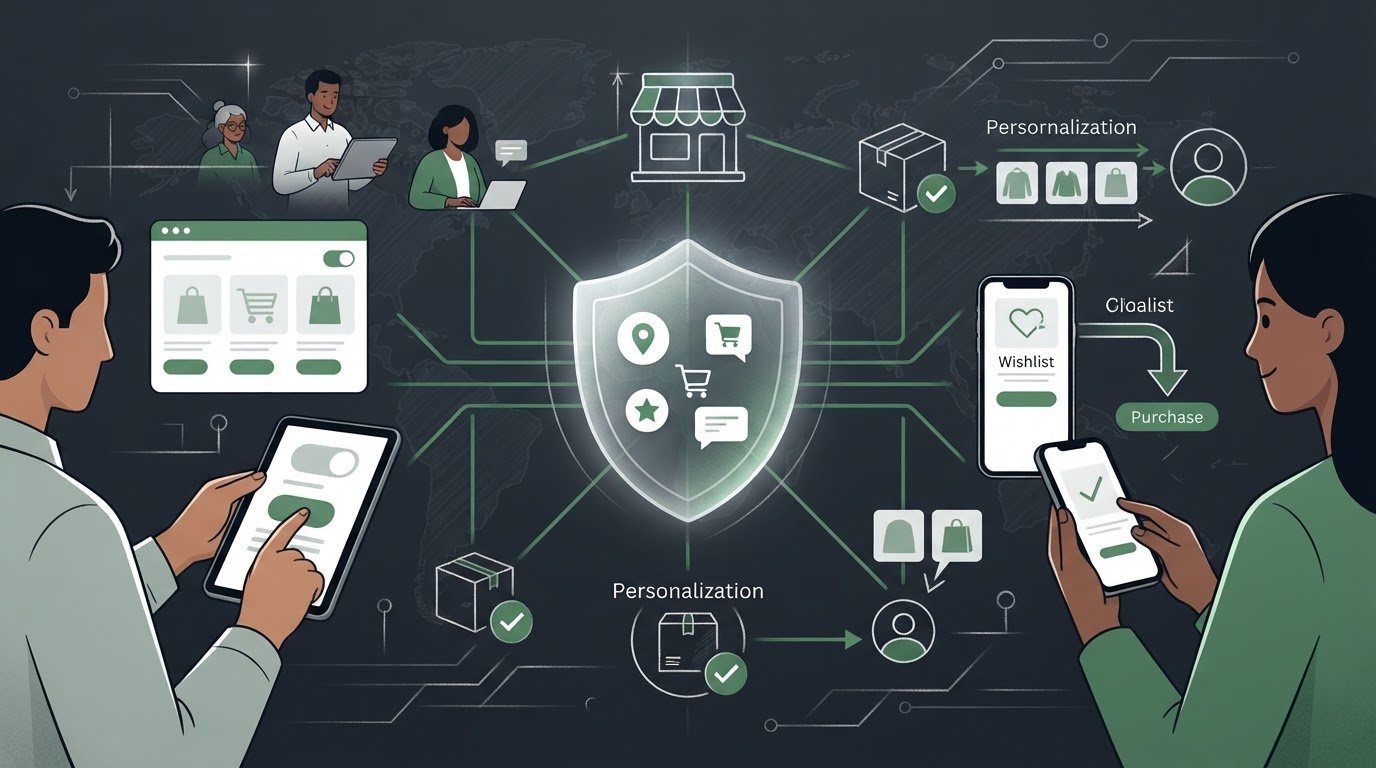
More customer data doesn’t automatically create more trust. A strong first-party data strategy for eCommerce collects information directly from customers with clear permission, makes data-driven experiences accessible, and prioritizes risks according to their potential impact. The goal isn’t to gather everything. It’s to use customer information purposefully and responsibly.
Customers value relevant experiences, but they also want clarity and control over how their information is used. Balancing those expectations takes more than a privacy notice or personalization tool. It requires an intentional approach that connects the value customers receive with the data a brand chooses to collect and use.
This article explains how consent-based collection works, how to make data experiences more accessible, and how to assess risks based on their potential impact on customers. It also shows how these choices shape personalization and growth, helping you build a strategy that earns trust and supports smarter eCommerce decisions.
Key Takeaways
- Collect information through clear, value-led customer interactions, and make the purpose of each request easy to understand.
- Shape privacy practices around the laws that apply to your customers and the choices those laws give them.
- Connect customer records across channels with consistent identifiers and careful data governance, so teams can act on a more coherent view.
- Choose tools based on your use cases, integration needs, and risk priorities, then weigh their costs against the work they can support.
How can eCommerce brands collect first-party data with customer consent?
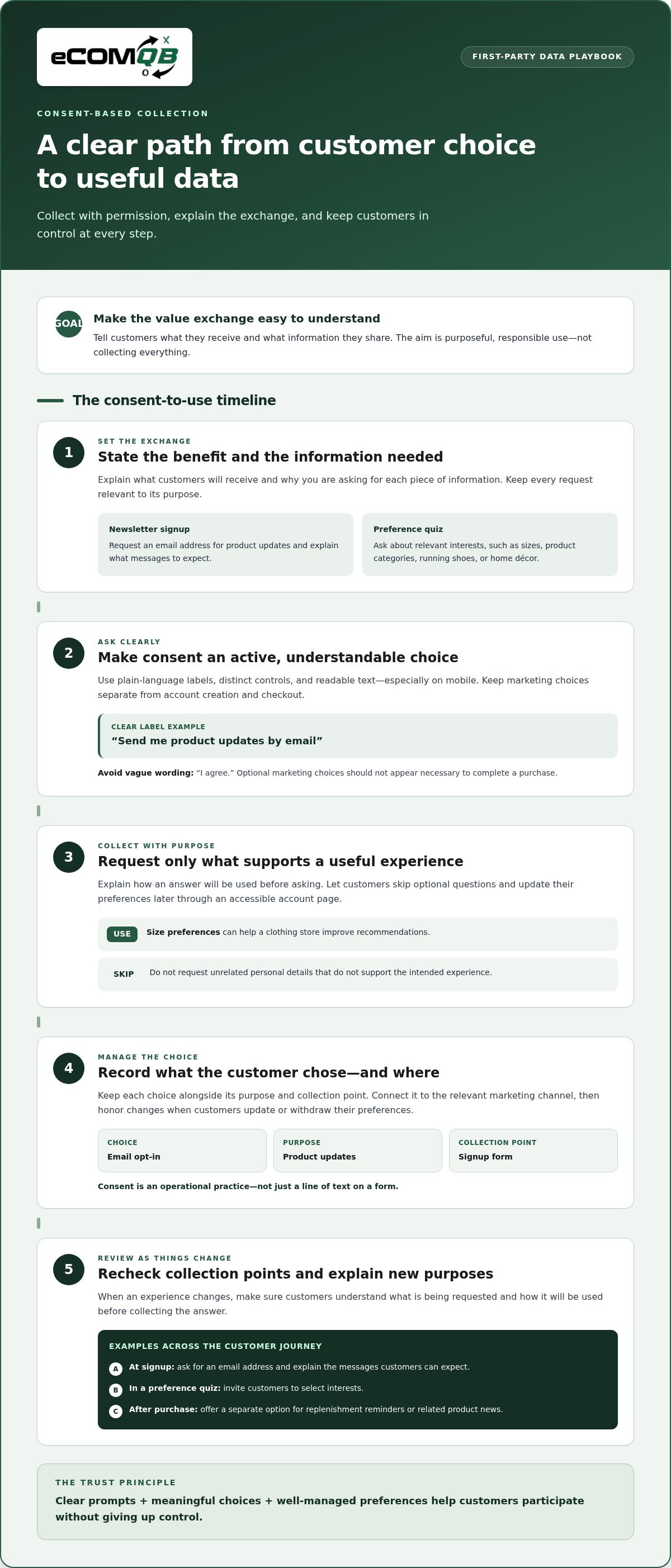
Start with a clear exchange: explain what customers receive and what information they share. A newsletter form can request an email address for product updates. A preference quiz can ask about sizes, product categories, or shopping interests. Keep each request relevant to its purpose, and don’t make optional marketing choices seem necessary to complete a purchase.
Make consent an active, understandable choice. Use plain-language labels such as “Send me product updates by email,” rather than vague terms like “I agree.” Keep marketing choices separate from account creation and checkout. For example, a customer buying skincare should be able to complete an order without subscribing to promotional messages. On mobile, make the choice clear with readable text and distinct controls.
- At signup: Ask for an email address and explain the messages customers can expect.
- In a preference quiz: Invite customers to select interests, such as running shoes or home décor.
- After purchase: Offer a separate option to receive replenishment reminders or related product news.
Collect only information that supports a useful customer experience. A clothing store might use size preferences to improve recommendations, but not need unrelated personal details. Explain how each answer will be used before requesting it. Let customers skip optional questions and update their preferences later through an accessible account page.
Record each customer’s choice alongside its purpose and collection point. For example, note whether someone opted into email during signup or selected product interests in a quiz. Connect the record to the relevant marketing channel, then honor changes when customers update or withdraw their preferences. This makes consent an operational practice, not just a line of text on a form.
Review collection points whenever the experience changes. If a quiz starts asking about a new interest, explain that purpose before collecting the answer. Clear prompts, meaningful choices, and well-managed preferences help a first-party data strategy for eCommerce earn participation without asking customers to give up control.
How do U.S. privacy laws affect first-party data collection and use?
U.S. privacy obligations can vary by jurisdiction, so one consent flow should not be treated as a universal legal solution. A California shopper and a Texas shopper may be covered by different state rules, depending on the business and data involved. For each customer journey, map the states served, the information collected, and its planned use. This gives legal and marketing teams a shared starting point.
Next, connect every data field to a clear purpose. An email address used for order updates serves a different function from one used for promotional messages. A preference form asking about product interests should explain how the answers shape recommendations. Separate these purposes in your notices and preference controls. This helps align customer expectations with the experience and assess which rules apply.
Use a practical review before launching a new collection or campaign:
- Map the flow: Record where information enters, which teams or vendors receive it, and how it supports the customer experience.
- Review customer choices: Make it straightforward to update preferences and submit requests involving personal information.
- Check campaign use: Confirm that an audience built from purchase history matches the purpose explained to customers.
Keep the review current as your store changes. Adding a quiz, loyalty feature, or advertising audience can create a new use for existing information. Document each flow’s purpose, access, retention approach, and customer controls. Include vendor relationships when a vendor processes customer data. A new tool shouldn’t quietly expand how information is used.
For a first-party data strategy for eCommerce, make privacy review part of campaign planning, not a final approval gate. Legal specialists can assess which requirements apply to the business and its data practices. Marketing teams can then build notices, choices, and audience rules around that assessment. The result is a clearer way to collect and use customer information across U.S. markets.
How can eCommerce businesses unify customer data across channels?
Unification starts with a shared customer record, not a larger pile of disconnected profiles. An online order, an email click, and a support conversation may all relate to the same shopper. A commerce platform, customer data platform, or warehouse can organize those events consistently. The right setup depends on your systems and the decisions your teams need to make.
Set identity rules before connecting channels. Use a customer account ID when someone is signed in, and treat an email address as an identifier only when it’s collected and handled appropriately. For example, a signed-in shopper might browse a product on a phone, then buy it later on a laptop. A consistent ID can associate those events without treating each device as a different person.
Next, align event names and fields across platforms. If the storefront records “purchase” while email software records “order completed,” define how both map to one shared event. Standardize fields such as product ID, order status, and timestamp. This helps analytics teams compare browsing, checkout, purchase, and support activity.
- Connect sources: Map storefront, email, customer service, and point-of-sale records to the systems that use them.
- Resolve duplicates: Set rules for merging profiles, and avoid joining records based only on a weak match.
- Preserve permissions: Carry channel preferences and consent status with each usable profile.
Test the unified view against a real customer journey. Follow a product view on the storefront through an email interaction and completed order. Check that the profile shows the right events, avoids duplicate purchases, and respects communication preferences. If an anonymous visit can’t be reliably linked to a person, keep it separate rather than forcing a match.
Finally, assign responsibility for data quality. Marketing can define audience needs, while analytics and engineering maintain event definitions and identity logic. Review integrations before activation so a social campaign or support tool doesn’t introduce conflicting fields. A reliable unified profile makes segmentation, measurement, and personalization more coherent across channels.
Which tools and platforms support eCommerce first-party data strategies, and what do they cost
A practical stack connects collection, storage, analysis, and activation. Shopify or another commerce platform records orders and customer accounts. Email and SMS platforms manage permitted campaigns. Analytics tools measure events, while a customer data platform or warehouse can organize records across systems. Each layer should support a defined business use rather than add complexity without purpose.
Choose tools based on the decisions your team needs to make. A smaller store may use its commerce platform, email software, and analytics tool to manage core customer journeys. A business with multiple storefronts or complex channel data may need a customer data platform to combine profiles and make audiences available to marketing systems. For omnichannel brands looking to capture unified in-person transaction data, comparison resources such as PaySelect help teams evaluate compatible POS setups. Consent management tools can help record preferences and share them with connected platforms.
- Collection: Use storefront forms, preference tools, and account features to capture relevant customer inputs.
- Organization: Use a CRM, customer data platform, or warehouse to structure records and resolve duplicates.
- Activation: Connect approved audiences to email, SMS, personalization, or advertising platforms.
Assess total cost, not just the software subscription. Pricing models may depend on contacts, event volume, features, integrations, and support. Implementation also requires internal time for data mapping, testing, and maintenance. For example, a platform that needs custom connections can add operational work beyond its license cost. Compare that effort with the specific marketing or analytics task the tool supports.
Build a shortlist around your current systems, required integrations, data quality, and team capacity. Test one use case, such as sending a relevant post-purchase message based on an order. Confirm that data moves correctly and respects communication preferences before expanding the setup. This keeps investment tied to practical value rather than feature count.
If your stack needs a sharper operating plan, map your eCommerce data and growth priorities with a strategist.
EComQB: Revenue Generating AI Tools
eComQB helps eCommerce brands turn growth priorities into practical AI and marketing execution. Its Revenue Generating AI Tools and AI transformation for eCommerce Brands can help teams connect customer insight with their broader growth strategy. For brands focused on paid acquisition, Agentic Media Buying and Meta Advertising Execution support stronger campaign operations.
Turn to eComQB when your data foundation is in place and your team needs a sharper plan for applying it across growth activities. The next step depends on your goals, systems, and marketing priorities. Visit ecomqb.com to start a conversation with eComQB.
Put customer insight to work
A first-party data strategy for eCommerce creates the most value when it informs a clear business decision. Choose a priority, such as improving product discovery or making campaigns more relevant. Define who owns the initiative, how customer preferences guide it, and which outcomes will show whether it’s working. Then build on what your team learns.
eComQB can connect that next step to Revenue Generating AI Tools, AI transformation for eCommerce Brands, or Agentic Media Buying. The right focus depends on where your growth strategy needs stronger execution and how customer insight can support it. Keep the ambition high and the operating plan focused.
Contact eComQB to discuss your strategy and choose a practical next step. Build with purpose, earn customer trust, and move forward with confidence.
Frequently Asked Questions
What is a first-party data strategy for eCommerce?
A first-party data strategy for eCommerce governs the customer information a brand collects through its own interactions. It connects business goals with decisions about which data is useful, who can access it, and how teams may use it. For example, a retailer could use product-return reasons to improve sizing guidance instead of collecting extra details without a defined purpose.
What first-party data should eCommerce businesses collect?
Collect information that improves a specific customer or business decision. Useful categories may include order and return history, product reviews, customer-service topics, loyalty activity, and product preferences. A home goods retailer might analyze common return reasons to clarify product dimensions. Don’t treat every available field as valuable. Prioritize data that answers a real question and can be handled responsibly.
What are the steps to build a first-party data strategy for eCommerce?
Start with a business objective, such as reducing avoidable returns or improving repeat purchases. Identify the customer signals that could inform that decision, then assign owners for access, quality, and use. Pilot the approach in one focused journey, such as post-purchase support. Before expanding to other channels, assess whether the data informs a decision or improves the experience.
What are the risks and common mistakes in first-party data collection and storage?
Common risks include collecting information without a clear purpose, keeping outdated records, granting broad access, and joining profiles incorrectly. A mistaken identity match could expose one shopper’s order details to another. Prioritize risks according to potential customer harm, then limit access, remove data that no longer serves its purpose, and test profile matching before using it for personalization or marketing.
How should eCommerce businesses measure first-party data strategy ROI?
Use analytics tools to measure customer events and assess whether the resulting data supports useful decisions, such as segmentation and personalization. Compare the tools’ total costs with the work they enable.