
A strong content strategy for luxury eCommerce brands connects social discovery to the shopping journey, helps customers picture ownership, and gives them a reason to stay engaged. The advantage isn’t simply publishing more. It’s creating a consistent rhythm of relevant stories that moves shoppers from interest to consideration.
Luxury customers expect more than polished imagery. They want to understand the product, its place in their lives, and the experience around it. This guide explains how to connect social media with the wider customer journey, make ownership feel tangible, use audience signals to shape ideas, and publish regularly without diluting the brand. The result is a deliberate content playbook that is distinctive, useful, and designed to turn attention into action.
Key Takeaways
- Connect social storytelling with product pages and other shopping touchpoints so each interaction gives customers a clear next step.
- Make ownership tangible with content that shows how products fit into customers’ lives and the experiences around them.
- Use audience behavior and competitor content as research signals to identify fresh, relevant story angles.
- Build a consistent publishing rhythm, then consider eComQB’s AI transformation for eCommerce Brands when you need strategic support aligning content with growth systems.
1. Social media as one touchpoint in an integrated customer journey
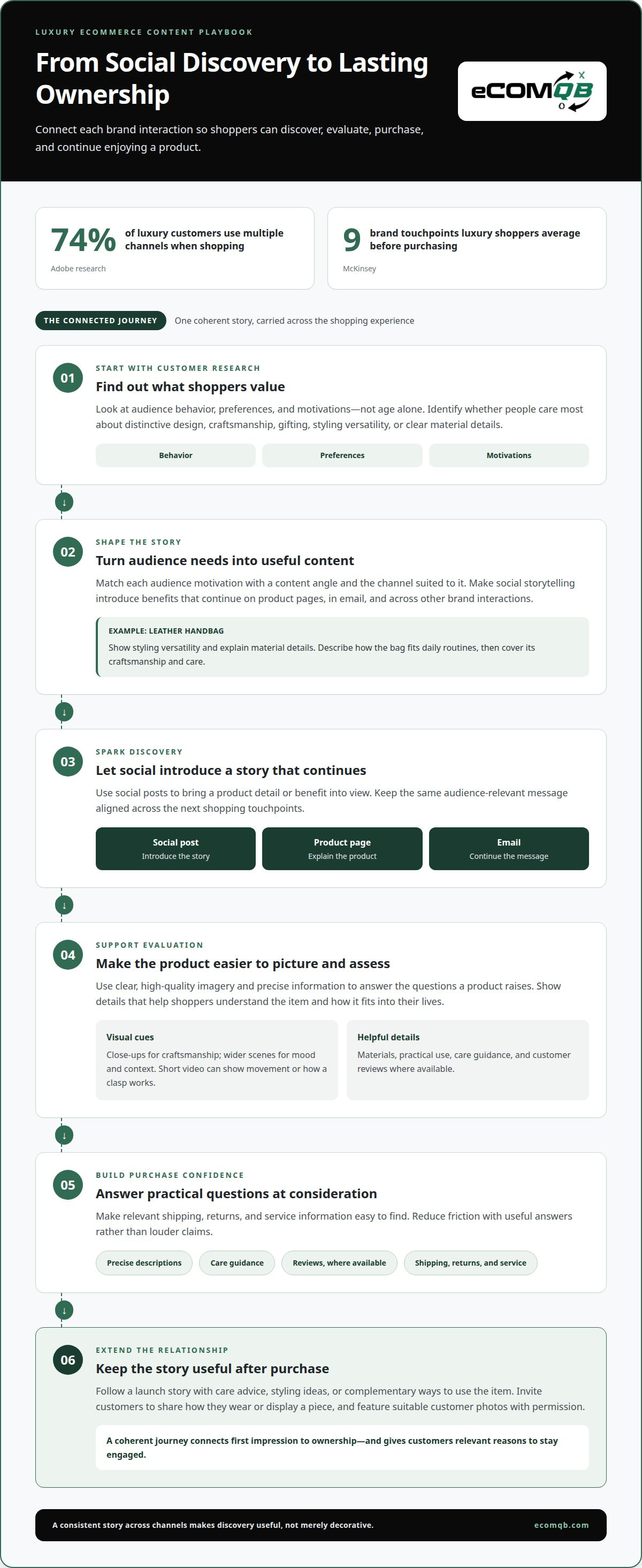
A content strategy for luxury eCommerce brands links social discovery, product evaluation, and purchase. Adobe research found that 74% of luxury customers use multiple channels when shopping. McKinsey reports luxury shoppers average nine brand touchpoints before purchasing. Social media should therefore introduce a story that continues across product pages, email, and other brand interactions.
Start with customer research, then turn what shoppers value into product descriptions focused on outcomes. For a leather handbag, research might show that customers care about styling versatility and clear material details. Explain how the bag fits into daily routines, then describe its craftsmanship and care. Keep social posts, product pages, and emails aligned around the same benefits. Consistency makes discovery useful, not merely decorative.
Build buyer personas around audience behavior, preferences, and motivations, not age alone. One luxury customer may seek a distinctive design; another may prioritize craftsmanship or gifting. Match each persona to a content angle and channel. A styling carousel can support visual discovery, while a detailed product page can answer questions during evaluation. Track which themes resonate through saves, replies, and product-page engagement.
High-value purchases call for clear, confidence-building information at the point of consideration. Use close-up imagery, precise descriptions, care guidance, and customer reviews where available. A social post can highlight a detail, while the product page explains materials and practical use. Make shipping, returns, and service information easy to find when relevant. Reduce friction with useful answers, not louder claims.
Content marketing can build loyalty after the first purchase, too. Follow a launch story with care advice, styling ideas, or complementary ways to use the item. Invite customers to share how they wear or display a piece, then feature suitable customer photos with permission. This sustains a relationship around the product and the brand’s values. A successful journey feels coherent across channels, from first impression to ownership.
2. Helping shoppers visualize product ownership and experiences
Luxury content should make a product feel present before it arrives. Show a silk scarf in motion with an outfit, a watch beside its packaging, or a candle styled in a living space. These visual cues help shoppers imagine ownership rather than simply inspect an object. Build each asset around a clear use case, then adapt its framing to the platform.
Use high-quality product imagery to show texture, scale, finish, and detail. Short videos can capture movement or demonstrate how a clasp works, while augmented reality can help shoppers preview an item in their surroundings. Choose formats based on the questions each product raises. A close-up can explain craftsmanship; a wider scene can convey mood and context.
Emotion-led descriptions connect visuals to a meaningful experience. Pair precise details with sensory language: describe how a cashmere wrap feels against the skin, then state its material and care information. Make the emotional story specific to the object and its values. Avoid abstract claims that could describe any product.
Production tools often include a camera, lighting, styling props, editing software, and, where useful, augmented-reality technology. Budgets depend on asset volume, production complexity, locations, talent, usage rights, and post-production. Prioritize the products and formats that need the clearest visual explanation, then plan reusable assets for product pages, social media, and email.
A social mindset means creating communication people want to share, save, or discuss. Product drops and brand collaborations can add access and participation to the story. One available drop format limits access to 24 hours, while 45% of consumers are interested in drops because they value access to hard-to-obtain products. Make timing and participation clear, and give the collaboration a story beyond scarcity.
To align the visual concept, production plan, and customer journey, discuss your content strategy.
3. Competitor and audience research for content ideas
Begin with a focused review of designer and fashion brands competing for the same audience. Compare their product stories, social formats, landing pages, and campaign themes, then identify questions their content leaves unanswered. Gen Z and Millennials account for almost half of luxury purchases, so research should examine what younger shoppers value without assuming every customer shares their preferences. Gucci, for example, makes over 55% of its sales from shoppers under 35.
Build audience segments around observable behavior, preferences, and purchase interests. Distinguish customers researching craftsmanship from those drawn to styling inspiration or limited releases. Match each segment with content that meets its needs, such as a material explainer, outfit guide, or launch preview. Track engagement and product interactions by channel to see which ideas resonate and where the journey stalls.
Facebook advertising can test creative themes with defined audiences. Develop distinct versions for interests such as designer accessories or contemporary fashion, and compare their response using the same campaign objective. Use the results to refine messaging and targeting, not to assume one successful ad represents the whole market. Keep the brand voice and product details consistent across variations.
For US audiences and regional markets, localize examples, seasonal references, terminology, and product context to suit each audience. Preserve the brand’s core identity while adapting details that make a story relevant, such as styling inspiration suited to local climates or occasions.
AI can personalize eCommerce content by matching product recommendations, page modules, or email messages to customer preferences and behavior. Use audience segments and interaction signals to guide variations, while keeping product claims and brand language consistent. Test one content element at a time, such as a recommendation or headline, and assess whether it improves relevance. Treat the results as input for the next creative decision, not a substitute for customer insight.
4. Regular content publishing for luxury brands
Luxury brands once communicated sparingly, a pattern contrasted here with the pace fifteen years earlier. Today, regular publishing helps a brand stay present between launches without turning every post into a sales pitch. Build a calendar around product stories, craft, care, customer experiences, and campaigns. Give each format a clear role, and ensure every message reflects the same brand standards.
Before engaging with a brand, 44% of consumers view three to five pieces of its content. That makes consistency a sequence, not a single standout campaign. Plan connected posts that move from discovery to product education, then to a useful next step. Search-friendly product and category pages can answer specific customer needs while preserving a refined voice. Use precise titles, clear descriptions, and language customers themselves would recognize.
Protect prestige by optimizing for relevance, not keyword repetition. Use natural search terms in headings and descriptions, while keeping the writing specific to the product’s design, materials, and intended experience. A designer handbag page, for example, can explain construction and styling without reducing its story to generic sales copy.
Measure performance with a balanced KPI set: organic visibility, qualified traffic, engagement, product-page visits, email sign-ups, and conversions. Compare results by content format and campaign objective, then use the patterns to shape the next publishing cycle. Traffic alone won’t show whether a story reaches the right audience or moves shoppers toward meaningful action.
Common mistakes include inconsistent publishing, unsupported product claims, and urgency that doesn’t match the offer. Careless cultural references or imagery can also undermine trust. Set editorial review steps for accuracy, tone, and context before publication, especially for collaborations and launch campaigns.
Turn those standards into a repeatable publishing system with a focused content strategy session.
EComQB: AI transformation for eCommerce Brands
eComQB helps luxury eCommerce brands connect growth strategy with technology and marketing execution. Turn to eComQB when your content plan needs closer alignment with paid media or when AI transformation is part of your growth priorities.
Revenue Generating AI Tools and AI transformation for eCommerce Brands support a more connected approach to growth. Agentic Media Buying and Meta Advertising Execution bring paid social into the wider strategy, helping campaigns carry consistent messaging from discovery to consideration. Start by defining the business objective, audience, and content signals your team wants to act on, then align execution with those priorities.
Contact eComQB to discuss your eCommerce growth priorities.
Turn your content direction into a growth system
Turn your editorial ambition into a practical decision system. Choose a business priority, define the customer action it should support, and assign clear ownership for planning, production, and review. Then establish a feedback loop: examine what earns meaningful attention, identify where interest fades, and use those signals to sharpen the next round of creative. This keeps your content strategy for luxury eCommerce brands focused on customer value and commercial direction, not output for its own sake.
That discipline also gives your team a stronger basis for investing in the right capabilities. eComQB can help connect strategic priorities with AI-powered growth initiatives and media execution. If you’re ready to map the next phase, contact eComQB to discuss your content. Bring your goals and current challenges; together, you can define a focused path forward. Build with intent, learn from every signal, and keep moving.
Frequently Asked Questions
What are the core elements of a content strategy for luxury eCommerce brands?
A content strategy for luxury eCommerce brands needs a defined commercial objective, clear audience priorities, and consistent editorial standards. Add a decision framework that assigns ownership for briefs, approvals, and updates. For example, a product launch brief can specify its audience, key message, required assets, publishing channels, and success measure. This structure connects creative decisions to business priorities without making every story feel like an advertisement.
How do luxury brands balance exclusivity and accessibility in online content?
Make the brand’s point of view and product knowledge accessible, while offering select experiences for customers who value deeper engagement. A public article might explain a designer’s creative inspiration, while a subscriber email offers an early look at a new release. Keep both experiences consistent in tone and detail. Exclusivity feels more credible when it comes from meaningful access, not vague claims or manufactured barriers.
Which content formats drive engagement and sales for luxury shoppers?
Choose formats according to the decision they need to support. A comparison guide can help shoppers distinguish materials or product versions, while a designer interview can add context to a collection. A concise email can bring a returning customer back to an item they explored. Assess each format by its role in the journey, then compare qualified product visits, saves, replies, and purchases.
How should luxury eCommerce brands define audience segments and buyer personas?
Build segments around meaningful differences in customer intent, relationship, and product interest. One persona might describe a first-time visitor researching a designer’s signature, while another represents a returning customer exploring a new category. Record each group’s needs, likely questions, preferred content, and next useful action. Treat these profiles as working tools and update them as customer behavior changes, rather than fixing them as character descriptions.
What are best practices for luxury product photography, video, and storytelling?
Plan a visual sequence that answers distinct shopper questions. For a handbag, show its silhouette, interior organization, hardware, and scale alongside a person carrying it. Keep lighting, color treatment, and composition aligned with the brand’s visual identity. Pair the imagery with specific stories about design choices or provenance, and secure usage permissions for any people, settings, or customer-created content.
How can luxury eCommerce brands plan an editorial calendar across channels?
Start with the business calendar, then assign each campaign a lead story, supporting assets, channel owner, and approval milestone. For a seasonal collection, coordinate a landing page, social posts, and customer email around one message, adapting each to its format. Add production deadlines and review checkpoints, while leaving room for timely brand news. A shared calendar helps teams see dependencies before publishing begins.