Cross-Channel Marketing Strategy for eCommerce: A Practical 2026 Playbook

More channels won’t fix a disconnected customer journey. A cross-channel marketing strategy for eCommerce works when every touchpoint responds to customer signals and supports a shared commercial goal. Simply adding another campaign to the calendar is not a strategy.
When advertising, email, SMS, and storefront teams work from separate data, customers can receive repeated messages while important intent goes unnoticed. If attribution doesn’t clarify how channels contribute, it’s also difficult to decide what to scale. The answer is better coordination, not more activity.
This practical 2026 playbook shows you how to assign each channel a clear role, connect journeys around customer behavior, and measure outcomes that matter. You’ll see how advertising, lifecycle messaging, personalization, and storefront experiences can work as one system, with AI supporting execution rather than replacing strategy or sound data. Then you’ll map a manageable starting point and use testing to improve it. Build the system, track the signals, and make your next move based on evidence.
Key Takeaways
- Distinguish cross-channel marketing from multichannel and omnichannel by how customer context connects the journey.
- Build a cross-channel marketing strategy for eCommerce around one measurable customer journey, linking a business goal to a customer signal, channel action, and outcome.
- Compare channels by customer fit, journey role, data readiness, execution effort, and measurement clarity, rather than by a universal ranking.
- Launch one journey, establish a baseline, and track delivery, journey progression, and commercial outcomes before expanding.
- Align advertising, lifecycle messaging, personalization, and storefront experiences so each supports the same customer intent.
What a Cross-Channel Marketing Strategy Means for eCommerce Growth
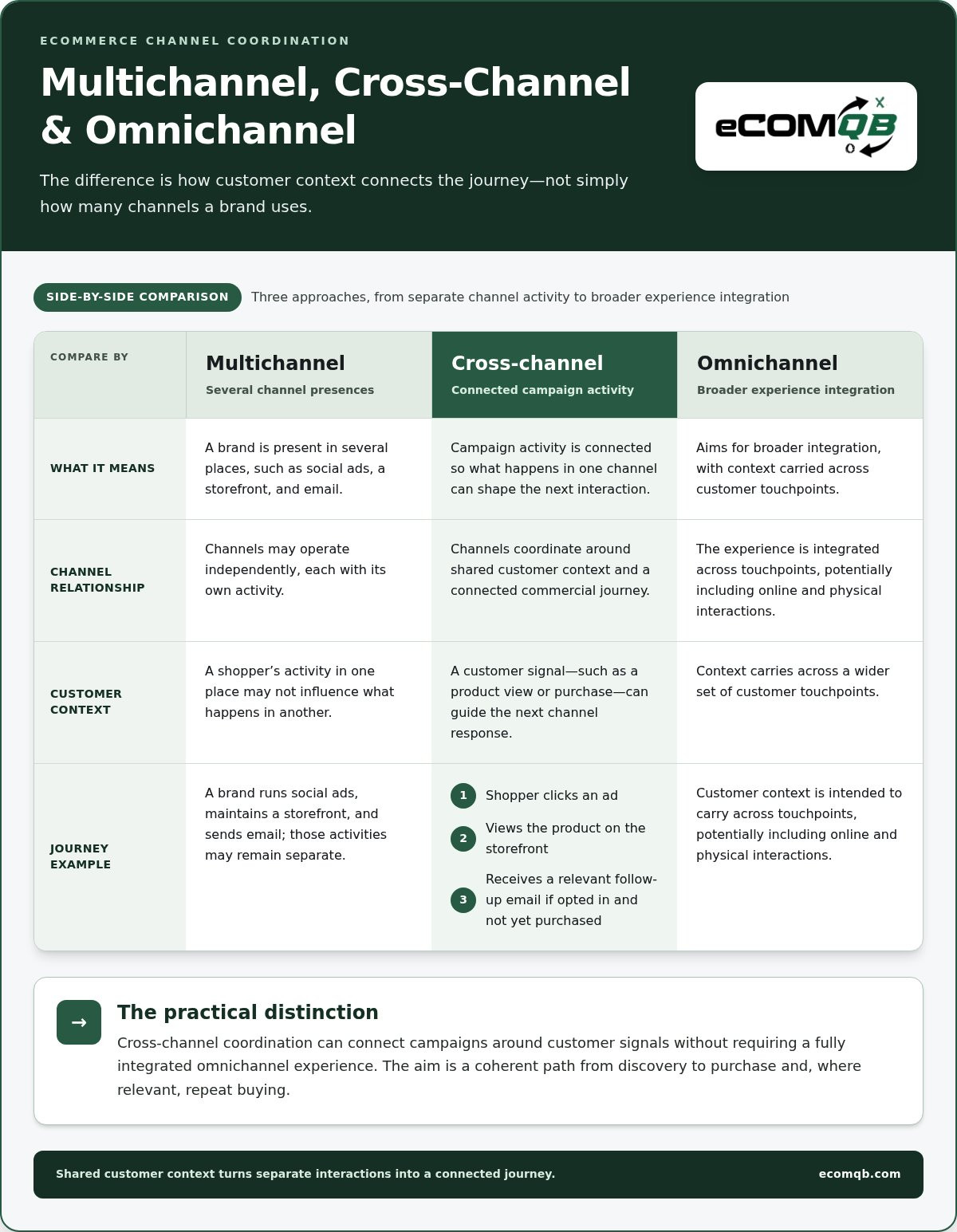
A cross-channel marketing strategy coordinates channels around shared customer context and a connected commercial journey. Instead of treating paid media, the storefront, email, and SMS as separate destinations, it uses a shopper’s actions in one place to shape what happens next. The goal is a coherent path from discovery to purchase and, where relevant, repeat buying.
For eCommerce, cross-channel marketing connects customer signals across channels so each interaction advances the same shopping journey.
Cross-channel versus multichannel and omnichannel marketing
These terms describe different levels of coordination. Multichannel means a brand is present in several places: it runs social ads, has a storefront, and sends email, but each channel may operate independently. Cross-channel connects campaign activity. A shopper might click an ad, view the product on the storefront, then receive a relevant follow-up email if they’ve opted in and haven’t purchased. Omnichannel aims for broader experience integration, so context carries across customer touchpoints, potentially including online and physical interactions. A brand can benefit from cross-channel coordination without building a fully integrated omnichannel experience.
Why disconnected customer journeys underperform
Disconnection shows up in moments customers notice. Someone buys an item but continues seeing ads for the same product. A shopper browses a category and receives a generic follow-up that ignores what they viewed. Different campaigns describe the same product in conflicting ways. Each message may make sense on its own, but together they create friction and weaken the sense that the brand understands the customer.
The cause is often operational. Advertising, lifecycle messaging, and storefront teams may rely on separate data, own different goals, and follow different campaign calendars. A purchase signal might reach one platform quickly but not another. A product update may appear on the storefront while an older message remains active in an email flow. Without shared rules for using signals and suppressing outdated messages, channel-level optimization can undermine the full journey.
That’s why channel performance can’t be judged only by activity inside each platform. A campaign may earn clicks but send shoppers to an experience that doesn’t match its promise. An email may generate engagement while overlapping with a paid promotion. The strategic question is whether the sequence makes sense to the customer and supports the business objective.
Start by mapping one real journey. Record the signal that begins it, the channel response, and the event that should change or stop the next message. For example, an ad click could lead to a product page, a browse signal could trigger a relevant follow-up, and a completed order should suppress acquisition messaging for that item. This map gives teams a shared operating picture and reveals gaps before you add channels or automation.
How to Build a Cross-Channel Marketing Strategy Around Customer Signals
Build the system around a customer journey, not a platform checklist. A practical cross-channel marketing strategy for eCommerce links a commercial objective to an observable signal, a purposeful channel response, and a measurable next action. Start with one journey, such as browse-to-purchase, then make the campaign rules clear enough for every channel owner to follow.
Map the customer journey before selecting channels
Choose the audience and journey stage first. For a browse-to-purchase journey, the audience might be shoppers who viewed a product but haven’t ordered it. They may need more product information or a relevant reminder; the commercial objective is to support a first purchase. Map what the storefront can record, what advertising and lifecycle teams can use, and where data or ownership gaps could interrupt the handoff.
- 1. Set the objective. Define the commercial outcome, such as completed first orders or repeat purchases. Choose a measure that reflects that outcome instead of relying only on delivery or engagement.
- 2. Name the audience signal. Specify the event that identifies the journey, such as a product view without a purchase. Distinguish customer actions, like browsing or adding to cart, from brand-triggered messages, such as an ad or follow-up email.
- 3. Assign each channel a role. Use the storefront to present relevant product information. Advertising can reinforce discovery or bring an eligible shopper back. Email can provide a useful follow-up, while SMS should have a distinct purpose and respect customer consent. Lifecycle programs, including agentic email marketing, should respond to the journey rather than repeat the same campaign in another format.
Turn a journey map into coordinated campaign rules
Translate the map into operating instructions. Define what starts the workflow, what each message is meant to accomplish, and which event pauses or ends it. A purchase should stop browse reminders for that item. If a customer has already received a relevant message, don’t send the identical offer through another channel simply because teams use separate schedules.
- 4. Set coordination rules. Establish sequence, timing, frequency limits, consent requirements, and suppression logic before launch. If a shopper receives a product follow-up by email, decide whether an ad should reinforce the product, serve a different purpose, or be suppressed.
- 5. Define the next action and measure. Make the desired action explicit, such as returning to a product page or completing an order. Track whether the signal was recognized, whether the intended message was delivered, and whether the journey advanced toward the commercial objective.
Keep the first workflow simple enough to audit. Put the signal, owner, channel action, stop condition, and success measure in one shared campaign brief. If you want help connecting journey design with channel execution, discuss your eCommerce growth strategy.
How to Compare eCommerce Channels and Choose the Right Mix
Choose channels by the job they can do in a specific customer journey, not by popularity or reach alone. A strong cross-channel marketing strategy for eCommerce balances customer fit, operational readiness, and the ability to see whether each touchpoint contributes to progress. Use the comparison below as a working scorecard. Rate each factor for your brand and audience rather than assuming one channel will always outperform another.
Match channel roles to customer intent and journey stage
Meta advertising can introduce products to shoppers who aren’t actively searching, while Google advertising can respond to people expressing relevant intent through a search. Neither role is universal; fit depends on audience behavior, product, and journey stage. The storefront should carry the campaign’s promise through to the product page, while personalization can make that experience more relevant. Email and SMS can support lifecycle moments when the message fits the shopper’s context and permissions.
| Channel | Customer fit | Journey role | Data readiness | Execution effort | Measurement clarity |
|---|---|---|---|---|---|
| Meta advertising | Can you define the audience and discovery need? | Does it introduce or re-engage? | Can you pass useful events and exclusions? | Can you sustain relevant creative? | Can you assess its contribution beyond clicks? |
| Google advertising | Is there active search demand? | Does it capture existing intent? | Are product and conversion signals usable? | Can you maintain campaigns and landing pages? | Can you separate demand capture from influence? |
| Storefront personalization | Does onsite context support relevance? | Can it reduce friction after a click? | Are behavior and product data reliable? | Can teams maintain the experience? | Can you compare outcomes with a baseline? |
| Email and SMS | Are audience permissions and preferences clear? | Can messaging support browse, purchase, or retention? | Are customer events and suppression rules available? | Is there capacity for coordinated content? | Can you connect response to journey outcomes? |
Assess readiness before expanding the channel mix
Before adding a channel, verify that your team can identify the intended audience, pass relevant events, and coordinate exclusions when a customer converts or changes journey stage. Assign owners for creative, message timing, product claims, and reporting. If responsibilities are unclear, more reach can create more overlap instead of a better experience. Keep the channel mix focused until execution is consistent.
Score each channel from low to high against the table’s five criteria, then prioritize the best fit for the journey and your team’s ability to execute. Treat reach as exposure, not proof of incremental contribution: a channel may touch many shoppers without changing what they would have done otherwise. Define the outcome each channel should influence, then review how channels work together using consistent reporting. For a deeper look at coordinating paid acquisition, connect the channel roles to your media buying approach.
How to Launch, Measure, and Improve Your Cross-Channel Strategy
Launch one customer journey before expanding the system. Choose a clear objective, document the current baseline, and track what changes after the coordinated campaign goes live. A disciplined cross-channel marketing strategy for eCommerce separates message delivery from journey progress and business impact, helping teams see where activity works and where a handoff breaks down.
Choose metrics that connect activity to business outcomes
Build a reporting plan with three layers. Delivery indicators show whether campaigns reached their intended audiences: impressions, clicks, message delivery, and spend. Journey indicators show whether shoppers moved forward: product-page visits, cart activity, checkout starts, or movement from a first order toward another purchase. Commercial outcomes show whether the journey supported business goals, using measures such as orders, repeat purchase, and customer value.
Set measurement rules before comparing channels. Use consistent attribution windows, conversion definitions, and reporting assumptions. Otherwise, platform reports may assign credit differently, making comparisons misleading. Treat platform-reported conversions as evidence of attribution, not proof that a campaign caused additional sales.
Attributed revenue is revenue assigned to a channel under a reporting model; incremental revenue is the additional revenue that would not have occurred without the activity. To investigate incremental contribution, compare suitable customer cohorts or use a holdout group where practical. These approaches can help distinguish a channel’s influence from sales that may have happened anyway.
Run a disciplined test-and-learn cycle
Make each test answer one decision. Record the hypothesis, audience, campaign change, success measure, and result that would justify keeping or changing the approach. For example, test whether a relevant post-click experience helps qualified shoppers move from a product page to checkout, while keeping the measurement method consistent.
- Check the journey: Look for friction between the ad, landing page, product details, and follow-up.
- Check coordination: Review message overlap, outdated creative, missed suppression, and timing conflicts between channels.
- Choose the next move: Expand patterns that support the objective, refine unclear results, and retire workflows that add noise without useful outcomes.
Include organic discovery in the same measurement picture. If SEO and content bring shoppers into the journey, track their role alongside paid and lifecycle touchpoints rather than treating them as separate from the commercial path. The aim isn’t to force every interaction into a single credit model. It’s to make channel decisions using shared assumptions and evidence.
Use each review to update campaign rules, reporting, and the next test. If you’re ready to turn scattered channel metrics into a coordinated measurement plan, plan your eCommerce growth strategy.
How eComQB Can Help Operationalize Cross-Channel eCommerce Marketing
A strategy creates value when channel teams can execute against the same priorities. eComQB helps eCommerce brands connect strategy and delivery across Meta and Google advertising, agentic email and SMS, AI personalization, and storefront experiences. Each capability supports a defined customer journey and commercial objective instead of operating as a disconnected activity.
Connect channel execution to one growth operating system
Start with the growth objective, then align the work around it. Advertising can introduce or capture demand. Agentic email and SMS can support relevant lifecycle communication. AI personalization can adapt experiences to customer context, while Shopify development and agentic landing pages can carry campaign intent through the post-click experience. A shopper who responds to a campaign should find a storefront that continues the same conversation, not a mismatched offer or message.
Managed workflows give teams a way to coordinate audiences, campaign timing, handoffs, and measurement. Technology should support the operating model, not dictate it. AI can help execute workflows and personalize experiences, but it can’t replace a clear strategy, reliable customer signals, or agreed measurement. The right tools and channel mix depend on the brand’s goals, data readiness, and ability to execute.
For brands exploring how curated technology and workflows can support coordinated growth, the eCommerce AI Growth System offers a way to connect strategy with execution.
Turn the framework into a focused next move
Bring the plan down to one practical decision. Identify a high-value journey, such as a first purchase or a return visit, then pinpoint where coordination currently breaks down. Does the campaign promise carry through to the landing page? Do lifecycle messages reflect what shoppers have already done? Can the teams see whether the journey is progressing? The answers reveal a useful first move without requiring a full rebuild.
A focused working session can turn those observations into a rollout sequence. Define the priority journey, channel roles, data or ownership dependencies, and measurement approach. Then decide what to launch first and what should wait. This keeps the system grounded in business needs rather than adding technology for its own sake.
If your team is ready to align channel activity around a clear growth priority, discuss your cross-channel marketing priorities with eComQB.
Make Your Next Move Count
Your next advantage won’t come from adding channels by default. It comes from choosing one customer journey, finding where coordination breaks, and improving that handoff with a clear measure of success. A cross-channel marketing strategy for eCommerce gives your team a practical way to turn customer signals into focused action, then build on what the evidence supports.
eComQB pairs strategic consulting with managed eCommerce growth systems, connecting execution across Meta and Google advertising, email and SMS, AI personalization, and Shopify development. Start with your goals, data, and operational priorities. The aim is a growth system your team can act on and refine, not more disconnected campaign activity.
Bring one priority journey and its biggest coordination gap into the conversation. Together, you can clarify where to focus, what needs to connect, and what a practical next step looks like. Book a cross-channel growth strategy call to put your next move in motion.
Start focused. Build with intent. Keep improving.
Frequently Asked Questions
How much should an eCommerce brand invest in each marketing channel?
There’s no fixed allocation that fits every brand. Set investment according to the channel’s role, the audience it can reach, and the evidence you have about its contribution. Start with a controlled budget that lets you assess performance while still supporting essential creative, landing-page, and measurement work. Review results against your margin and business priorities, then shift spend based on what you learn rather than copying another brand’s channel split.
Can a small eCommerce brand use a cross-channel marketing strategy?
Yes. A small brand can coordinate a focused set of touchpoints without building a complex technology stack. For example, connect one acquisition source to a product page and a relevant follow-up for shoppers who have agreed to receive it. Give each touchpoint a distinct purpose, and make sure someone owns the handoffs. A lean cross-channel marketing strategy for eCommerce can start with tools and workflows the team already uses.
Is cross-channel marketing the same as omnichannel marketing?
No. Cross-channel marketing coordinates selected channels around shared campaign or customer context. Omnichannel marketing aims for a more integrated experience across a broader set of touchpoints, which may include online and offline interactions. A brand focused on online sales might coordinate advertising, its storefront, and lifecycle messages without integrating every possible customer interaction. Choose the level of integration that supports your journey and that your team can maintain.
How long does it take to see results from a cross-channel strategy?
Timing depends on the buying cycle, campaign volume, data quality, and how quickly you can gather enough evidence to make a decision. Delivery and engagement signals may appear before you can assess repeat purchasing or longer-term customer value. Set review points that match the journey, and avoid changing several campaign elements at once. That gives you a clearer read on whether the strategy is progressing or needs adjustment.
Do I need a customer data platform to coordinate eCommerce channels?
No, a customer data platform isn’t automatically required. First check whether your current systems can reliably share the signals needed for a specific journey, such as a product view, order, or unsubscribe. A clear event definition, consistent customer identifiers where available, and agreed audience exclusions may be enough to begin. Consider additional infrastructure only when a real coordination gap can’t be solved with your existing setup.
How can I tell whether a cross-channel campaign caused incremental sales?
Compare outcomes with a credible counterfactual: what happened to a similar group that wasn’t exposed to the campaign? Where practical, use a randomized holdout; otherwise, compare carefully selected cohorts and account for meaningful differences between them. Check the sales result alongside audience eligibility, campaign exposure, and other promotions. Platform attribution can help describe credit assignment, but it can’t establish by itself that the campaign created extra sales.