ECommerce AI Readiness Assessment: Engineering the 8-Figure Revenue Machine

While 89% of retailers have adopted AI in some form, only 7% have successfully scaled it to drive 8-figure growth. Most brands aren't building a future; they're just piling expensive software on top of broken foundations. If your customer data is trapped in silos and your team is drowning in manual marketing workflows, you aren't ready for the next era of growth. You're simply leaking revenue through latency and poor integration. A comprehensive eCommerce AI readiness assessment is the only way to determine if your brand will lead the agentic commerce revolution or be left behind by it.
You recognize that the current pace of the digital economy demands more than just incremental improvements. It requires a total architectural overhaul. We'll show you how to audit your systems, eliminate data leaks, and engineer a high-velocity Shopify environment that operates with precision. This is your strategic blueprint for AI transformation. We are moving past basic automation into a world of autonomous execution, reduced operational overhead, and scalable performance. By the end of this guide, you'll have a clear roadmap to turn your tech stack into an 8-figure revenue machine.
Key Takeaways
- Stop settling for "slide deck" consulting. A true eCommerce AI readiness assessment is a tactical system audit designed to prepare your brand for autonomous, high-velocity execution.
- Move beyond static data storage to AI-extractable intelligence. Your infrastructure must prioritize RAG-compatibility and low-latency APIs to support real-time, automated decision-making.
- Identify the revenue-leaking gaps between manual operations and agentic commerce. We'll contrast legacy manual bidding with the power of agentic media buying and zero-latency retention strategies.
- Execute a 10-point technical audit to ensure your Shopify architecture is ready for agentic storefronts. It's about engineering a scalable, integrated machine rather than just adding more software.
- Transition from auditing to action with a managed growth system. Discover how to deploy a curated AI tech stack that eliminates manual overhead and drives aggressive revenue targets.
The 2026 Mandate: Why an eCommerce AI Readiness Assessment is the First Step to 8-Figure Velocity
Leadership in 2026 isn't about following trends; it's about engineering systems that outpace the competition. An eCommerce AI readiness assessment isn't a passive data review. It is a tactical audit of your data integrity, infrastructure agility, and execution capacity. Most brands treat AI as a shiny new tool to bolt onto a rusting frame. This is a strategic error. High-performance brands treat AI as the engine itself. Without a rigorous assessment, you're flying blind. You'll face high operational friction, massive revenue leakage, and crushing latency that your competitors will exploit. The AI transformation for eCommerce brands has become the 2026 industry standard for those aiming for 8-figure velocity.
You don't need a legacy advisor who hands you a 50-page slide deck filled with theoretical buzzwords. You need a field general who understands the mechanics of growth. While the advisor talks about possibilities, the field general engineers systems. They identify where your data is leaking and where your tech stack is lagging. Research shows that 31% of IT budgets are still consumed by maintaining legacy systems. This is a structural anchor. It prevents you from reaching peak performance. Conducting a formal eCommerce AI readiness assessment is the first move in any serious growth playbook. It's the difference between guessing and executing with certainty.
The High Cost of Tech Bloat and Data Silos
Fragmented tools create "SaaS friction" that kills profit margins. When your customer data is trapped in disconnected silos, your AI can't learn, adapt, or execute. This fragmentation forces your team into manual scaling, which inevitably hits a ceiling at low 7-figure plateaus. You can't reach 8-figure velocity with manual workflows. The Revenue Machine is a unified AI ecosystem where data, logic, and execution operate in a single, friction-free loop.
Readiness as a Competitive Weapon
8-figure brands use AI to execute media buying and retention with zero latency. They don't wait for weekly reports; their systems adjust in real-time. The application of Artificial intelligence in marketing has evolved from simple segmentation to autonomous execution. Specialized AI consulting for eCommerce ensures your brand is prepared for this agentic era. Waiting for "the right time" to audit your architecture is a strategic failure. In a high-velocity economy, speed is the only sustainable advantage. You either engineer the machine now or get outpaced by those who did.
The Four Pillars of High-Velocity Readiness: Data, Infrastructure, Strategy, and Execution
A true eCommerce AI readiness assessment evaluates more than your software subscriptions. It dissects the four critical pillars of your operation to ensure they can withstand 8-figure pressure. Clean data is table stakes. Extractable intelligence is the prize. Your infrastructure must be agile, your strategy must be programmable, and your execution must be autonomous. If any pillar is weak, the entire system collapses under the weight of modern digital speed. We don't just look for tools; we look for the systemic capacity to win.
Infrastructure agility requires a Shopify Plus environment that isn't bogged down by legacy middleware. Strategic alignment means your brand goals are translated into automated workflows that don't require human intervention at every turn. Finally, execution capacity is the ability to run agentic media buying and email flows without a single manual bid or send. This is how you move from a reactive business to a proactive growth machine. If you're unsure where your pillars stand, it's time to audit your technical foundation with a tactical partner.
Engineering the Data Layer for Agentic Workflows
Traditional databases often fail 2026 AI models because they lack the structure for Retrieval-Augmented Generation (RAG). Your data must be more than organized; it must be extractable in real-time. This requires structuring product metadata so autonomous agents can discover and source items without friction. To see how specialized PIM and e-commerce platforms handle this complexity, you can learn more about Mon-key and their tailored digital solutions. Unified customer records are the backbone of agentic email marketing, allowing for precision that legacy segmented lists simply cannot match. When your data layer is engineered for speed, your revenue follows.
Infrastructure for Storefront Velocity
Bloated Shopify apps are performance bottlenecks that kill AI crawlability. You must audit your stack to ensure your storefront is optimized for both human users and AI agents. In 2026, SEO and content strategy for Shopify has evolved into Generative Engine Optimization (GEO). Your architecture must be ready for agentic landing pages and dynamic personalization that shifts based on user intent. This level of velocity requires a lean, high-performance tech stack that prioritizes API speed over aesthetic fluff. An eCommerce AI readiness assessment identifies these bottlenecks before they drain your marketing budget.
Legacy Tech vs. Agentic Architecture: A Comparative Readiness Framework
The 8-figure game has changed. Legacy tech is an anchor, while agentic architecture is the engine. If your current operations rely on manual bidding and human-led adjustments, you are fighting a losing battle against machines. An eCommerce AI readiness assessment reveals the stark contrast between these two worlds. In the legacy model, you react to yesterday's data. In the agentic model, your systems anticipate tomorrow's demand. Transitioning to this high-velocity framework isn't just about software; it's about shifting from a reactive posture to a dominant, proactive strategy.
Consider the difference in advertising execution. Legacy manual bidding is slow, emotional, and prone to error. Agentic media buying is precise, tireless, and operates at the speed of the auction. The same logic applies to customer retention. Traditional segmented lists are static snapshots of the past. Zero-latency retention systems use real-time behavioral triggers to engage customers at the exact moment of intent. Understanding these differences is critical because tools alone won't save a broken process. This is why the ROI of managed AI services for eCommerce far exceeds the simple purchase of a SaaS subscription.
The Implementation Gap: Advice vs. Execution
8-figure brands are firing consultants who only provide slide decks. Strategy without execution is just noise. High-performance leaders demand managed systems that eliminate the delay between data insight and revenue generation. You don't need more theories; you need a system that works while you sleep. Unmanaged AI tools are profit-leaking engines that increase complexity without guaranteeing performance. By closing the implementation gap, you ensure every data point is immediately weaponized for growth.
Reclaiming Strategic Time through Automation
Mastering AI workflow automation for eCommerce is the ultimate path to founder liberation. You must move from managing people to orchestrating systems. When your infrastructure handles the repetitive tasks of bidding, sorting, and sending, your mental bandwidth is freed for high-level orchestration. High-velocity execution provides a decisive advantage in competitive Meta and Google auctions. Speed is your most valuable currency. If your systems can't outpace the market, your brand will eventually be priced out of it.
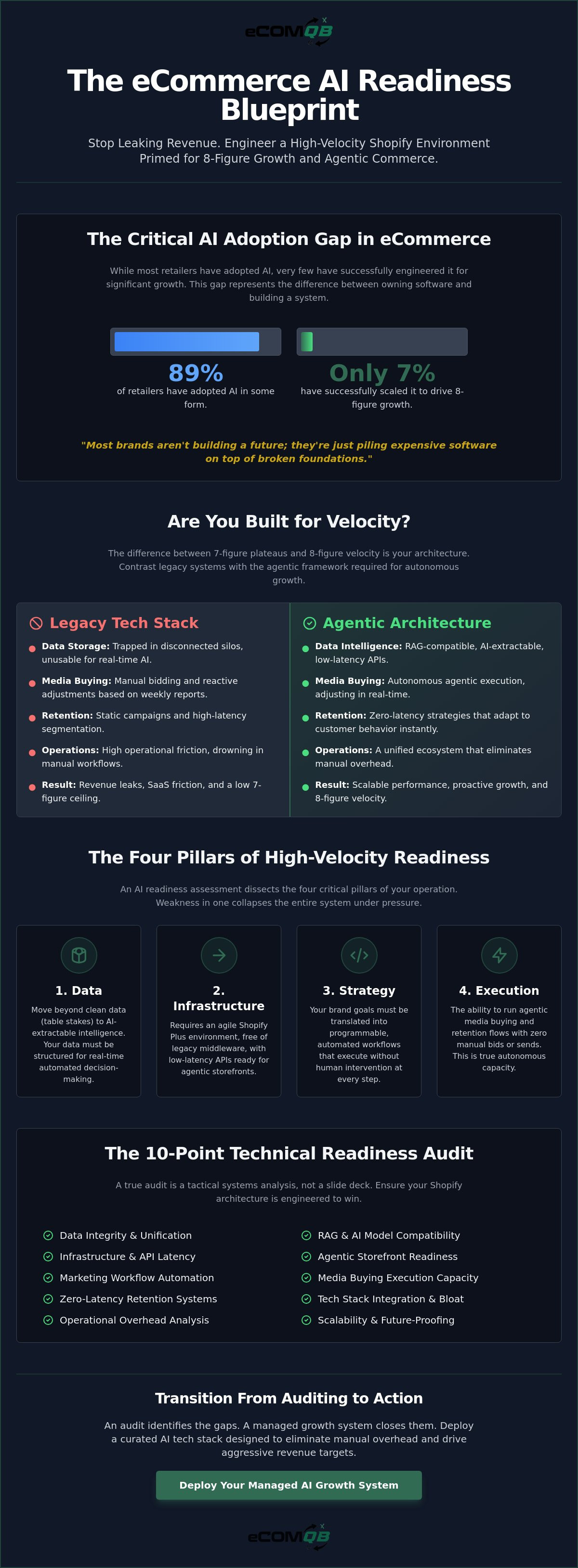
The eCommerce AI Readiness Checklist: 10 Critical Audits for High-Growth Brands
Execution requires a diagnostic approach. You can't optimize what you haven't measured. An eCommerce AI readiness assessment provides the technical and operational clarity needed to scale without friction. If your systems are lagging, your revenue is leaking. This checklist is your tactical briefing for the 2026 landscape. It separates the brands that are merely "using tools" from the brands that have engineered a high-velocity machine. Run these audits to identify your structural vulnerabilities before they become expensive failures.
- Audit for RAG-compatibility: Determine if your product and customer data is structured for Retrieval-Augmented Generation. AI agents must be able to extract and use your data in real-time to drive autonomous sales and support.
- Evaluate API Latency: Measure the speed of your data transfers. If your tech stack is slow, your automated decisions will be delayed. In the agentic era, milliseconds translate directly into conversion rates.
- Test for Entity Clarity: Ensure your brand is unambiguously identifiable to AI search engines. Your entity footprint must be clean, consistent, and authoritative across the web.
- Check Agentic Media Readiness: Audit your pixel data and conversion APIs. Autonomous bidding requires high-signal, zero-noise data to execute Meta and Google campaigns with precision.
- Verify Storefront Velocity: Confirm your Shopify theme supports sub-second rendering for AI crawlers. Speed isn't just for humans anymore; it's a requirement for AI discovery.
This is the baseline for 8-figure performance. If you fail even one of these audits, your growth will plateau. You need to schedule your technical audit to ensure your foundation is ready for the next phase of commerce.
Technical Readiness for AI Discovery
Visibility in 2026 depends on your site’s "extractability." You must implement llms.txt files to guide AI crawler bots and use advanced schema markup for deep entity recognition. This isn't just about traditional SEO. It's about ensuring LLMs can accurately parse your inventory and brand values. Testing your site’s RAG-driven capacity ensures that when a customer asks an AI agent for a recommendation, your brand is the one that surfaces.
Operational Readiness for Scalable Growth
Strategy is useless without the bandwidth to manage it. You must decide if your team can handle the orchestration of a unified AI system or if you need a managed partner to maintain the machine. High-velocity brands operate from a single source of truth for LTV, CAC, and net profit. Your final audit must measure the latency between a customer action and your marketing reaction. If that gap is measured in hours instead of seconds, you aren't ready for 8-figure velocity.
Beyond the Audit: Deploying Your Managed AI Growth System with eComQB
An eCommerce AI readiness assessment is a map. eComQB is the engine. Knowing your vulnerabilities is the first step, but engineering the solution is where the 8-figure game is won. We don't just identify data leaks or infrastructure bottlenecks. We plug them. Our team functions as your tactical partner to deploy a curated AI technology stack designed for aggressive, high-velocity growth. We eliminate the friction between strategy and execution by providing a fully managed system that operates with surgical precision. This is about moving from a state of readiness to a state of dominance.
The eComQB approach is bold, assertive, and unapologetically focused on peak performance. We strip away the traditional corporate fluff and focus on the mechanics of revenue generation. By integrating agentic media buying and zero-latency email flows, we remove the burden of manual operations from your team. You gain the advantage of a sophisticated AI infrastructure without the crushing operational overhead. We don't just advise on the future; we build it, manage it, and optimize it for total market leadership.
Engineering Your 8-Figure Revenue Machine
We deploy agentic media buying to dominate Meta and Google auctions with tireless, real-time adjustments. Your brand strategy is hard-coded into automated workflows that capture every ounce of available profit. We implement agentic email and SMS systems that drive zero-latency revenue retention, ensuring your customers are engaged at the exact moment of intent. Our Shopify excellence ensures your storefront is engineered for maximum velocity and conversion, providing the foundation for a scalable, high-performance ecosystem. We build the machine. You lead the trajectory.
Schedule Your Tactical Briefing
An audit is only valuable if it leads to immediate systemic optimization. In a high-velocity economy, there is no prize for second place. You must act on your data insights before they become obsolete. The eComQB commitment is simple: peak performance and unapologetic results. We are ready to transition your brand from legacy limitations to agentic mastery. Book your eCommerce AI readiness audit and tactical call with eComQB to begin your transformation today.
Own the High-Velocity Future
The 8-figure threshold isn't reached through tool bloat or manual effort. It's engineered through architectural precision. You've seen how legacy systems act as a drag on growth and how the four pillars of readiness define the winners of 2026. Transitioning to agentic commerce requires more than just an audit; it requires a total systemic overhaul that prioritizes net profit velocity. By conducting a formal eCommerce AI readiness assessment, you identify the exact levers needed to eliminate latency and reclaim your strategic time. This is the moment to move from a reactive posture to a dominant, proactive strategy.
eComQB provides the tactical partnership you need to move from insight to execution. We specialize in managed AI systems, agentic media buying, and high-performance Shopify engineering designed for brands that refuse to settle for mediocre growth. Our focus remains on your net profit velocity and systemic optimization. Don't let your competition outpace you while you're still managing manual workflows. Your brand's potential is a machine waiting to be unlocked. Let's build it together.
Stop leaking revenue. Book your eCommerce AI readiness assessment now.
Frequently Asked Questions
What is an eCommerce AI readiness assessment and why do I need one?
An eCommerce AI readiness assessment is a tactical audit of your data integrity, infrastructure agility, and execution capacity. You need it because 89% of retailers have adopted AI but only 7% have successfully scaled it. Without this assessment, you are building on a broken foundation. It identifies revenue leaks and prepares your brand for the high-velocity era of agentic commerce.
How long does a full AI readiness audit take for a Shopify brand?
A comprehensive audit typically takes 7 to 14 days depending on the complexity of your tech stack. We move fast because the digital economy doesn't wait for slow transitions. This timeframe allows for a deep-dive analysis of your API latencies, data silos, and RAG-compatibility. It is a series of rapid tactical briefings that move you toward immediate systemic optimization.
Can my existing Shopify team perform an AI readiness assessment?
Most internal teams are too embedded in day-to-day operations to maintain the necessary bird's-eye view. While they understand your current tools, they often lack the specialized engineering knowledge required for agentic architecture. You need a tactical partner who understands the mechanics of growth and the latest 2026 AI regulations. It requires a field general's perspective to see the systemic gaps.
What is the most common reason eCommerce AI projects fail in 2026?
Broken data trust is the primary killer of AI initiatives. Three out of four leaders report that outdated or inaccurate data still drives their key decisions. When your data layer is fragmented, your AI models can't learn or execute effectively. Projects fail when brands prioritize shiny tools over structural integrity and AI-extractable intelligence. Success requires a clean, unified data foundation.
How does AI readiness impact my customer acquisition cost (CAC)?
High-velocity AI systems reduce CAC by executing media buying with zero latency. When your infrastructure is AI-ready, you can leverage agentic media buying to dominate auctions on Meta and Google. This precision eliminates wasted spend and focuses your budget on high-intent segments. Readiness turns your marketing from a manual expense into an automated revenue machine that scales efficiently.
What technical changes are required to make a storefront AI-ready?
You must prioritize API speed, implement llms.txt files, and optimize your schema markup for deep entity recognition. Your Shopify theme needs to support sub-second rendering for AI crawler bots to ensure discovery. Moving toward a RAG-compatible architecture is essential. These changes ensure that both human customers and AI agents can navigate and extract value from your storefront instantly.
Is an AI readiness assessment just for large 8-figure brands?
No, it is a strategic requirement for any brand serious about reaching 8-figure velocity. Smaller brands often have the most to gain by eliminating manual overhead and SaaS friction early. Building a scalable architecture now prevents the low-7-figure plateaus that trap most businesses. Every ambitious brand needs a playbook for the agentic era to maintain a decisive competitive advantage.
What is the difference between a tech audit and an AI readiness assessment?
A tech audit reviews what you have; an eCommerce AI readiness assessment engineers what you need to automate. Standard audits look at software functionality and basic security. Our assessment focuses on execution capacity, data extractability, and agentic compatibility. It is a strategic blueprint for high-velocity growth rather than a simple inventory of your current software subscriptions.