The 2026 CAC Reduction Playbook: Systemic Strategies for High-Velocity Brands

In 2026, the era of the "lucky" media buyer is dead. If you are still trying to out-maneuver rising CPMs with manual tweaks and gut feelings, you are fighting a losing war. With Shopify merchants seeing average costs climb to $318 and median industry CAC hitting $84, the margin for error has evaporated. You likely feel the squeeze every day as attribution remains a black box and creative fatigue sets in before you can even scale. To effectively reduce eCommerce customer acquisition cost, you must stop treating marketing as a series of experiments and start treating it as a systems engineering problem.
We provide the tactical framework to master this shift. This playbook details how agentic AI and high-performance data systems strip away the inefficiency that plagues your current spend. We will analyze the mechanics of automated media buying, predictive targeting, and creative velocity. It's time to replace the manual grind with a precision system that delivers predictable, scalable, and profitable results. Let's build your competitive advantage through superior execution and strategic mastery.
Key Takeaways
- Escape the CAC death spiral by shifting focus from vanity channel metrics to systemic contribution margin per acquisition.
- Leverage agentic media buying to orchestrate spend, kill underperforming ads, and maximize ROAS with autonomous precision.
- Implement a high-velocity creative feedback loop to reduce eCommerce customer acquisition cost in a post-cookie landscape.
- Secure your competitive advantage by deploying server-side tracking and LTV prediction models that fuel high-performance AI systems.
- Orchestrate media, creative, and data under a single growth framework to drive predictable, high-velocity results.
The New Math of 2026: Why Traditional CAC Reduction Fails
The rules of the game have shifted. In 2026, many brands find themselves trapped in the "CAC Death Spiral." This is the systemic tipping point where rising CPMs and platform saturation outpace your ability to grow lifetime value. If you rely on legacy "Channel CAC" metrics, you are flying blind. To truly reduce eCommerce customer acquisition cost, you must pivot your focus to Contribution Margin per Acquisition. This transition moves the target from top-line vanity revenue to bottom-line profitability. Efficiency is no longer found within the ad manager interface; it is engineered in the data layer. Manual bidding has become a primary source of "Algorithmic Friction," slowing down the machine-learning loops that prioritize your best prospects. In this landscape, the ad manager is simply a terminal. The real intelligence lives in your proprietary data systems.
Blended CAC vs. Incremental CAC
Blended metrics are a sanctuary for lazy scaling decisions. They mask the reality that your last dollar spent is often your least efficient. As you push for 8-figure growth, you must calculate the true cost of the "next" customer rather than the average of the whole. This requires a ruthless focus on incremental performance. In a saturated market, your blended Customer Acquisition Cost (CAC) might look healthy while your incremental costs are actually hemorrhaging cash. You need to identify where your paid spend is actually driving new behavior versus just claiming credit for existing demand. Incremental CAC is the only metric that determines 8-figure scalability.
The LTV-to-CAC Ratio: The Only Compass That Matters
A 3:1 ratio is your absolute floor. Anything less is a slow bleed. To maintain this, high-performance brands build an organic moat through AI-enhanced SEO and AI visibility services. This reduces long-term reliance on paid auctions by capturing high-intent traffic before it enters the bidding war. By utilizing predictive LTV models, you can identify high-value cohorts within days of their first purchase. This foresight allows you to justify a higher initial cost to reduce eCommerce customer acquisition cost over the long term because you have the data to prove the yield. Precision beats volume every time. You aren't just buying clicks; you are acquiring future cash flow. To win, you must out-read, out-calculate, and out-execute the competition by leveraging these three pillars of growth:
- Predictive Data: Anticipating cohort value before the competition does.
- Organic Moats: Using content marketing and social media to lower the blended floor.
- Systemic Optimization: Automating the feedback loop between creative and spend.
Agentic Media Buying: Eliminating Manual Inefficiency
Manual media buying is a relic of a slower era. In 2026, the auction environment moves with a velocity that renders human intervention obsolete. To effectively reduce eCommerce customer acquisition cost, you must deploy agentic media buying. This is not basic automation or simple auto-bidding. It is the autonomous orchestration of your entire ad spend across fragmented platforms. You are no longer managing ads. You are now managing the AI that manages the ads. This shift allows your growth team to move from the trenches of button-clicking to the command center of strategic oversight. It identifies, analyzes, and kills underperforming assets in real-time, ensuring your capital always flows toward the highest yield without hesitation.
Zero-Latency Optimization
Humans sleep. AI agents don't. When a Meta campaign dips at 3 AM, an agentic system reacts instantly. It doesn't wait for a Monday morning review to pull the plug on a failing creative or a decaying audience. This zero-latency approach drastically reduces "Learning Phase" waste by using predictive audience modeling to bypass traditional platform friction. The system also masters the art of cross-platform budget rebalancing. If Google Search starts outperforming Meta mid-day, the agent shifts funds automatically to capture the momentum. This fluidity is essential when seeking proven strategies to reduce customer acquisition costs in a volatile market. In the 2026 landscape, precision is the only speed that matters. You must detect, analyze, and execute before your competitor even opens their dashboard.
Algorithmic Dominance: Feeding the Machine Better Data
The machine is only as good as the data it consumes. In 2026, data hygiene is the ultimate competitive advantage for high-velocity brands. This starts with robust Conversions API (CAPI) and server-side tracking to ensure no signal is lost to privacy filters or browser limitations. Relying on browser-side cookies is a tactical failure that leads to wasted spend. You must also integrate zero-party data to sharpen targeting algorithms from the inside out. Real eCommerce ROAS improvement starts with these infrastructure fundamentals. When you feed the platform better signals, the algorithm works for you instead of against you. It finds your buyers faster, cheaper, and with higher certainty. If you're ready to move beyond manual guesswork and embrace systemic precision, you should audit your current media buying stack to identify where your data is leaking.
Integrating these agentic workflows into your daily operations transforms your growth trajectory. It replaces the "boring" parts of media buying with a high-performance engine that scales without proportional increases in headcount. You aren't just reducing eCommerce customer acquisition cost; you are building a resilient system that thrives on complexity. This is how you win the game of 2026.
Creative as Targeting: The High-Velocity Feedback Loop
Targeting is no longer a setting in your ad manager. It is a visual signal embedded in your creative. In a post-cookie environment, the algorithm follows the audience that engages with your content. If your creative is generic, your targeting remains broad and expensive. To effectively reduce eCommerce customer acquisition cost, your assets must act as the primary filter. They must speak to specific pains, desires, and demographics with surgical precision. This shift demands a move away from "Big Production" mindsets. High-stakes growth in 2026 requires high-velocity iteration. You don't need a cinematic masterpiece; you need a relentless stream of data-backed variations that find your buyers where they live. Analyze the visual hooks, identify the winners, and double down before the trend shifts.
AI-driven personalization has fundamentally changed the post-click experience. Every ad click should lead to a unique storefront tailored to that specific user's intent. When your creative and your destination are perfectly aligned, conversion rates climb and waste disappears. We use AI to dissect which visual elements—the lighting, the first three seconds, the specific call to action—are actually driving down your costs. Stop guessing what your audience wants. Let the data dictate your production schedule. Build, measure, and refine.
The 48-Hour Creative Sprint
Speed is your greatest competitive advantage. A static creative strategy is a recipe for rapid fatigue and rising costs. You must build a workflow that produces, tests, and scales new hooks every 48 hours. By leveraging AI for rapid UGC iteration and localized variations, you can maintain a fresh presence in the feed without the overhead of traditional agencies. This allows you to test dozens of angles simultaneously to see which one resonates with your high-value cohorts. The Hook Rate is the single most critical leading indicator of your ability to slash acquisition costs and maintain platform momentum.
Agentic Landing Pages and Dynamic CX
Static product pages are the primary cause of CAC leakage. Sending high-intent traffic to a generic page is a tactical failure that ignores the nuances of the buyer's journey. You need to deploy agentic landing pages that adapt in real-time to the user's specific intent and referral source. These systems reduce friction by personalizing the experience at the point of click, ensuring the messaging they saw in the ad carries through to the checkout. This level of dynamic CX ensures that every dollar spent to reduce eCommerce customer acquisition cost is maximized through superior conversion engineering. Precision in the ad must be matched by precision on the page.
- Dynamic Headlines: Matching the ad hook to the page hero.
- Predictive Social Proof: Showing the most relevant reviews for that user segment.
- Automated Layouts: Adjusting the content hierarchy based on scroll behavior.
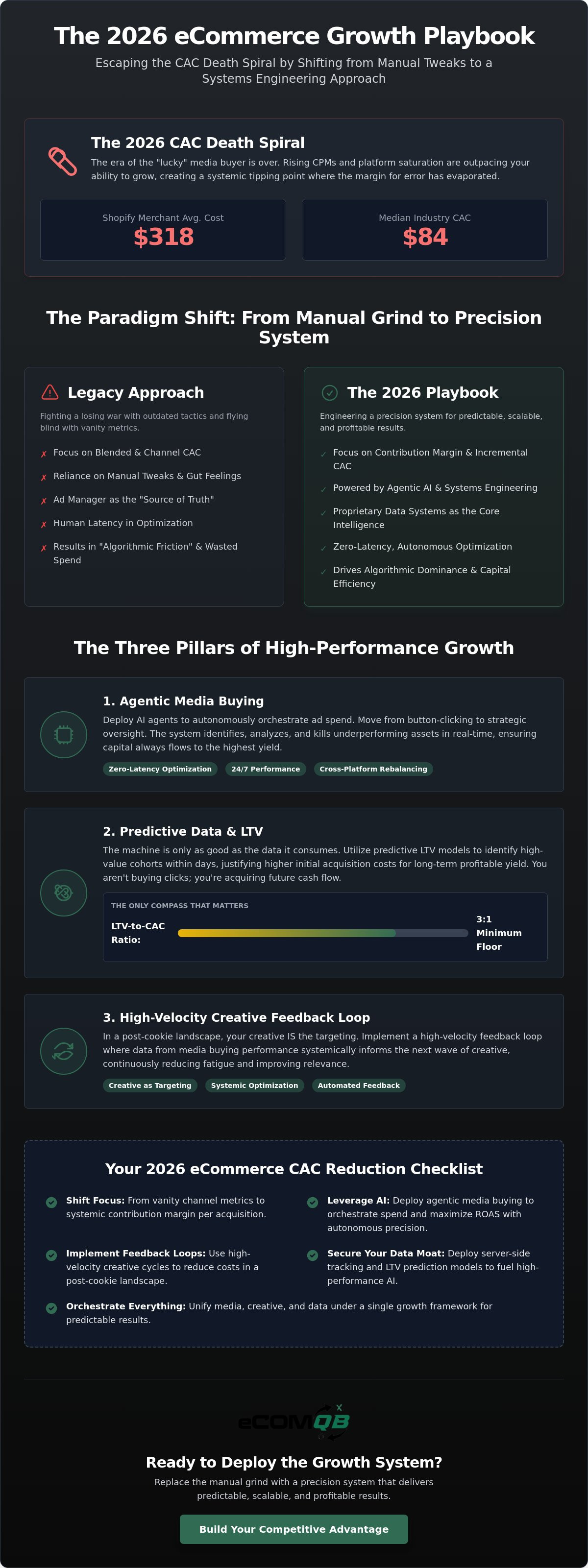
The 2026 eCommerce CAC Reduction Checklist
Strategic theory is useless without a rigorous execution framework. In a market where digital noise is at an all-time high, your ability to reduce eCommerce customer acquisition cost depends on how quickly you can move from insight to action. This checklist is your operational roadmap. It is designed to strip away the inefficiencies that drain your budget and replace them with high-performance systems. If you aren't checking these boxes weekly, you are leaving your growth to chance. Execution is the only differentiator left in 2026. Follow these five phases to secure your competitive advantage.
- Phase 1: Infrastructure Audit. Secure your data perimeter. Validate every signal across tracking, CAPI, and server-side environments to ensure zero data loss.
- Phase 2: Data Orchestration. Move beyond historical reporting. Use LTV prediction and cohort analysis to identify which customers are worth the high acquisition price.
- Phase 3: Creative Velocity. Deploy agentic testing. Produce, test, and scale hooks with a focus on visual signals that lower your blended costs.
- Phase 4: Funnel Friction. Eliminate point-of-click resistance. Use AI personalization and rapid landing page speed to ensure a seamless transition from ad to cart.
- Phase 5: Retention Feedback. Close the loop. Feed post-purchase LTV data back into your acquisition algorithms to sharpen your targeting precision.
Technical Infrastructure & Data Hygiene
Your growth engine is only as powerful as the data fueling it. Start by validating your Conversions API (CAPI) setup. In 2026, you need 99% signal accuracy to win the auction. Anything less is a donation to the ad platforms. You must also audit your Shopify technology stack for revenue-leaking latency. Every millisecond of delay in your data pipeline results in a higher CAC. Implement a unified customer data platform (CDP) to track multi-touch attribution with total clarity. This allows you to see the full journey, identify the true drivers of demand, and cut the spend that isn't contributing to the bottom line.
Creative & Conversion Optimization
High-velocity brands do not wait for monthly reviews to update their creative. To effectively reduce eCommerce customer acquisition cost, you must deploy at least 5 new creative "hooks" per week for every winning product in your catalog. This volume ensures you stay ahead of creative fatigue and platform decay. Simultaneously, run A/B tests comparing agentic landing pages against static versions for your top-spending ad sets. The goal is a dynamic experience that converts at a higher rate than the industry average. Finally, optimize your mobile checkout speed. If it takes longer than 2 seconds to load, you are inflating your CAC through bounce-back abandonment. If you are ready to stop the bleed and start scaling with precision, you should request a systemic growth audit today.
Deploying the eComQB Growth System for Peak Efficiency
High-velocity brands require more than just an agency; they require a systemic architecture for growth. In the 2026 landscape, the traditional marketing department is often a liability. It is slow, expensive, and fragmented. To effectively reduce eCommerce customer acquisition cost, you must remove the human bottleneck from the execution loop. The eComQB Growth System functions as your "Field General." We orchestrate media, creative, and data under one roof. We replace the "black box" of attribution with a transparent, data-driven framework that provides total visibility into your spend. This unified approach ensures that every tactical move is aligned with the ultimate objective: profitable, 8-figure scale. We don't just suggest moves; we execute them with surgical precision.
The Managed AI Advantage
Managed AI growth systems outperform internal teams because they operate with a precision that humans cannot replicate. Our curated AI stacks work 24/7. They don't sleep, they don't get fatigued, and they don't miss performance fluctuations. By integrating agentic media buying directly into your operations, we reclaim your strategic time. This isn't about replacing people; it's about augmenting your capacity to win. Our system identifies winning creative, scales profitable ad sets, and kills underperforming assets in real-time. You move from managing people to overseeing a high-performance engine. This transition from "Agency Client" to "Strategic Partner" is essential for brands aiming for peak velocity. We eliminate the overhead, streamline the workflow, and maximize the output. Our systems provide continuous optimization, reacting to market shifts before the competition even realizes the game has changed.
Your Next Move: The AI Diagnostic
Scaling is impossible if your bucket is leaking. Your first priority is to identify the specific friction points in your current funnel. Whether it is data loss, creative decay, or landing page latency, these leaks must be plugged immediately. A diagnostic isn't just a review; it's a strategic briefing that prepares you for the next phase of the game. The roadmap for your AI transformation starts with a deep dive into your technical infrastructure. We analyze your systems, locate the waste, and deploy the fixes. It's time to stop guessing and start engineering your growth trajectory. To reduce eCommerce customer acquisition cost and secure your competitive advantage, you need a playbook built for the speed of the digital economy. Don't let manual processes hold your brand back from its true potential. Schedule your high-performance growth audit with eComQB to see exactly where your next level of efficiency is hidden.
Command Your Growth Trajectory
The digital economy does not reward hesitation. To win in 2026, you must stop treating marketing as a manual craft and start treating it as a high-performance system. You have seen how agentic media buying on Meta and Google eliminates human latency. You understand that creative velocity is your new targeting lever. These aren't just incremental updates; they are the foundation of 8-figure scalability. Managed AI transformation is no longer a luxury for the few. It is the inevitable requirement for any brand that refuses to be squeezed by rising platform costs.
Implementing this systemic framework is the only sustainable way to reduce eCommerce customer acquisition cost while maintaining aggressive momentum. By optimizing your Shopify development for high-velocity and feeding your algorithms better data, you secure a moat that competitors cannot cross. The tools are ready. The playbook is clear. The only variable left is your willingness to execute. Deploy your 2026 AI Growth System with eComQB and take control of your results. Your next move defines your decade. Let's build it.
Strategic Intelligence: Frequently Asked Questions
How do I calculate eCommerce CAC accurately in 2026?
Accurate calculation requires summing your total ad spend, agency fees, creative production costs, and marketing salaries, then dividing that total by the number of new customers acquired. Many brands underestimate their true cost by 20% to 40% because they only look at ad manager data. In 2026, you must isolate new customer acquisition from repeat purchases to understand your true growth efficiency.
What is a good customer acquisition cost for a Shopify store?
A "good" CAC is relative to your lifetime value, but 2026 benchmarks show Shopify merchants face an average CAC between $274 and $318. While the broader eCommerce median sits between $68 and $84, your specific target must maintain a minimum 3:1 LTV-to-CAC ratio. If your acquisition cost exceeds one third of your customer's projected value, your growth model is unsustainable.
Can AI really reduce my Meta ad costs without losing volume?
AI reduces Meta costs by eliminating the human latency that leads to wasted spend on underperforming assets. Agentic systems monitor campaigns 24/7, killing "dead" ads and reallocating budget to high-performers in real-time. This precision allows you to reduce eCommerce customer acquisition cost while maintaining the aggressive volume required to capture market share and outpace competitors who rely on manual tweaks.
What is the difference between CAC and Blended CAC?
CAC measures the cost to acquire a single new customer, whereas Blended CAC averages your total marketing spend across all customers, including those who are returning. Relying on blended metrics is a tactical error that often hides a failing acquisition strategy. You must isolate your new customer costs to ensure you aren't just paying to "re-acquire" people who would have bought anyway.
How does creative velocity affect my customer acquisition cost?
Creative velocity is the primary lever for lowering your costs in a post-cookie environment. By deploying at least 5 new hooks per week, you prevent creative fatigue and give the platform's algorithm fresh data to find your ideal buyers. Higher velocity leads to better "Hook Rates," which directly lowers your CPMs and improves the overall efficiency of your acquisition funnel.
Why is my LTV-to-CAC ratio dropping despite high ROAS?
A dropping ratio despite high ROAS usually indicates you are acquiring "one-and-done" customers with no long-term value. High ROAS on an initial sale is a vanity metric if those customers never return. You need to shift your targeting toward high-value cohorts. If your payback period exceeds 120 days, you are likely overpaying for low-quality traffic that won't sustain 8-figure growth.
Is it better to focus on retention or acquisition to lower CAC?
You must focus on both, but retention is what makes expensive acquisition viable. It's 5 to 25 times more expensive to acquire a new customer than to retain an existing one. A 5% increase in retention can boost profits by up to 95%. High retention rates allow you to reduce eCommerce customer acquisition cost by increasing the lifetime value floor of every new lead.
What role does Shopify site speed play in acquisition efficiency?
Shopify site speed is a direct determinant of your conversion rate and effective CAC. If your mobile load time exceeds 2 seconds, your bounce rate will spike, and you'll effectively pay for clicks that never even see your offer. High-velocity brands treat site speed as a core marketing metric. Faster stores convert more traffic, which immediately lowers the cost of every customer acquired.