SEO and Content Strategy for Shopify: The 2026 High-Velocity Playbook

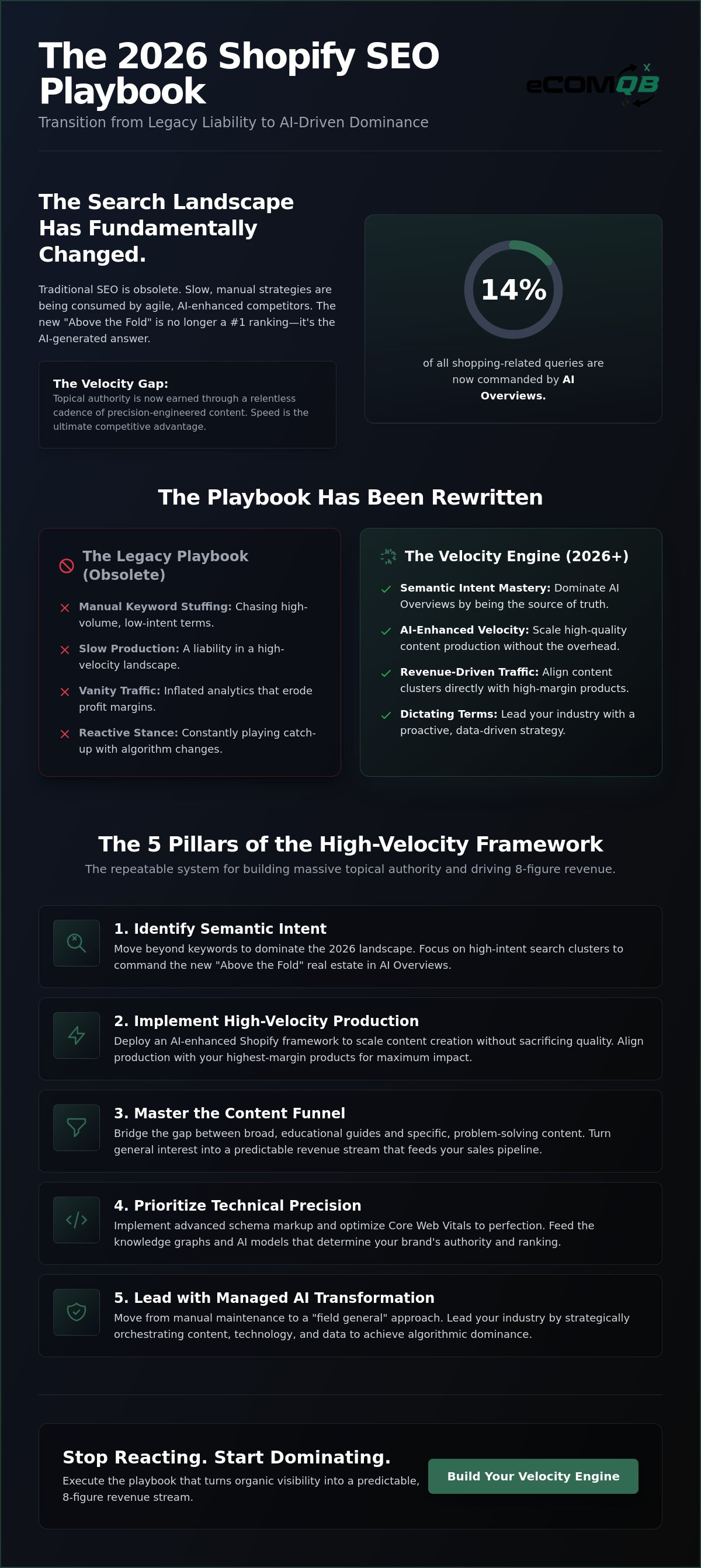
The traditional SEO playbook isn't just outdated; it is a liability. In a landscape where AI Overviews now command 14% of shopping-related queries, relying on slow, manual production is a recipe for irrelevance. To maintain a competitive edge, your SEO and content strategy Shopify framework must evolve from a tactical checklist into a high-velocity engine of algorithmic dominance.
You already feel the pressure. Organic traffic is stalling as Google prioritizes AI-generated answers, and rising CAC on paid channels is eating your margins alive. It's a high-stakes environment where the slow are consumed by the precise. We are here to change the trajectory of your growth. This playbook delivers the transition from manual labor to AI-driven velocity, designed to secure your position at the top of the SERPs and drive 8-figure revenue.
We will break down the repeatable systems required to build massive topical authority. You'll learn to outpace the competition, master agentic search, and turn organic visibility into a predictable revenue stream. It is time to stop reacting to the algorithm and start dictating the terms of your market. Let's analyze, adapt, and accelerate.
Key Takeaways
- Identify semantic intent to dominate the 2026 landscape where AI Overviews have replaced legacy keyword stuffing. Command the new Above the Fold real estate.
- Implement a high-velocity SEO and content strategy Shopify framework to align high-margin products with high-intent search clusters. Scale production without compromising quality.
- Master the content funnel by bridging the gap between educational guides and specific problem solving. Turn broad interest into predictable revenue.
- Prioritize technical precision through advanced schema markup and Core Web Vitals. Feed the knowledge graphs that AI models use to rank your brand.
- Move from manual maintenance to managed AI transformation. Lead your industry with a field general approach to content, tech, and data.
The 2026 Shopify SEO Landscape: Why Legacy Strategies Are Leaking Revenue
Manual keyword stuffing is a relic. It belongs in the 2010s. Modern search engines have moved beyond matching strings of text to understanding deep semantic intent. If your brand is still chasing high-volume, low-intent keywords, you're effectively burning your marketing budget. Legacy search engine optimization (SEO) relied on volume; the 2026 playbook relies on precision. You must adapt, evolve, and dominate.
The "Above the Fold" real estate has been completely redefined. Google's AI Overviews now dominate the top of the SERP for approximately 14% of shopping-related queries. This shift means even a #1 organic ranking can be pushed below the fold by a single AI-generated summary. To win, your SEO and content strategy Shopify framework must transition from traditional optimization to AI Visibility Optimization (AVO). AVO isn't about ranking for a term; it's about being the primary source for the AI's answer.
Traffic without intent is a vanity metric. It inflates your Analytics dashboard while eroding your margins. High-velocity brands focus on capturing users at the exact moment of decision. They align content clusters with high-margin SKUs. They don't just want clicks; they want conversion-ready prospects. If your content doesn't drive revenue, it is overhead. Period.
The Shift to Agentic Search
AI agents are the new gatekeepers. ChatGPT, Copilot, and Google’s AI Mode are now the primary tools for product discovery. These agents don't care about your backlink count in the traditional sense. They prioritize brand entity authority and data clarity. Your content must be structured, authoritative, and citeable. If an AI model can't easily synthesize your data to answer a user's prompt, your brand doesn't exist in the agentic economy. You are either the source or you're invisible.
The Velocity Gap: Speed as a Competitive Advantage
Topical authority is earned through consistency, volume, and precision. There is a direct correlation between publication frequency and search dominance. Legacy brands are losing market share to agile, AI-enhanced competitors who produce high-quality content at ten times the speed. In 2026, the standard for high-performance output isn't a single weekly update. It is a relentless cadence of precision-engineered content that saturates your niche. Speed is no longer just a metric; it is your ultimate competitive advantage.
Building the Content Velocity Engine: A Strategic Framework
Precision. Velocity. Impact. These are the three pillars of a high-performance SEO and content strategy Shopify. You cannot afford to treat content as a secondary concern. It is the fuel for your revenue engine. In 2026, successful Ecommerce SEO in 2026 requires a surgical alignment between search intent and inventory profitability. We don't just build traffic; we build pipelines to your high-margin SKUs.
Deploying AI-enhanced workflows allows you to scale production without the traditional overhead. This isn't about generating noise. It is about engineering authoritative assets that dominate search results. If you aren't measuring success through direct revenue attribution, you are playing a legacy game. To truly scale, you must integrate your content efforts into a broader eCommerce AI growth system designed for 8-figure velocity.
Step 1: Topical Map Architecture
Authority is not accidental; it is engineered. You must build a silo structure that establishes your brand as the definitive leader in your category. This involves mapping supporting articles to core product pillars to maximize link equity distribution. By leveraging modern content management, you maintain structural integrity across thousands of pages. Every piece of content must serve a strategic purpose, pushing both users and crawlers toward your most valuable conversion points. If you want to see how your current architecture stacks up, you can book a strategic briefing with our team.
Step 2: AI-Enhanced Content Engineering
Prompts are for amateurs. To dominate in 2026, you need agentic content workflows. These systems move beyond simple text generation to perform deep research, competitive analysis, and brand-voice alignment. Maintaining a high-stakes, authoritative brand voice at scale requires a "Human-in-the-Loop" approach. Your subject matter experts provide the strategic direction and final polish, ensuring every asset meets 8-figure brand standards. This combination of machine velocity and human precision is what separates market leaders from those who are simply filling space. You aren't just publishing articles; you are deploying strategic assets that capture and convert intent at the highest level.
Mapping Intent to Revenue: The Shopify Content Funnel
Traffic is a raw material. Intent is the catalyst. Without a structured funnel, your SEO and content strategy Shopify is just a series of disconnected efforts. To dominate in 2026, you must map every search query to a specific stage of the buyer's journey. This isn't about casting a wide net. It's about building a precision-guided revenue pipeline. You must analyze, optimize, and dominate every touchpoint.
Top of Funnel (TOFU) content captures broad interest. It builds the trust moat. By the time a user reaches your product page, they should already view your brand as the authoritative expert. This process aligns with foundational SEO best practices that prioritize user value and relevance. Middle of Funnel (MOFU) content solves specific problems and compares solutions. Bottom of Funnel (BOFU) content drives the final conversion. Agentic landing pages now play a critical role here. They close the intent-to-purchase gap by dynamically adapting to the user's specific context and needs.
Informational Content: Building the Trust Moat
Create "How-To" guides that frame your products as the inevitable solution. Don't just provide information; provide a path to success. Use data-driven insights to answer questions before your competitors even identify them. This high-value informational content does double duty. It establishes topical authority and serves as the raw material for AI-powered ad creative. You are building an ecosystem where search visibility feeds your paid performance. This is how you outpace the market.
Commercial and Transactional Content: Closing the Sale
Collection pages are your heavy hitters. Optimize them for high-intent "Best [Category]" queries. This is where you capture users ready to pull the trigger. The science of the Shopify product description has evolved. It is no longer a choice between SEO and persuasion. It is a fusion of both. In 2026, "Zero Latency" in content updates is the new standard. Your content must reflect real-time inventory levels and seasonal shifts. If your content is stagnant, your revenue will be too. Precision. Speed. Conversion. That is the playbook for 8-figure scaling.
Technical SEO for Shopify: Optimizing for Bots and Buyers
Technical SEO is the structural integrity of your 8-figure growth engine. If your foundation is cracked, your visibility will crumble. In 2026, site speed is no longer a feature; it is a baseline requirement. Core Web Vitals act as the ultimate gatekeeper for search rankings. Google's core update in May 2026 reinforced this reality by prioritizing technical precision alongside content quality. You cannot afford a sluggish storefront.
Shopify stores often suffer from app bloat. Every third-party script is a tax on your conversion rate. You must audit your liquid code and strip away legacy scripts that slow down your Largest Contentful Paint (LCP). Precision requires a lean, high-performance environment. This is the only way to support a high-velocity SEO and content strategy Shopify. Expansion into global markets demands similar rigor. International SEO requires precise hreflang implementation and localized content clusters to scale without losing technical performance.
Agentic Architecture: Preparing for the Future
AI models don't browse; they synthesize. Your robots.txt and sitemaps must be engineered for efficient AI crawling. While Shopify's native features provide a base, high-velocity brands often leverage headless architectures to gain ultimate control over performance. Structured data is the language of the Knowledge Graph. By implementing advanced schema markup, you provide the data AI models crave for rich snippets and AI Overviews. You must make your data undeniable to the algorithms. If your technical foundation is leaking revenue, book a technical AI audit to optimize your infrastructure for 8-figure scaling.
Mobile-First Domination
Mobile devices account for 68% of all e-commerce traffic. Your storefront must be designed for mobile-first indexing from the first line of code. Layout stability, measured by Cumulative Layout Shift (CLS), is non-negotiable. A shifting layout on a mobile device kills user trust and search rankings instantly. High mobile speed isn't just an SEO metric; it's the primary driver of organic conversion rates. Analyze. Optimize. Dominate. Every millisecond you shave off your load time is a direct investment in your bottom line. You are building for the modern consumer who demands instant, stable, and seamless experiences across all device types.
Executing the Playbook: From Strategy to 8-Figure Scaling
Strategy is a blueprint; execution is the building. To reach 8-figure revenue in 2026, your SEO and content strategy Shopify must move from theory to high-velocity operation. You don't need more ideas. You need a managed AI transformation that automates the mundane and amplifies the strategic. The market moves too fast for manual updates or slow approval cycles. You either lead the pace or get left in the dust.
We take a "Field General" approach to growth. This means orchestrating tech, content, and data into a single, cohesive strike force. You must look at your organic performance through the lens of business outcomes. Stop obsessing over vanity rankings. Set KPIs that actually move the needle: ROAS, LTV, and Organic Contribution Margin. True mastery comes when you integrate your organic visibility with agentic media buying to create a self-reinforcing growth loop. Analyze, adapt, and accelerate.
The ROI of Organic Mastery
Dominating the search landscape is the ultimate hedge against rising ad costs. A superior SEO position slashes your blended CAC. It builds a foundation of trust that paid channels simply can't replicate. High-velocity content creates a compounding effect on your brand equity. Every precision-engineered article is a long-term asset that pays dividends for years. Waiting to implement AI-driven SEO isn't just a delay; it's a high-stakes revenue leak. While you hesitate, your competitors are claiming the digital real estate that should be yours. Efficiency. Authority. Profit.
Your Growth Playbook Starts Here
The path to dominance begins with a cold, hard look at your current performance. Audit your stack. Identify the bottlenecks. Strip away the friction. Once the foundation is solid, deploy the first phase of the Content Velocity Engine. This isn't about doing everything at once; it's about doing the right things at speed. Partnering for precision is the final lever. The eComQB managed growth system provides the technical expertise and strategic leadership required to scale. We don't just give you a playbook; we help you win the game. Analyze. Execute. Dominate.
Secure Your Category Dominance
The 2026 landscape doesn't reward effort; it rewards precision. We have moved past the era of manual SEO into a period of algorithmic dominance. Success now depends on transforming your storefront into an authoritative entity that AI models trust and cite. You must bridge the gap between technical speed, content velocity, and strategic precision to create a moat your competitors cannot cross. Implementing a sophisticated SEO and content strategy Shopify framework is the only way to ensure your brand remains visible as AI Overviews redefine search real estate.
It's time to stop reacting to market shifts and start engineering them. We provide the managed AI technology stacks, agentic media buying precision, and end-to-end Shopify growth execution required to scale. You need a partner who understands the mechanics of 8-figure growth and possesses the tools to execute it. The window to claim your territory in the agentic economy is closing. Deploy your 8-figure AI growth system with eComQB and take command of your industry. The future belongs to the agile. Let's build it.
Frequently Asked Questions
How long does it take to see results from a Shopify SEO strategy in 2026?
Technical performance gains usually manifest within 30 to 45 days. However, building deep topical authority and dominating AI Overviews typically requires a consistent high-velocity execution over three to six months. Speed depends on your publishing cadence and the existing health of your domain. Agile brands that deploy AI-enhanced workflows often compress these timelines. Stagnation is the only variable that guarantees failure in a competitive landscape.
Does Shopify have better built-in SEO than other platforms like WooCommerce?
Shopify provides a superior out-of-the-box infrastructure compared to legacy platforms that require extensive plugin management. Its automated sitemaps, canonical tags, and clean URL structures offer a solid foundation. While other platforms offer more granular control, they often lead to technical debt and security vulnerabilities. For high-volume merchants, Shopify’s stability and integrated ecosystem provide the necessary leverage to execute a complex SEO and content strategy Shopify without constant maintenance overhead.
How does AI impact my Shopify store’s organic search rankings?
AI has shifted the search landscape from simple keyword matching to semantic intent synthesis. Google’s core updates now prioritize E-E-A-T and technical precision over legacy metrics. If your store doesn't provide structured data and authoritative content, AI agents will ignore your brand. You must transition from search engine optimization to AI visibility optimization. This means becoming the primary source that AI models cite when answering user queries in real-time.
What is the most important technical SEO factor for Shopify brands?
Site speed remains the ultimate gatekeeper for your rankings and conversion rates. Specifically, you must optimize for Largest Contentful Paint and Cumulative Layout Shift. As of June 2026, Google’s algorithms place extreme weight on mobile performance. Every millisecond of latency is a tax on your organic revenue. Auditing liquid code and removing app bloat are non-negotiable steps for any brand serious about 8-figure scaling in the digital economy.
Should I use AI to write my Shopify product descriptions and blogs?
Use AI to engineer your content, not just generate it. High-velocity brands utilize agentic workflows to handle deep research and drafting while subject matter experts provide the final strategic polish. Generic AI output will fail to rank or convert because it lacks authority. You need a system that maintains your high-stakes brand voice while hitting the production volume required for topical dominance. Precision and volume are the two levers you must pull.
How do I optimize my Shopify store for Google’s AI Overviews (SGE)?
Optimization for AI Overviews requires a focus on structured data and clear, authoritative answers. You must implement advanced schema markup to feed the Knowledge Graph. Ensure your content directly addresses specific user questions with data-driven insights. AI models prioritize sources that are easy to synthesize and link to. If your content is citeable, you will capture the prime real estate at the top of the search engine results pages.
Is blogging still relevant for eCommerce SEO in 2026?
Blogging is the engine that builds your trust moat. In 2026, it is no longer about journaling but about creating educational guides that frame your products as inevitable solutions. This informational content establishes the topical authority required for your product pages to rank. Without a robust blog strategy, you lack the link equity and semantic depth needed to compete in high-stakes niches. It is your primary tool for capturing top-of-funnel intent.
How can I measure the actual revenue generated by my SEO efforts?
Move beyond vanity metrics and focus on Organic Contribution Margin. Use multi-touch attribution models to track how organic touchpoints influence the final sale. By analyzing first-click and last-click data in your Shopify dashboard, you can calculate the exact return on investment of your content production. High-velocity brands treat SEO as a performance channel, measuring success through direct sales and the reduction of blended customer acquisition costs. Data doesn't lie.