ECommerce Channel Expansion Strategy: How to Choose Your Next Growth Channel

More channels don’t automatically mean more growth. The wrong move can add fees, operational drag, and a fractured customer experience without creating profitable demand. The real question isn’t how fast you can show up everywhere. It’s which channel can reach the right buyers and earn its place in your growth system. That’s the foundation of a practical eCommerce channel expansion strategy.
If you’re weighing marketplaces, social commerce, retail media, or another route, the uncertainty is real: customer fit, channel economics, attribution, and team capacity all matter. Expansion can widen your reach, but only when acquisition, conversion, and retention work together instead of competing across disconnected touchpoints.
This guide will help you prioritize channels using customer and business evidence, assess the economics and operational demands, and design a controlled pilot with clear success measures. You’ll learn how to compare performance, track incremental revenue, and coordinate the customer experience across channels. The goal is a focused plan: test one channel at a time, learn from the results, and scale when the evidence supports it.
Key Takeaways
- Build your eCommerce channel expansion strategy around customer behavior, brand control, and the role each channel plays in the buying journey.
- Compare potential channels by audience fit, incremental reach, margin impact, and operational readiness before committing resources.
- Use revenue, conversion, repeat-purchase, and recommendation data to sharpen channel priorities and test assumptions.
- Set up a channel pilot with clear ownership, a baseline, and coordinated content, campaigns, storefronts, and customer journeys.
- Connect expansion to acquisition, conversion, and retention, using curated AI to strengthen proven growth frameworks rather than replace them.
Why eCommerce Channel Expansion Strategy Starts With Incremental Growth
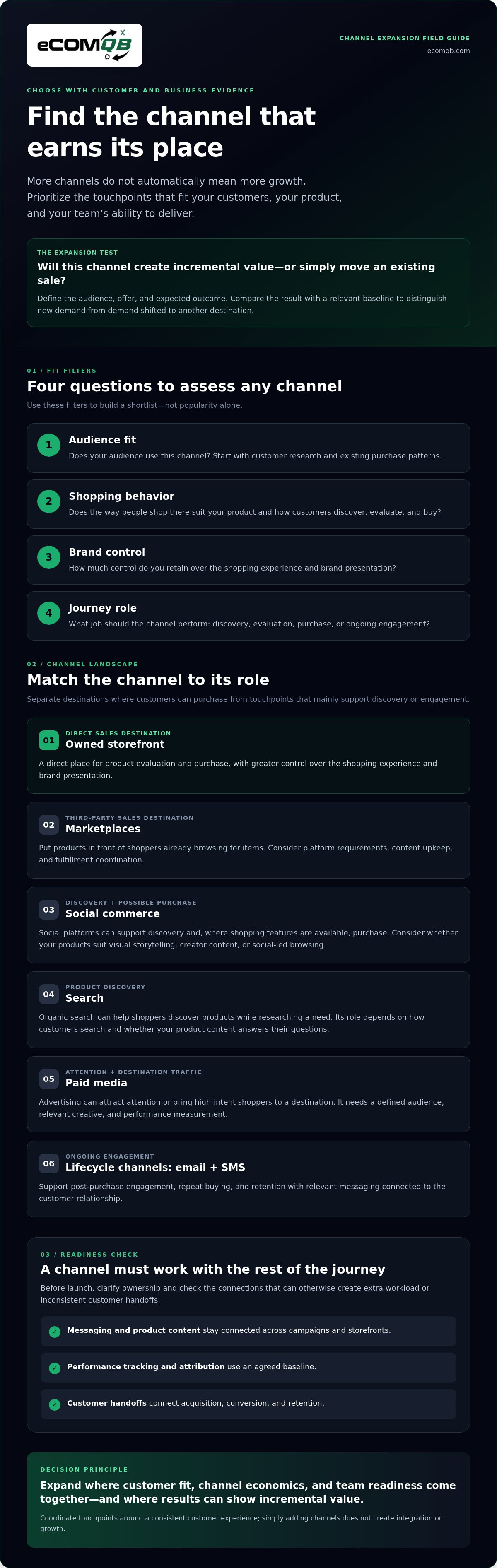
Adding a sales account is easy. Building a channel that attracts qualified customers, converts them, and supports profitable growth takes a plan. Channel expansion means adding or developing customer touchpoints to create new opportunities to reach and serve buyers. It might mean entering a marketplace, strengthening social commerce, or improving how search and lifecycle marketing connect with your storefront.
An eCommerce channel expansion strategy is a deliberate plan to add or develop customer touchpoints that create incremental value without overwhelming the business. That definition sets a higher bar than simply being present. Opening an account or copying the same campaign onto another platform may increase activity, but it doesn’t show that the channel reaches new customers or adds revenue.
Use an incremental-growth test before committing: what value should this channel create beyond shifting existing demand? For example, if a marketplace sale replaces a purchase that would have happened on your own storefront, the channel may be redistributing revenue rather than expanding it. Define the audience, offer, and outcome you expect, then compare results with a relevant baseline. Be explicit about what would count as new demand and what might simply move an existing sale to a different destination.
Multichannel and omnichannel: what changes as you expand?
Multichannel means selling or engaging across more than one channel, without assuming those channels are integrated. Multichannel marketing principles help frame how brands distribute and market products across touchpoints. Omnichannel goes further by coordinating those touchpoints around a more consistent customer experience, from discovery through purchase and follow-up. Adding channels alone doesn’t create coordination, stronger handoffs, or incremental growth. Those outcomes depend on how the channels work together and what the evidence shows.
The risks of expanding before the business is ready
Expansion adds moving parts. Without clear ownership, channel messaging can drift, performance data can sit in separate systems, and customers can encounter inconsistent handoffs between campaigns, storefronts, and follow-up. New content, campaign management, and customer-service demands can also increase workload before the channel demonstrates incremental results.
Before launch, identify who owns the channel and how its activity connects to the rest of the customer journey. Map the dependencies across:
- Messaging and product content across campaigns and storefronts
- Performance tracking and attribution against an agreed baseline
- Customer handoffs from acquisition to conversion and retention
This is a growth-system decision, not a platform checklist. The eCommerce AI growth system connects channel activity to acquisition, conversion, and retention, helping teams assess expansion as part of a coordinated framework rather than a standalone launch.
Which eCommerce Channels Fit Your Customers and Growth Model?
The best next channel is the one that fits how your customers discover, evaluate, and buy your products, and that your team can operate well. A channel’s popularity alone doesn’t make it a fit. Build your shortlist from customer research, existing purchase patterns, and the role each touchpoint can play in your growth model.
Start by separating sales destinations, where customers can complete a purchase, from channels that primarily drive discovery or ongoing engagement. Then evaluate each option against four questions: Does your audience use it? Does its shopping behavior suit your product? How much control do you retain? What job should it perform in the customer journey?
- Owned storefront: A direct destination for product evaluation and purchase, with greater control over the shopping experience and brand presentation.
- Marketplaces: Third-party sales destinations that can put products in front of shoppers already browsing for items. Consider platform requirements, content upkeep, and fulfillment coordination.
- Social commerce: Social platforms can support product discovery and, where shopping features are available, purchase. Assess whether your products suit visual storytelling, creator content, or social-led browsing.
- Search: Organic search can help shoppers discover products while researching a need. Its role depends on how customers search and whether your product content answers their questions.
- Paid media: Advertising across platforms can attract attention or bring high-intent shoppers to a destination. Execution needs a defined audience, relevant creative, and performance measurement. The agentic media buying playbook explores how paid-channel execution can fit into a broader growth approach.
- Lifecycle channels: Email and SMS can support post-purchase engagement, repeat buying, and customer retention. Their value depends on relevant messaging and a clear connection to the customer relationship.
Match channel roles to customer intent
Map the journey: where customers discover products, what helps them evaluate, where they transact, and what brings them back. Sales and conversion data can show which products are bought together, where customers drop off, and which buyers return. Customer research can fill gaps in that picture. The Harvard Business Review study on multichannel shoppers also underscores why it’s useful to understand behavior across touchpoints, not just within one channel.
Compare channel control, reach, and operating demands
An owned storefront offers more control over the customer experience, while third-party platforms bring their own audiences and operating requirements. Neither is automatically the better choice. Compare the content and campaign work each demands, the customer data you can use, and how fulfillment and follow-up will connect. For a practical comparison, note who owns each task, what systems or content it depends on, and how you will measure the result. Choose channels that match both buyer behavior and your team’s capacity.
A focused eCommerce channel expansion strategy doesn’t require every channel. eComQB helps brands align channel roles with acquisition, conversion, and retention. Learn more about eComQB’s growth approach.
How to Prioritize Expansion: Compare Economics, Readiness, and Risk
A promising channel can still be the wrong next move if your team can’t support it or its economics don’t hold up. Compare candidates using the same criteria, then separate what your data shows from what you still need to test. The scorecard below is a decision aid, not a performance forecast.
Use a channel scorecard to make the trade-offs visible
Rate each candidate from 1 to 5 against the criteria below. Use the same scale for every channel, where 1 means weak fit or low readiness and 5 means strong fit or high readiness. Add a short evidence note beside each score. If you lack evidence, mark the score as a hypothesis rather than treating it as a fact. This makes it easier to see whether a high overall score rests on solid customer and business evidence or on assumptions that need testing.
| Criterion | What to assess |
|---|---|
| Audience fit | Do customer research and purchase patterns indicate that your target buyers use this channel? |
| Incremental potential | Could it reach customers or occasions beyond demand already captured elsewhere? |
| Margin implications | How might channel-specific fees, promotions, acquisition activity, and servicing affect contribution? |
| Control | How much influence do you retain over brand presentation, customer experience, and access to useful data? |
| Operational readiness | Can your team support content, campaigns, customer service, data tracking, and fulfillment coordination? |
Don’t compare unrelated platform features. Compare the work and value each channel could deliver. For example, a candidate might show strong audience fit but weak readiness because product content and customer-service processes aren’t prepared. That’s not an automatic rejection. It identifies a dependency to resolve or a risk to include in the pilot.
Check channel economics before committing resources
Use your existing business data to anchor the decision. Review revenue and conversion performance by product and traffic source, then examine revenue per visitor and repeat-purchase behavior where available. Product-recommendation data can help reveal which items attract interest or pair naturally with other purchases. Together, these inputs can indicate whether a channel hypothesis deserves a controlled test. Where possible, view the findings by product or assortment so that strong performance in one area doesn’t obscure weaker results elsewhere.
Keep observed evidence separate from assumptions. “Customers who arrive through this source convert well today” is an observation if your tracking supports it. “This channel will bring new customers” is a hypothesis until a test shows whether demand is incremental. Define what the pilot must validate, such as audience response, conversion, repeat engagement, or whether the channel adds value beyond shifting existing sales.
Also account for the operating model behind the numbers. A channel may require different merchandising, creative, campaign management, customer data handling, or lifecycle follow-up. These dependencies can affect the effort needed to learn and optimize. Broader technology decisions should support the growth model, not add complexity for its own sake. AI transformation for eCommerce brands considers how systems and technology fit into that wider picture.
Prioritize a channel when customer fit and operating readiness support a measurable test. If the case rests mainly on assumptions, identify the evidence you need before scaling. That discipline keeps the next move focused, testable, and grounded in your business.
How to Launch, Measure, and Refine an eCommerce Channel Pilot
A pilot turns a channel idea into a controlled business decision. Keep the scope focused, assign clear ownership, and agree on what evidence will determine the next move. This gives your team a way to learn without mistaking activity for growth.
Set the pilot hypothesis and measurement plan
Before launch, state which audience and customer need the channel is meant to address. Set a baseline, define attribution assumptions, and record the outcomes that would support scaling, refinement, or stopping. Make the test specific enough to evaluate, and keep expectations grounded in evidence.
- Define the hypothesis. Describe the target audience, the need you expect to meet, and why this channel may reach or serve those customers differently.
- Set the baseline. Capture relevant current performance, such as conversion, revenue per visitor, retention, and repeat purchases. Note how you’ll distinguish channel-attributed sales from incremental business outcomes.
- Prepare operations. Name the channel owner and confirm dependencies across product content, campaigns, storefront experience, customer service, data tracking, and fulfillment coordination. Resolve gaps that could distort results or disrupt the customer journey.
- Launch with a defined scope. Keep the test focused on the selected audience, offer, and channel activity. Track leading indicators such as qualified traffic, engagement, or product interest alongside commercial outcomes.
- Review the evidence. Compare results with the baseline and the decision criteria you set in advance. Check whether observed sales represent new demand, a shift from another channel, or a mix of both.
- Decide and document. Choose whether to scale, refine, or stop. Record what the test showed, what remains uncertain, and what the next action will be.
Decide whether to scale, refine, or stop
Scale when customer fit, measurable contribution, and operating capacity align. Refine when the channel produces useful signals but execution or customer-experience gaps are limiting the result. Stop when evidence doesn’t support the hypothesis or the operational burden outweighs the value demonstrated. Don’t use an arbitrary universal testing period. Review when you have enough relevant evidence to assess the criteria you set.
Interpret the full picture. A rise in traffic or engagement is a leading signal, not proof of profitable incremental growth. Compare it with conversion, revenue per visitor, retention, and repeat purchases, while keeping attribution assumptions visible. If the tracking can’t distinguish channel activity from broader business results, treat the conclusion as provisional and improve measurement before scaling.
A disciplined eCommerce channel expansion strategy turns each pilot into a learning loop: test, measure, refine. eComQB’s growth approach connects channel decisions to acquisition, conversion, and retention. Explore the consultation option.
How eComQB Connects Channel Expansion to a Managed Growth System
A new channel shouldn’t operate as an isolated growth bet. It needs to connect with the systems that attract customers, convert demand, and encourage repeat purchases. eComQB builds on proven acquisition, conversion, and retention frameworks, then layers curated AI into the parts of the system where it can support performance and efficiency.
Build the channel plan on proven growth fundamentals
Think of the customer journey as one connected system. Acquisition brings qualified visitors to a channel. Conversion depends on the relevance and clarity of the storefront or shopping experience. Retention continues the relationship through lifecycle marketing and repeat-purchase opportunities. If a new channel brings attention but its customer handoff or follow-up is disconnected, the growth system has a gap.
eComQB helps brands align those stages before and during expansion. AI Stack Curation selects and integrates best-in-class platforms across the eCommerce ecosystem, rather than adding tools without a clear role. AI Implementation & Onboarding turns the selected approach into an AI implementation roadmap, with setup, integration, and configuration connected to the brand’s growth priorities.
The work builds on a digital growth program launched in 2002. After 15 years, it spun off into eComQB in 2017. The company describes its experience as almost 25 years, spanning major shifts in digital platforms and consumer behavior. That perspective informs a practical principle: technology should strengthen the growth framework, not replace it.
Keep the growth system optimized as channels change
Expansion changes the inputs to your business. New traffic sources, storefront experiences, and customer interactions can shift performance across the funnel. Ongoing optimization helps teams evaluate those changes and respond with evidence rather than assumptions.
eComQB’s Revenue Audits assess revenue per visitor, conversion performance, product-recommendation effectiveness, lifecycle marketing efficiency, and repeat-purchase behavior. Revenue Optimization can use those findings to guide merchandising improvements, lifecycle flow optimization, and campaign performance analysis. Managed AI Operations adds ongoing model performance reviews, automation health monitoring, and recommendation accuracy analysis.
Governance & Oversight supports clean AI architecture, data quality enforcement, and strategic decisions about adopting or retiring tools. It also monitors outputs for hallucination and accuracy risks. This oversight helps teams manage risk and avoid technology sprawl, but it doesn’t mean every AI output is error-free. Human review and ongoing optimization remain part of responsible operations.
Your eCommerce channel expansion strategy should reflect customer demand, channel economics, and your ability to execute, while staying connected to the wider growth system. Book a free consultation to map your next channel decision to your acquisition, conversion, and retention priorities.
Turn Your Next Channel Decision Into a Growth Move
Your next channel doesn’t need to be a leap of faith. Treat it as a strategic choice you can validate, learn from, and improve. A focused eCommerce channel expansion strategy gives your team a clear way to act on customer demand while keeping growth connected to the experience you want to deliver.
Turn your strongest evidence into a specific next move. Identify the customer or business need you want to address, align the teams and systems that will support the test, and define what you need to learn before scaling. That creates momentum without confusing more activity with better performance.
Ready to shape a channel plan around your growth priorities? Book a free consultation with eComQB and map your next growth move.
Frequently Asked Questions
What is an eCommerce channel expansion strategy?
An eCommerce channel expansion strategy is a decision framework for selecting, testing, and coordinating new ways customers discover or buy from your brand. It should define the business objective, intended audience, channel role, responsible owner, and evidence needed to justify further investment. For example, a brand seeking stronger product discovery needs a different test from one focused on repeat orders. Define the job first, then choose the channel.
How do I choose the next channel for my eCommerce business?
Start with signals from your own customers, not a platform’s popularity. Review onsite search terms, customer-service questions, product-page engagement, and purchase paths to spot unmet needs or friction. If shoppers repeatedly ask for demonstrations, for example, a channel that supports richer product education may be worth exploring. Then check whether your team can deliver the required content and customer experience, and turn the strongest opportunity into a focused test.
What is the difference between multichannel and omnichannel eCommerce?
Multichannel eCommerce means customers can interact with a brand through multiple channels, which may operate separately. Omnichannel eCommerce connects those interactions so the experience feels more continuous. For example, a customer might discover a product on social media, research it on a storefront, and later receive relevant follow-up. The distinction is in coordination, not the number of platforms. A brand can be multichannel without making those customer handoffs seamless.
Can expanding into more eCommerce channels reduce profitability?
Yes. A new channel can add transaction costs, promotions, creative production, campaign work, and customer-service demands. Revenue may rise while contribution falls if those expenses outpace the value of new demand. Assess profitability at the product or assortment level where possible, and include channel-specific costs and labor in the calculation. Also look for sales that shift from an existing channel, since transferred demand may not justify the extra operating load.
How do I measure whether a new sales channel is working?
Measure outcomes against a baseline and the purpose of the test. Track relevant channel activity, such as qualified visits or product engagement, but connect those signals to completed orders, revenue per visitor, and repeat behavior. Use consistent attribution rules and note where tracking is incomplete. For a clearer read on incrementality, compare the pilot with a relevant prior period or audience group, while accounting for other changes that could influence results.
Should an eCommerce brand expand into several channels at once?
Usually, testing one major channel change at a time makes it easier to see what caused the result and where operations need adjustment. Launching several at once can blur attribution, stretch content and campaign teams, and complicate customer handoffs. A coordinated rollout can make sense when channels serve distinct roles and ownership is clear. Keep the scope manageable, document dependencies, and make sure each channel has a way to be evaluated.
How does AI support an eCommerce channel expansion strategy?
AI can support an eCommerce channel expansion strategy by helping teams apply proven growth frameworks across acquisition, conversion, and retention. For example, AI-enabled personalization may help tailor product experiences, while automation can support campaign workflows. The value depends on fit, integration, and oversight, not simply adding tools. Curate technology around a defined business need, monitor outputs and data quality, and keep people involved in reviewing performance and making strategic decisions.