Ecommerce Customer Journey Optimization: The 2026 High-Velocity Playbook

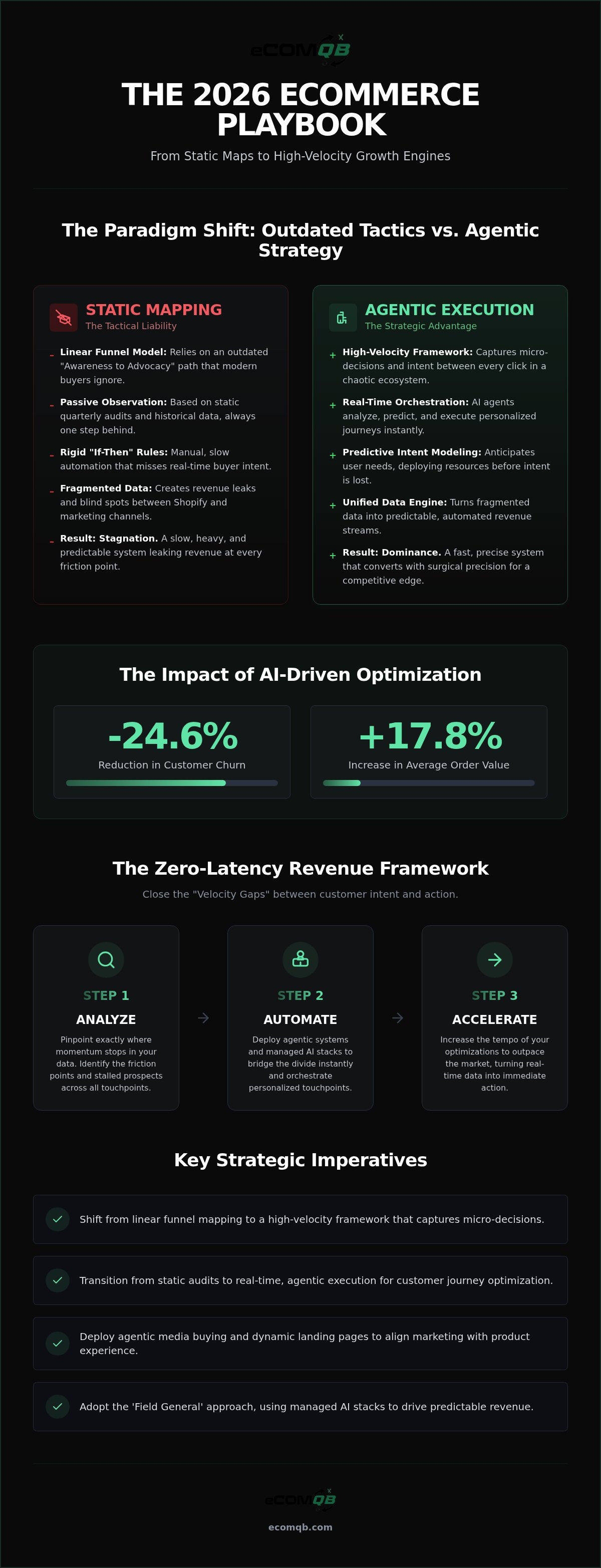
The map is dead; the engine is everything. In 2026, traditional funnel mapping is no longer a strategic advantage, it's a tactical liability. You've likely felt the pressure of Shopify Plus base prices climbing to $2,500 and the relentless surge of fragmented data across your marketing channels. Relying on a linear path in a world of AI-driven micro-decisions is a recipe for stagnation. High-performance ecommerce customer journey optimization now demands a shift from passive observation to real-time, agentic execution. You already know that static landing pages and rigid funnels are leaking revenue. It's time to stop sketching the journey and start dominating it.
This playbook delivers the strategic mastery required to transition into a high-velocity growth model. You will master the transition from static mapping to agentic systems that capture every buyer decision as it happens. We will break down the mechanics of lowering checkout friction, automating personalized experiences, and deploying AI stacks that turn fragmented data into predictable revenue. This is your tactical briefing on how to build, optimize, and scale a storefront that converts with surgical precision. Prepare to move fast, execute with intent, and secure your competitive edge in the new digital economy.
Key Takeaways
- Shift from outdated linear funnel mapping to a high-velocity framework that captures micro-decisions and intent between every click.
- Master ecommerce customer journey optimization by transitioning from static quarterly audits to real-time, agentic execution.
- Deploy agentic media buying and dynamic landing pages to instantly align your marketing promise with the product experience for every segment.
- Adopt the 'Field General' approach to orchestrate growth using managed AI stacks that eliminate operational overhead and drive predictable revenue.
- Implement a zero-latency revenue framework where AI agents orchestrate personalized touchpoints across your entire Shopify ecosystem.
Beyond the Linear Funnel: The 2026 Customer Journey Reality
The traditional "Awareness to Advocacy" model is a relic. For 8-figure brands, relying on this linear progression is a strategic failure. In 2026, the modern buyer doesn't follow a path; they inhabit an ecosystem. They bounce between social commerce, AI assistants, and mobile apps in a chaotic web of micro-decisions. If your strategy is built on a static map, you're already behind. True ecommerce customer journey optimization requires a shift from drawing maps to building systems. You must capture the intent that lives between the clicks, where the real revenue is won or lost.
Static tech stacks are riddled with revenue leaks. These are the moments where fragmented data across Shopify and marketing channels creates blind spots. When your landing pages don't convert different segments instantly, you lose. You need a system that feels, reacts, and optimizes in real-time. This isn't about making minor adjustments; it's about a total overhaul of how you perceive the buyer's movement through your digital storefront.
The Death of the Predictable Path
Cross-platform fragmentation has effectively destroyed traditional attribution. With the average brand selling across 3.4 channels in 2026, tracking a single user journey is nearly impossible with legacy tools. New privacy standards and the rise of "AI Assistant" referral traffic in Google Analytics 4 have made visibility a premium asset. Most journey maps are obsolete before the ink dries because they assume a stability that no longer exists. You aren't managing a funnel; you're managing a high-velocity environment where variables change by the millisecond. Precise, automated, and ruthless execution is the only way to maintain a competitive edge.
Defining Your Brand’s Velocity Gaps
Where do your prospects stall? Identification is the first step toward mastery. In the consideration phase, even a minor friction point can trigger a bounce to a competitor. Slow response times in personalization or customer service aren't just inconveniences; they're growth killers. You must audit your touchpoints to find where the tempo drops and the customer loses interest.
A Velocity Gap is the total time elapsed between a customer’s initial intent and their completed action.
To close these gaps, you must eliminate the lag across every channel. Use this triadic approach to regain momentum:
- Analyze: Pinpoint exactly where the momentum stops in your data.
- Automate: Deploy agentic systems to bridge the divide instantly.
- Accelerate: Increase the tempo of your optimizations to outpace the market.
The goal is zero-latency revenue. You don't need a better map. You need a faster engine.
Engineering Zero-Latency Revenue: The Agentic Journey Framework
The map is not the territory. While your competitors are busy sketching flowcharts, leaders are engineering engines. Agentic ecommerce customer journey optimization is the shift from reactive tracking to autonomous orchestration. It replaces static "if-then" triggers with AI agents that analyze, predict, and execute in real-time. This isn't just personalization; it's individualized commerce. You're no longer waiting for a user to fall into a predefined segment. You're creating a unique path for every visitor as they move across your storefront. This is the new standard of precision.
Zero-latency revenue is the ultimate objective. By anticipating intent before a user even considers leaving, you prevent cart abandonment rather than trying to recover it. Research from July 2026 indicates that AI-driven personalization can reduce churn by 24.6% while increasing average order value by 17.8%. These aren't marginal gains. They represent a fundamental shift in how 8-figure brands capture value. If your system isn't moving at the speed of intent, you're losing money to the gap between clicks.
Autonomous Orchestration vs. Manual Rules
Traditional marketing automation is built on rigid "if-then" logic. In a high-velocity environment, this approach is too slow, too heavy, and too predictable. By the time a manual rule triggers, the moment of intent has passed. 2026 requires predictive intent modeling. This system identifies the subtle signals of a high-value buyer and deploys resources instantly. Integrating agentic email marketing ensures that your retention efforts are as dynamic as your storefront. You aren't sending blasts; you're conducting a symphony of real-time touchpoints that adapt to the individual's behavior.
The Three Pillars of High-Velocity Journeys
To achieve peak performance, your framework must stand on three tactical pillars designed to identify, deploy, and dominate:
- Precision Targeting: Finding high-intent users early in the journey through agentic media buying and advanced data modeling.
- Dynamic Content: Adapting every pixel of your storefront to match the user's specific pain points and desires in milliseconds.
- Frictionless Conversion: Removing every technical or psychological barrier to the purchase through specialized Shopify development and streamlined checkouts.
If your current stack lacks these capabilities, you're leaving revenue on the table. It's time to audit your AI readiness and deploy a system designed for the speed of the modern digital economy. This is how you win the game of micro-decisions.
Static Mapping vs. Real-Time Optimization: Choosing Your Edge
The Old Guard approach to ecommerce customer journey optimization is a liability. It relies on quarterly audits, manual spreadsheets, and static snapshots of a market that has already moved on. By the time you identify a friction point through a manual audit, you've already lost thousands in potential revenue; instead, leveraging an AI-driven critique from WeVibe.fail can pinpoint conversion leaks instantly. This legacy mindset treats the journey as a fixed path to be studied. In reality, the journey is a high-velocity environment that must be mastered in real-time. The New Guard doesn't map; they optimize. They deploy continuous, AI-driven evolution that adapts to user behavior as it happens.
Analysis paralysis is the silent killer of 8-figure DTC brands. Leaders often find themselves buried in fragmented data from Meta, Google, and Shopify, unable to make a decisive move. Static maps exacerbate this by presenting too many variables without a clear path to execution. Transitioning to an agentic model eliminates this friction. It replaces "what if" with "what now." Measuring the ROI of this transformation is simple: look at your Marketing Efficiency Ratio (MER). In 2026, the benchmark for a healthy MER is between 3.0 and 5.0x. If you aren't hitting these numbers, your static strategy is likely the culprit.
Manual journey management is a drain on resources and a magnet for human error. When you rely on team members to manually update funnels or adjust bidding, you introduce latency. This delay is where revenue leaks occur. Your competitors are already winning by deploying eCommerce AI growth systems that operate without the need for constant human intervention. These systems don't get tired, they don't miss patterns, and they don't freeze under pressure. They provide a level of systemic precision that manual efforts simply cannot match. You must choose between the weight of legacy overhead or the speed of autonomous growth.
Data Integrity as the Ultimate Tactical Advantage
A unified data layer is the foundation of strategic mastery. Without it, your AI agents are flying blind. You must eliminate the silos between your advertising platforms and your Shopify storefront to create a single source of truth. Integrity in your data allows for surgical execution. Leveraging AI for Shopify personalization ensures that every touchpoint is informed by the totality of the customer's history and current intent. This isn't just about collecting data; it's about weaponizing it. When your data is clean, synchronized, and actionable, you gain a decisive edge over every competitor still stuck in the Old Guard way of thinking.
The Tactical Playbook: 5 Levers to Optimize Every Touchpoint
Strategy without execution is just a hallucination. To achieve true ecommerce customer journey optimization, you must move beyond the "app-bloat" mentality that slows down your storefront and frustrates your users. Instead, you need to deploy five specific levers designed for speed, precision, and profit. These tactical moves ensure that your brand remains the inevitable choice at every micro-decision point. You don't just want to participate in the market; you want to dictate its terms.
Optimizing the Entry Point: Agentic Media Buying
The journey begins long before the first click. While your competitors struggle with manual bidding and broad targeting, you must leverage agentic media buying to secure the high ground. AI agents now identify high-LTV signals in real-time, adjusting your Meta and Google spend with surgical precision. This isn't just about traffic; it's about quality. By identifying the specific behaviors of your most valuable customers, you reduce CAC and ensure that every dollar spent is an investment in long-term growth. You aren't just buying ads; you're acquiring future revenue at a discount.
The Conversion Engine: Agentic Landing Pages
Static product pages are the primary bottleneck in the modern buyer journey. They are rigid, generic, and unresponsive to the unique intent of the visitor. In 2026, high-performance brands replace these relics with dynamic storefronts that adapt instantly. Agentic Landing Pages are self-optimizing conversion environments that adjust layout, copy, and offers based on the referral source and user behavior. If a visitor arrives with specific pain points, the page shifts to address them. This level of AI personalization ensures that the promise made in your ad is matched by the experience on the page, eliminating friction and maximizing your conversion floor. To further support these conversions, managing your ethical standing with WhoRatesMe provides the Google-compliant social proof needed to build immediate trust with new visitors.
The post-purchase phase is where 8-figure brands are built. With 69% of online orders now generated via smartphones, your retention strategy must be mobile-first and high-velocity. Stop sending generic email blasts. Instead, use agentic SMS and email flows to predict the next best action for every individual. SMS conversion rates can reach 11 to 20% when the timing and offer are perfectly aligned with the user's history. By automating the feedback loop, you turn every buyer into a data point that improves the journey for the next customer. You must analyze, adapt, and accelerate to keep your brand at the center of their digital life.
Stop losing revenue to slow systems and manual errors. Book your tactical briefing and deploy the high-velocity playbook your brand deserves.
Scaling to 8-Figures: Deploying Your Managed AI Growth System
Scaling to 8 figures is a game of systemic precision, not headcount. In the 2026 digital economy, traditional growth strategies often lead to bloated teams and diminishing returns. The "Field General" approach rejects this complexity. It demands that you orchestrate your growth with the same tactical mastery a commander brings to a high-stakes operation. Just as you optimize your tech stack, you can also optimize your cognitive clarity; for instance, high-performing executives explore Remote Neurofeedback from Neurobics to enhance the focus required for such complex orchestration. True ecommerce customer journey optimization at scale isn't about adding more human variables to the equation. It's about removing them. You must transition from manual oversight to a managed AI growth system that operates with surgical efficiency.
The perfect internal hire for AI strategy is a myth. Many DTC leaders waste months searching for a unicorn to lead their technical execution, only to find that the landscape has shifted again by the time they're onboarded. Managed services eliminate this friction. By partnering with eComQB, you gain access to a battle-tested AI technology stack without the massive overhead of a specialized in-house team. We act as your tactical partner, embedding high-performance agents directly into your Shopify ecosystem. This allows your leadership to focus on high-level strategy while our systems handle the technical orchestration of your revenue engine.
Your roadmap for success is already written. Mastery requires a clear path, and the AI transformation for eCommerce brands playbook provides the framework for this transition. It's time to move beyond experimentation and start deploying systems that deliver predictable, high-velocity growth.
The Next Move: Your Competitive Playbook
Success in 2026 is reserved for those who move with intent. You must audit your current journey for Velocity Gaps today. Every second of lag between a customer's intent and their completed action is a leak in your revenue bucket. Use this final checklist to assess your readiness for 8-figure velocity:
- Data Synchronization: Is your data unified across Shopify, Meta, and Google?
- Agentic Execution: Are your media buying and landing pages optimizing in real-time?
- Predictive Retention: Does your system anticipate churn before it happens?
- Operational Leanliness: Can you scale revenue without increasing your internal headcount?
If you're missing even one of these pillars, your growth is at risk. Set your 2026 targets with data-driven confidence and stop settling for "good enough" performance. The map is dead; the engine is everything. It's time to secure your high-performance growth system with eComQB and dominate your category.
Dominate the High-Velocity Digital Economy
The era of passive observation is over. In 2026, the brands that win are those that replace static maps with autonomous engines. You've seen how the traditional funnel has fractured into a series of rapid micro-decisions. Mastering ecommerce customer journey optimization now requires a relentless focus on zero-latency execution. You must bridge velocity gaps, deploy agentic systems, and eliminate manual overhead. The engine is built. The playbook is clear. Now, you must execute.
Strategic mastery is not a solo pursuit. As agentic media buying experts, we specialize in 8-figure eCommerce scaling through Shopify-first growth strategies that prioritize results over activity. Don't let legacy thinking anchor your brand while the market accelerates. It is time to move from the drawing board to the field. Scale your brand with a managed AI growth system and secure your position at the top of the leaderboard. The future belongs to the fast, the precise, and the bold. Let's win.
Strategic Briefing: Frequently Asked Questions
What is the difference between customer journey mapping and optimization?
Mapping is a static snapshot; optimization is active execution. Mapping identifies a theoretical path, but ecommerce customer journey optimization focuses on the real-time engine that drives the user forward. In 2026, mapping is often a legacy exercise that leads to analysis paralysis. Optimization uses agentic systems to adapt touchpoints as behaviors change. This ensures your storefront remains a high-velocity conversion environment rather than a fixed drawing on a whiteboard.
How does AI improve the ecommerce customer journey in 2026?
AI shifts the experience from segmented to individualized. It processes real-time intent signals to adapt storefronts, ads, and emails instantly. Research shows AI-driven personalization can reduce churn by 24.6% and increase average order value by 17.8%. By deploying agentic systems, brands capture micro-decisions that manual rules miss. This creates a high-performance environment where the system anticipates needs before the customer articulates them. It turns your storefront into a proactive revenue engine.
What are the most critical KPIs for customer journey optimization?
The most critical metric is the Marketing Efficiency Ratio (MER). The 2026 benchmark for healthy operations is between 3.0 and 5.0x. You must also track Velocity Gaps, which measure the time between initial intent and final action. Other vital indicators include the global average conversion rate, which currently sits at 2.5 to 3.0%. Focus on high-LTV signals and real-time attribution rather than outdated vanity metrics like total clicks or impressions.
Can I optimize the customer journey on Shopify without third-party apps?
Yes, and it is often the superior strategy. Over-reliance on third-party apps leads to "app-bloat," which slows down your storefront and increases friction. Professional ecommerce customer journey optimization involves specialized Shopify development and custom AI stacks. These integrations run natively or via managed systems. This ensures high-speed performance without the technical debt of generic plugins. A lean, custom-built storefront is the ultimate tactical advantage for scaling 8-figure brands.
How do agentic landing pages increase conversion rates?
Agentic landing pages function as self-optimizing conversion environments. They don't just sit there; they react. By analyzing the referral source and browsing behavior, these pages adjust layout, copy, and offers in milliseconds. This eliminates the bottleneck of static product pages. When the storefront adapts to match the specific promise of an ad, psychological friction disappears. This level of precision leads to a significant increase in your brand's conversion floor.
What is zero-latency revenue in eCommerce?
Zero-latency revenue is the elimination of the lag between a buyer's desire and the completed transaction. It is the primary tactical objective of a high-velocity growth system. In 2026, any delay in personalization or response is a revenue leak. By using AI agents to orchestrate real-time touchpoints, you capture intent at its peak. This approach prevents cart abandonment before it starts. It ensures your brand captures every possible dollar in the modern journey.
How do I reduce friction in the checkout process using AI?
AI reduces friction by predicting and removing technical or psychological barriers. This includes deploying simplified mechanisms for returns, as required by EU standards starting June 19, 2026. AI also streamlines the process through predictive form filling and dynamic payment options based on user history. By analyzing where users stall, AI agents trigger real-time assistance or personalized offers. This secures the "Yes" without requiring manual intervention from your internal team.