Predictive Personalization for eCommerce: The 2026 Strategic Playbook

Standard retargeting is dead, and your rising customer acquisition costs are the autopsy report. You've seen the diminishing returns on your Meta and Google spend as the old playbook of chasing clicks loses its edge. It's frustrating to watch data silos fragment your customer view while your competition moves faster. You need a system that anticipates, executes, and scales. You deserve a strategy that works as hard as your capital.
Mastering predictive personalization for eCommerce is the only way to bridge the gap between raw data and 8-figure velocity. We're moving beyond basic product recommendations into a new era of agentic growth. This guide serves as your strategic playbook to transform reactive marketing into a proactive revenue engine. It's time to stop guessing and start winning. You'll learn to deploy AI tools that sense customer intent, deliver intuitive experiences, and maximize profitability without adding operational overhead. We will explore the mechanics of agentic storefronts, the power of unified data, and the tactical framework required to lead your market through 2026 and beyond.
Key Takeaways
- Shift from reactive segmentation to proactive intelligence: anticipate customer needs, drive higher LTV, and outpace the competition.
- Unify fragmented data from Shopify, Meta, and Google into a single, high-performance source of truth for elite decision-making.
- Master predictive personalization for eCommerce by bridging the gap between raw software capabilities and fully managed revenue execution.
- Eliminate the "Ghost Tool" problem by replacing underutilized software with an integrated system that drives automated growth.
- Execute a tactical 5-step blueprint to map intent, maximize margin, and scale your brand to 8-figure velocity.
Beyond Reactive Marketing: Why Predictive Intelligence is the 2026 Standard
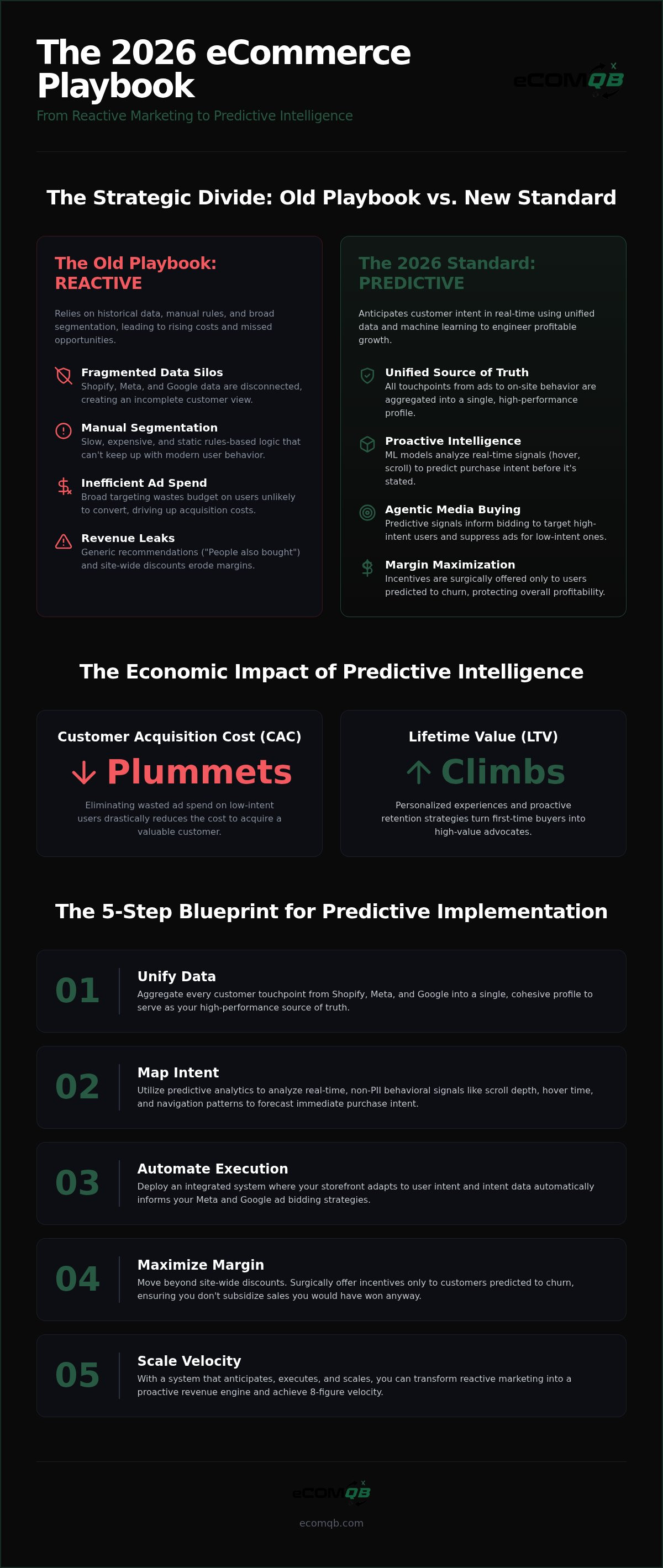
The era of tracking what a customer *did* is over. In the 2026 market, looking at historical data alone is like driving a race car by looking through the rearview mirror. To lead, you must look forward. This shift defines predictive personalization for eCommerce: the systemic anticipation of customer intent before it's explicitly stated. It's the difference between reacting to a sale and engineering one. Manual segmentation and rules-based logic are failing at scale because they can't handle the velocity of modern digital behavior. They are static, slow, and expensive. If your growth depends on a human setting manual rules, you've already lost the race to brands using automated intelligence.
Reactive vs. Predictive: The Strategic Divide
Legacy tactics like "People also bought" are revenue leaks masquerading as features. They rely on broad averages that ignore the specific context of the current session. Modern predictive engines utilize predictive analytics to analyze session-based affinities in real time. They forecast immediate purchase intent based on subtle signals: scroll depth, hover time, and navigation patterns. This approach relies on non-PII data, ensuring your brand remains privacy-compliant while maintaining surgical accuracy. You aren't just following the customer; you're leading them to the checkout. Predictive personalization for eCommerce turns your storefront into a living sales agent that learns, adapts, and converts with every click.
The Economic Impact on CAC and LTV
Anticipation is the ultimate friction killer. When a storefront adapts to a user's intent instantly, conversion rates climb and Customer Acquisition Costs (CAC) plummet. Predictive intelligence allows you to identify high-value customers before they even make their first purchase. You can prioritize your ad spend on the users most likely to become 8-figure brand advocates. This precision extends to margin protection. Instead of blasting site-wide discounts, the system only offers incentives to customers predicted to churn. This ensures you aren't subsidizing sales you would have won anyway. It's a lean, aggressive approach to profitability that maximizes every dollar spent. By 2026, this isn't a luxury; it's a core survival requirement for brands that refuse to settle for mediocrity. You must choose: innovate your architecture or watch your margins evaporate.
The Architecture of Anticipation: How Predictive Engines Drive Revenue
Execution is only as good as the intelligence behind it. To scale an 8-figure brand in 2026, you cannot rely on fragmented data silos that separate your Shopify store from your Meta and Google ad accounts. True predictive personalization for eCommerce requires a unified architecture. This single source of truth aggregates every touchpoint into a cohesive profile. It's about building a foundation where data flows seamlessly between your acquisition channels and your storefront. When your system understands the full customer journey, it stops reacting to history and starts engineering the future. This isn't just about collecting data; it's about weaponizing it for growth.
The heart of this architecture is the Machine Learning Loop. This system doesn't just store information. It learns from every click, scroll, and skip in real time. It identifies patterns that human analysts miss. By implementing proactive, predictive personalization, your brand moves from static segments to individual intent mapping. However, the tech stack must be curated with precision. Bloated AI software that doesn't talk to your core systems creates operational overhead. You need a managed revenue engine that simplifies complexity rather than adding to it. If you're ready to audit your current stack, you can speak with a tactical partner to identify your growth levers.
The Role of Agentic Media Buying
Predictive intent data is the ultimate advantage in paid media. Instead of broad targeting, agentic media buying uses real-time signals to inform Meta and Google bidding strategies. This system identifies high-intent users and aggressively captures their attention while suppressing ads for those unlikely to convert. It eliminates wasted spend. It protects your margins. By feeding predictive signals back into your ad platforms, you train the algorithms to find your most profitable customers with surgical precision. This is high-velocity acquisition at its most efficient.
Dynamic Storefronts and Agentic Landing Pages
The journey from ad to cart must be frictionless and intuitive. Predictive personalization for eCommerce allows you to deploy dynamic storefronts that adapt hero sections and product grids based on predicted user affinity. This is the science of the "Agentic Landing Page." Every visitor sees a version of your site tailored to their specific needs. Our expertise in Shopify design and development ensures these experiences are fast, responsive, and conversion-optimized. You aren't just showing products. You are presenting the exact solution the customer is looking for before they even have to search for it.
Software vs. Managed Systems: The Execution Gap in eCommerce
Buying software isn't a strategy. It's a bill. Many 8-figure brands fall into the trap of purchasing expensive platforms only to realize they lack the tactical expertise to run them. This creates the "Ghost Tool" problem. Industry reports indicate that roughly 70% of personalization software goes underutilized. It sits in your tech stack, draining your budget without moving the needle on your bottom line. To win, you need more than a dashboard. You need a managed revenue engine that functions with surgical precision.
The hidden cost of internal management is staggering. Building an in-house team requires hiring data scientists, specialized developers, and AI prompt engineers. That's a massive operational overhead that distracts from your core mission. A curated AI technology stack, managed by experts, beats a single monolithic platform every time. At eComQB, we take a "Field General" approach to AI transformation. We don't just hand you the tools. We orchestrate the entire offensive line, ensuring every component of predictive personalization for eCommerce is optimized for peak performance.
The Managed AI Growth System Advantage
Part of this orchestration involves staying current with industry-specific technology trends; for instance, you can discover Jewelry eCommerce to see how specialized platforms are shaping the future of digital diamond and jewelry retail.
Managed systems eliminate the friction of execution. We deploy fully managed agentic workflows that adapt as fast as the market moves. This is how you scale to 8-figures without bloating your internal marketing team. Our systems provide continuous optimization, keeping pace with algorithmic shifts in real time. You get the results of a world-class AI department without the management headache. It's about precision, speed, and sustained profitability. Much like how EdNex Automation optimizes physical workflows through industrial robotics, these digital systems allow you to focus on high-level strategy while we handle the technical complexities of growth.
Shopify brands are uniquely positioned for high-velocity scaling, but standard apps often hit a ceiling. Rules-based logic can't handle the complexity of 2026 consumer behavior. You need custom AI growth systems that integrate deeply with your storefront. This includes deploying agentic email marketing to bridge the gap between acquisition and retention. By unifying predictive personalization for eCommerce across every channel, you create a zero-latency revenue machine. Don't settle for a collection of disconnected tools. Invest in a managed system that executes with authority and delivers measurable growth.
From Data to Dollars: A 5-Step Blueprint for Predictive Implementation
Theory alone won't hit your revenue targets. You need a tactical roadmap to move from fragmented data to a high-velocity revenue engine. This 5-step blueprint is designed to strip away complexity and focus on the levers that actually drive growth. It's about moving from broad assumptions to surgical execution. By following this framework, you transform predictive personalization for eCommerce from a buzzword into a managed system that generates profit on autopilot. You aren't just reacting to the market; you're dictating the terms of engagement.
Step 1: Resolving the Identity Crisis
You can't personalize for a ghost. Step 1 focuses on Data Hygiene and Identity Resolution across every touchpoint. In a post-cookie world, your brand's survival depends on unifying anonymous session data with known customer profiles. Identity resolution is the bedrock of predictive accuracy. Without it, your AI is merely guessing. By centralizing first-party data from Shopify, Meta, and Google, you create a clear, centralized, and actionable view of every individual in your ecosystem.
Step 2: Intent Mapping. Once your data is clean, you must define the high-value behaviors that signal purchase readiness. This isn't about basic demographics; it's about sequence and velocity. We identify the patterns—the specific products viewed, the dwell time on key pages, the cart additions—that indicate a user is moving from "browsing" to "buying." This allows your system to prioritize high-intent traffic and maximize your ad spend efficiency before a competitor even realizes the lead is active.
Step 3: Activating Agentic SMS and Email
Standard automation is a legacy tactic. You need agentic execution. This step involves deploying messages based on "predicted need" rather than "past purchase." We trigger SMS and email at the user's individual peak engagement time, creating zero-latency revenue. This ensures your brand is present exactly when the customer is most likely to convert. At eComQB, we specialize in managing these AI growth systems so you can scale without increasing your internal workload.
Step 4: Dynamic Creative Optimization (DCO). Your creative must be as fluid as the data driving it. Step 4 uses predictive affinities to serve the right image, headline, and offer to the right person in real time. Step 5: Iterative Performance Auditing. Finally, you must link every personalized touchpoint directly to ROAS. We audit the system constantly to ensure every automated action contributes to your 8-figure trajectory. If you're ready to deploy this framework and own your market, book a tactical briefing today.
Engineering Velocity: Scaling Your Brand with eComQB’s AI Growth Systems
You've built a brand. Now you must build a machine. Scaling to 8 figures requires more than just increased ad spend; it requires a systemic upgrade of your entire operation. eComQB exists to turn AI complexity into a high-performance revenue engine. We specialize in AI transformation for eCommerce brands that are tired of fighting technical bloat and diminishing returns. Our mission is clear: we provide the managed systems that turn data into decisive market leadership. We don't just offer tools. We offer a path to peak performance.
Why do 8-figure brands choose managed AI transformation over manual scaling? The answer is velocity. Manual processes are the friction that kills growth. By deploying predictive personalization for eCommerce through our Revenue Generating AI Tools, you eliminate the need for constant human intervention. You move from a reactive posture to a proactive offensive. This isn't just about efficiency. It's about owning the customer journey before your competitors even see the signal. You need a system that thinks, acts, and scales as fast as the market moves.
The competitive advantage in a crowded DTC market belongs to those who embrace "Agentic" workflows. These are autonomous systems that sense, adapt, and execute without adding to your internal headcount. Whether it's agentic media buying or agentic landing pages, these systems work around the clock to capture and convert high-intent traffic. Most brands are currently leaking revenue through fragmented data silos. Our AI diagnostic finds these leaks and plugs them with surgical precision, ensuring every dollar of your capital works harder. This is the difference between surviving and dominating.
A Strategic Partnership for Peak Performance
The same principles of precision and intent-based targeting are vital for high-value niche markets; for example, you can learn more about Colorado Horse Property to see how specialized platforms serve the unique needs of the equestrian real estate market.
We don't operate as a standard vendor. We function as your tactical coach and partner. This is a "Field General" model of leadership where we understand the technical complexities but remain focused on your ultimate objective: 8-figure velocity. Our roadmap to scaling involves a managed AI technology stack that integrates seamlessly with your Shopify store. We take the technical burden off your shoulders so you can focus on high-level strategy and brand vision. You get the power of an elite data science team without the operational overhead.
The transition to predictive personalization for eCommerce is the most critical move you'll make this year. Don't let your brand get left behind by legacy thinking. It's time to stop managing software and start leading a revenue machine. Accelerate your growth, protect your margins, and dominate your niche with a managed AI growth system. The game has changed. It's time to play at a higher level. Book your AI diagnostic now to begin your transformation.
Dominate the 2026 Market with Predictive Intelligence
The window for reactive marketing is closing fast. To lead your category, you must replace stagnant, rules-based logic with a system that anticipates intent in real time. We've outlined the architecture required to unify your data and the tactical blueprint to activate it across every channel. You've seen why predictive personalization for eCommerce is the engine behind 8-figure velocity. It's no longer about having the right tools; it's about having the right managed execution to drive consistent results.
eComQB provides the Managed AI Transformation you need to eliminate technical friction and maximize profitability. We specialize in Shopify Development and Agentic Media Buying, turning complex data into a high-performance revenue machine. Don't let your brand settle for underutilized software or rising acquisition costs. Take command of your growth trajectory and outpace the competition before they even see you coming. You have the playbook. Now, it's time to execute with surgical precision.
Deploy Your Revenue-Generating AI System with eComQB and start engineering your 8-figure future today. The market rewards the bold and the prepared.
Frequently Asked Questions
What is the difference between personalization and predictive personalization?
Standard personalization is reactive; it looks backward at historical purchases or past behavior. Predictive personalization for eCommerce is proactive; it looks forward at future intent. It uses real-time session signals to anticipate a user's next move before they make it. You aren't just following the customer; you are leading them. This shift from "what they did" to "what they will do" is the core of 8-figure velocity.
Does predictive personalization require a huge amount of customer data?
Precision matters more than volume. You don't need petabytes of data to start, but you do need clean, unified first-party data. The system thrives on quality signals from your Shopify store, Meta ads, and Google campaigns. Small, high-quality datasets often yield faster results than massive, fragmented silos. We focus on resolving identity and mapping intent to ensure every data point serves your growth objectives.
How does predictive personalization improve eCommerce ROAS?
It optimizes your capital by eliminating waste. Predictive engines identify high-intent users and prioritize them for high-value ad placements. This precision suppresses spend on visitors unlikely to convert while maximizing exposure to those ready to buy. By protecting your margins and focusing on high-velocity segments, you drive higher ROAS. It's about playing the game with better intelligence, faster execution, and superior intent mapping.
Is predictive personalization compliant with GDPR and CCPA?
Compliance is a foundational requirement, not an afterthought. These systems prioritize first-party data and utilize session-based affinities rather than sensitive personal identifiers. By focusing on non-PII signals and secure identity resolution, you maintain a privacy-first posture while delivering intuitive experiences. You get the competitive advantage of high-level intelligence without compromising the trust of your customers or the legal integrity of your brand.
Can predictive personalization be used for Shopify brands of all sizes?
Scalability is built into the architecture. While 8-figure brands see the most immediate impact due to higher traffic volume, any brand ready to move beyond manual rules-based logic can benefit. Implementing predictive personalization for eCommerce allows smaller brands to punch above their weight. It levels the playing field by providing the same enterprise-level AI transformation used by industry leaders to dominate their respective niches.
How long does it take to see results from an AI growth system?
Speed to lead is our priority. Most brands see significant baseline improvements within 30 to 90 days of implementation. This window allows the machine learning loop to ingest session data, map customer intent, and begin optimizing your marketing channels. The system gets sharper, faster, and more efficient with every interaction. You'll see the momentum build as the engine moves from initial learning to autonomous revenue execution.
Do I need a data scientist to manage predictive personalization?
You don't need to hire an internal team to win. Managed growth systems provide the specialized expertise and technical infrastructure required for peak performance. You gain access to elite data science, prompt engineering, and systemic optimization without the operational headache of internal management. This allows you to focus on high-level strategy while we orchestrate the technical offensive. It's about leverage, speed, and sustained results.