Online Retailers’ Sales Revenue Increase Strategies for 2026: A Practical Playbook

More traffic is often the wrong first move. If revenue feels inconsistent, adding campaigns or cutting prices can bring in more orders without fixing the constraint holding back growth. The strongest online retailers sales revenue increase strategies 2025 start by diagnosing the funnel, then improving the lever with the clearest path to profitable gains.
Marketing activity can rise while store performance stays flat. Discounts can lift conversion today while shrinking margin. Sustainable growth means knowing where revenue is leaking, which action deserves priority, and whether the result improves profit, not just sales volume.
This playbook shows how to identify ecommerce revenue levers and prioritize them with performance data. Assess acquisition, conversion, average order value, retention, and repeat-purchase behavior, then measure each change against revenue and profitability. The goal is a sharper growth plan: address the binding constraint first, layer AI onto proven frameworks, and keep optimizing as customer behavior changes.
Key Takeaways
- Separate revenue, order volume, and profit to see whether growth is strengthening the business.
- Use the online retailers sales revenue increase strategies 2025 playbook to assess acquisition, conversion, order value, and repeat purchasing.
- Match performance symptoms to diagnostic metrics, then test the clearest opportunity instead of launching every tactic at once.
- Use a 90-day framework to establish a baseline, focus on one constraint, run tests, and review results. The timeline is a planning tool, not a guarantee.
- Apply AI to proven growth frameworks, using audits and ongoing oversight to keep data, automation, and performance aligned.
Online Retail Sales Revenue: Understand the Levers Before Choosing Tactics
Before choosing a tactic, define the outcome. Ecommerce revenue is the value generated by customer transactions over a defined period, shaped by the number of orders and the value of those orders. The online shopping journey can include product discovery, comparison, purchase, and repeat orders. A revenue change may reflect several stages, not just an increase in traffic.
Revenue isn’t the same as orders, units sold, or profit. Orders count transactions; units sold count products within those transactions. Profit accounts for the costs associated with generating and fulfilling sales. A store can sell more units or record more orders while revenue barely changes. Revenue can also rise while profit weakens. For useful analysis, define whether revenue includes discounts, shipping, taxes, returns, and refunds, then use that definition consistently.
Revenue movement usually traces back to four connected levers: attracting qualified traffic, converting visitors into buyers, increasing order value, and encouraging repeat purchases. More visitors won’t help much if they have little purchase intent. Better conversion can lift orders without increasing traffic. Relevant recommendations may increase order value, while lifecycle marketing can encourage previous customers to return. First identify which lever is limiting performance, then choose a tactic.
Which ecommerce metrics explain revenue movement?
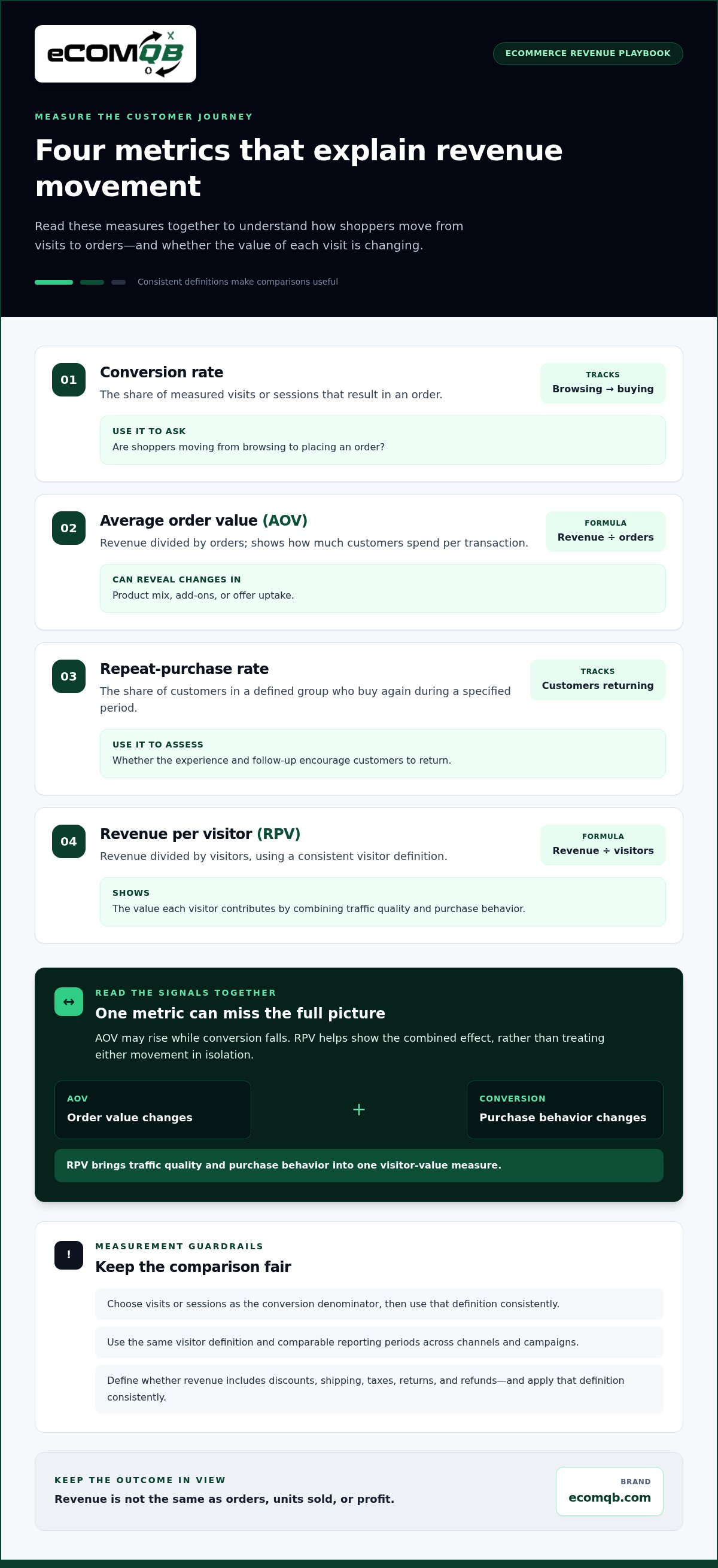
Track metrics that connect store performance to customer behavior. Use the same definitions and comparable reporting periods across channels and campaigns. Otherwise, an apparent gain may reflect a change in measurement rather than actual performance.
- Conversion rate: The share of measured visits or sessions that result in an order. It helps show whether shoppers are moving from browsing to buying. Choose visits or sessions as the denominator and use that definition consistently.
- Average order value (AOV): Revenue divided by orders. It shows how much customers spend per transaction and can reveal changes in product mix, add-ons, or offer uptake.
- Repeat-purchase rate: The share of customers in a defined group who make another purchase during a specified period. It helps assess whether the experience and follow-up encourage customers to return.
- Revenue per visitor (RPV): Revenue divided by visitors, using a consistent visitor definition. It combines traffic quality and purchase behavior to show the value each visitor contributes.
Read these metrics together, not in isolation. AOV may rise while conversion falls; RPV helps show the combined effect. A Revenue Audit can also examine recommendation effectiveness, lifecycle marketing efficiency, and repeat-purchase behavior to identify where the customer journey needs attention.
Why more orders do not automatically mean healthier growth
Consider a hypothetical store that raises order volume through a broad discount and increased acquisition spend. Revenue may increase, but the discount reduces what each order contributes, while advertising adds another cost. If new customers don’t return, the short-term lift may not support durable growth or healthy cash performance.
Set guardrails before launching promotions or scaling acquisition: monitor margin alongside revenue, assess acquisition efficiency, and track whether customers return. These online retailers sales revenue increase strategies 2025 work best when each test has a clear commercial purpose and measurement plan. More sales is a signal. Profitability and repeat behavior help show whether the growth is worth extending.
Five Ecommerce Revenue Levers That Move Customers from Discovery to Repeat Purchase
Revenue growth is a connected sequence, not a collection of disconnected campaigns. Relevant discovery earns attention, a useful storefront builds confidence, and a strong post-purchase experience gives customers a reason to return. If one handoff breaks, more activity elsewhere may not fix the leak.
Use these five levers to connect the journey and decide where to focus:
- Attract qualified visitors. Search visibility, paid media, and relevant content bring potential customers to the store. Assess acquisition by whether visitors match the products and intent you can serve, not by traffic volume alone. A campaign promoting a specific product should lead to a page that clearly delivers on that promise.
- Align discovery with the landing page. Match ad creative, search content, and audience expectations to the product page or storefront. If a shopper clicks looking for a particular use, feature, or product type, make that path easy to recognize. Relevance narrows the gap between what brought someone in and what they find.
- Convert purchase intent. Clear product information, compelling imagery, straightforward navigation, and a focused checkout help shoppers evaluate and act. Review the pages where visitors hesitate or exit. Improve the specific point of friction instead of redesigning the entire storefront without a clear reason.
- Grow order value through merchandising. Recommendations, complementary products, bundles, cross-sells, and upsells can help shoppers discover useful additions. Treat each as a test, not an automatic revenue lift. Check whether the offer increases order value without distracting from the main purchase or weakening commercial performance.
- Retain customers with relevant follow-up. Lifecycle email and SMS can support replenishment, product education, related-product discovery, and repeat purchasing. Segment messages around customer behavior and product context. A timely, useful follow-up is more likely to earn attention than a stream of generic promotions.
Assess acquisition quality before scaling. If paid media attracts clicks but the audience, product, and landing page don’t align, increasing spend can amplify the mismatch. Search visibility and content can capture demand, while paid campaigns can reach selected audiences. Neither guarantees revenue. Set a clear objective for each and compare the customer behavior it produces.
Then test storefront changes against a defined question. If shoppers view a product but don’t add it to the cart, clarify product details or improve the page’s presentation. If customers buy one item but rarely add complementary products, test a relevant recommendation. Keep the test focused so you can distinguish its effect from other activity.
The strongest online retailers sales revenue increase strategies 2025 coordinate acquisition, storefront relevance, conversion, order value, and retention. Treat each stage as part of one system and use performance data to find the weakest handoff. To connect these levers to your store’s performance, map your ecommerce growth priorities.
How to Prioritize Revenue Strategies Using Ecommerce Data
A crowded backlog isn’t a growth strategy. Start with the customer-journey signal that most clearly explains the revenue gap, then test the intervention closest to it. Diagnose the constraint before choosing the intervention. This keeps teams from changing ads, landing pages, promotions, and email flows all at once, then guessing which change mattered.
Use the symptom as a starting point, not a verdict. Check the relevant metric, inspect the customer experience behind it, and choose a focused first test.
| Observed symptom | Candidate lever | Diagnostic metrics | First test |
|---|---|---|---|
| Traffic grows, but visitors show little purchase intent | Acquisition quality | Channel-level conversion, landing-page engagement, revenue per visitor | Align one campaign or content entry point more closely with its audience, product, and destination page |
| Product pages attract visits, but few shoppers proceed | Conversion | Product-page add-to-cart activity, checkout progression, conversion rate | Improve one product page’s clarity or address a specific checkout friction point |
| Orders come through, but order value is weaker than intended | Merchandising and order value | Average order value, recommendation engagement, revenue per visitor | Test a relevant complementary-product recommendation or offer |
| First-time customers rarely return | Retention | Repeat-purchase rate, time between purchases, lifecycle message engagement | Test a behavior-based email or SMS follow-up for a defined customer group |
Match common revenue symptoms to the right investigation
For weak traffic quality, compare the promise in the ad, search result, or content with the landing page shoppers reach. For conversion friction, review product information, mobile usability, checkout steps, and whether recommendations help rather than distract. For weak repeat purchasing, examine customer groups and lifecycle messaging: are follow-ups timely and relevant to what a customer bought? Don’t label a symptom a root cause until the data supports it.
Separate observed evidence from assumptions. Record what analytics show, what customer behavior suggests, and what remains unknown. If tracking is incomplete, channel definitions differ, or a reporting period includes unusual promotional activity, note the limitation. Missing or unreliable data isn’t proof that a tactic failed; it’s a reason to validate measurement before scaling a decision.
Choose tests that protect profitable growth
Give every test four parts: a measurable hypothesis, a defined audience, one primary change, and an evaluation period suited to the behavior being measured. For example: “For visitors arriving from a specific campaign, matching the landing-page headline to the advertised product will improve conversion without reducing revenue per visitor.” This makes the test actionable and sets a clear boundary for interpreting the result.
Track revenue alongside the indicators that explain its quality: conversion, acquisition efficiency, average order value, and retention where relevant. Avoid calling a winner based on an isolated short-term lift or an unverified industry benchmark. Check that the measurement window is comparable and that other changes haven’t distorted the result.
These online retailers sales revenue increase strategies 2025 work best as a decision system: find the strongest signal, test one response, and use the result to set the next move. A focused sequence creates cleaner learning than launching every promising idea at once.
A Practical 90-Day Plan to Increase Online Retail Sales Revenue
Use 90 days as an organizing framework, not a promise that growth will arrive on schedule. The objective is to build a disciplined operating rhythm: establish a trustworthy baseline, investigate the main constraint, run focused tests, and decide what the evidence supports next.
Give every workstream a clear owner. Analytics owns metric definitions and reporting quality. Merchandising owns product-page clarity and recommendations. Campaign owners manage acquisition relevance and performance. Lifecycle marketing owns email and SMS communication. One accountable lead keeps priorities aligned and prevents disconnected changes from muddying the results.
Days 1-30: establish the baseline and diagnose
Start by agreeing on how the team defines revenue, conversion, revenue per visitor (RPV), recommendation performance, and repeat purchasing. Use consistent reporting periods and document gaps in tracking. Then review the customer journey by channel, landing page, product page, and customer group. The goal isn’t to collect every possible metric. It’s to identify the clearest credible signal of where performance is breaking down.
Write down the leading constraint and the evidence behind it. For example, note whether campaign visitors engage with the intended landing page, whether shoppers progress from product pages to checkout, or whether customer groups make subsequent purchases. Separate measured facts from working assumptions. If the data is incomplete, record what needs validation before treating a pattern as a conclusion.
Days 31-90: test, learn, and refine
Choose one focused test tied to the diagnosis. State the hypothesis, audience, change, success measure, and evaluation period before launch. If the suspected issue is a mismatch between a campaign and its destination, adjust one relevant landing-page element for the selected audience. Avoid changing the campaign, page, offer, and follow-up sequence simultaneously. That makes the result harder to interpret.
During the test, review revenue alongside the indicators that explain its quality. Depending on the intervention, these may include conversion, RPV, acquisition efficiency, recommendation engagement, or repeat-purchase behavior. Review campaign performance and lifecycle-flow efficiency as well. At the end of the evaluation period, decide whether to keep, revise, or retire the intervention based on evidence and operational fit. A mixed result can still be useful if it clarifies the next question.
Use the review to set the next priority, not to declare that the entire growth system is solved. A practical understanding of eCommerce AI growth systems can help teams connect proven acquisition, conversion, and retention workflows with appropriate AI support. The operating model still needs clear ownership, reliable inputs, and ongoing review.
A structured plan turns online retailers sales revenue increase strategies 2025 into a sequence of decisions rather than a list of disconnected tactics. To turn performance signals into a focused roadmap, explore your next growth moves.
Turn Revenue Strategies into a Managed, AI-Enabled Growth System
AI can add leverage to ecommerce growth, but it isn’t a growth strategy on its own. Start with proven acquisition, conversion, and retention frameworks, then apply AI where it can strengthen execution, insight, or personalization. The system still needs clear goals, reliable data, and people accountable for the decisions it supports.
That’s the principle behind eComQB’s approach. Its original digital growth program began in 2002 and spun off into eComQB in 2017 after 15 years. The company describes its experience as almost 25 years. Its services connect AI Stack Curation, AI Implementation & Onboarding, Managed AI Operations, Revenue Optimization, Revenue Audits, and Governance & Oversight with established growth systems.
What continuous optimization looks like in practice
AI isn’t a “set it and forget it” system. Ongoing management means reviewing model and automation performance against business goals, checking data quality, and assessing whether recommendations remain relevant to customers and products. These reviews can help identify accuracy risks, address weak inputs, and prevent technology sprawl. Governance provides oversight; it doesn’t promise that every error will disappear.
Optimization also means improving the customer journey. Review merchandising and recommendation performance, refine lifecycle flows, and analyze campaign results against revenue and efficiency measures. If recommendations surface irrelevant products, investigate the data and logic informing them before adding more automation. If a lifecycle flow isn’t supporting repeat behavior, examine its timing, audience, and message relevance. The goal is a managed feedback loop: review, adjust, and measure.
When a managed growth system is the right next move
Fragmented tools, unclear ownership, and revenue reports that don’t connect activity to outcomes can signal that the operating system needs attention. A Revenue Audit can examine revenue per visitor (RPV), conversion, recommendation effectiveness, lifecycle marketing efficiency, and repeat-purchase behavior. It produces a prioritized roadmap to guide the next steps, rather than another disconnected tool or campaign.
AI Stack Curation selects and integrates AI platforms across the ecommerce ecosystem. AI Implementation & Onboarding includes a roadmap, setup, integration, and configuration. Managed AI Operations and Governance & Oversight provide ongoing performance review and executive-level oversight. To understand how this fits into an AI transformation playbook for ecommerce, connect the technology to the business process it’s meant to improve, not the other way around.
The strongest online retailers sales revenue increase strategies 2025 combine a clear commercial objective with disciplined execution and ongoing review. If your growth activity feels fragmented, learn about eComQB’s managed growth approach.
Make Your Next Growth Move Count
The next advantage won’t come from adding more activity. It will come from building a sharper decision loop: notice what customers do, identify the opportunity, and respond with a focused change you can evaluate. That discipline turns online retailers sales revenue increase strategies 2025 into a repeatable way to make better growth decisions, not a one-time campaign push.
Choose one signal your team needs to understand better. Give someone ownership of the investigation, agree on what a useful outcome looks like, and set a review point before work begins. Then use what you learn to guide the next move. Well-measured decisions can build momentum without losing sight of margin or customer experience.
To connect your growth priorities with a managed, AI-enabled approach, book a consultation with eComQB. Take the next step with focus, clarity, and a stronger plan for profitable growth.
Frequently Asked Questions
How can an online retailer increase sales revenue?
Find the customer-journey opportunity with the strongest evidence, then improve it. For example, if shoppers search for a specific product type but land on a broad category page, create a more relevant path and measure what visitors do next. The best online retailers sales revenue increase strategies 2025 connect customer intent to a useful shopping experience, then assess revenue alongside margin and repeat behavior.
What is the difference between sales revenue and profit for an online store?
Sales revenue is the income recorded from customer purchases under your chosen accounting definition; profit is what remains after relevant expenses are deducted. Those expenses may include product costs, advertising, payment processing, and other operating costs. A store can report stronger revenue while profit falls if discounts deepen or acquisition costs rise. Track both, and make sure your team understands which costs its profit measure includes.
How do I calculate revenue per visitor for an ecommerce store?
Divide revenue for a reporting period by the number of visitors in that same period: revenue per visitor = revenue ÷ visitors. Use a consistently defined revenue total and unique visitors for the same date range. Don’t mix session counts with visitor counts or compare periods that use different revenue rules. Segmenting RPV by channel or landing page can show where visitor value varies.
Can an online retailer increase revenue without increasing ad spend?
Yes. A retailer can work on the value generated by existing traffic by improving product discovery, clarifying product details, or making relevant complementary items easier to find. Email and SMS can also support purchases from an existing audience. Compare results with an appropriate period and account for promotions or seasonal shifts. More revenue without added ad spend still needs a margin check to confirm the change is commercially useful.
Which ecommerce metric should I improve first?
Start with the metric that best reflects the clearest, reliably measured constraint, not the one that looks weakest in isolation. If visitors arrive but don’t proceed, inspect conversion indicators and the shopping experience. If customers buy once and don’t return, examine repeat-purchase behavior. Confirm tracking and reporting definitions before acting. The right first metric depends on where customers drop out and which outcome your team can influence.
Can AI help increase online retail sales revenue?
AI can support revenue growth when it’s applied to a clear business objective and integrated with established growth processes. It may help personalize product discovery, analyze campaign performance, or support timely lifecycle messages. Monitor its output rather than accepting it automatically: data quality, relevance, and accuracy matter. AI doesn’t replace sound merchandising, customer understanding, or ongoing performance review, and it can’t guarantee a revenue increase.