AI Average Order Value Optimization: A Revenue-Led Playbook

A higher average order value can still hide a weaker business. AI average order value optimization only works when it increases basket value without pushing shoppers away or undermining profitable growth. Generic upsells and bundles may lift an order total, but they can miss customer intent and weaken the shopping journey.
Looking beyond AOV is the right move. The goal is to make each recommendation relevant, then measure its effect on conversion, revenue per visitor, and repeat purchases. This playbook shows you how to identify AI use cases that fit your merchandising and customer journey, test them against meaningful performance signals, and build governance into ongoing optimization.
AI isn’t a standalone growth engine or a set-it-and-forget-it fix. It’s an operating layer on proven acquisition, conversion, and retention systems. Here’s how to use it with precision, protect customer trust, and turn bigger baskets into stronger business performance.
Key Takeaways
- Use AI average order value optimization to match recommendations to the shopper’s moment, from discovery through post-purchase.
- Separate AOV from revenue per visitor so a larger basket doesn’t mask weaker conversion.
- Compare recommendations, bundles, upsells, and lifecycle offers by customer fit, risk, and the metric each is meant to improve.
- Start with a revenue audit, then prioritize, test, review, and refine AI use cases against clear performance signals.
- Build AI into a managed growth system: curate the right tools, implement with a roadmap, and keep performance under review.
What AI Average Order Value Optimization Means for eCommerce
A larger basket looks like progress, but the number alone can mislead. If shoppers abandon more often or incentives consume the value of the extra items, the business may be worse off. Strong AI average order value optimization uses relevant data to improve product discovery, offers, and merchandising decisions while keeping customer experience and order economics in view.
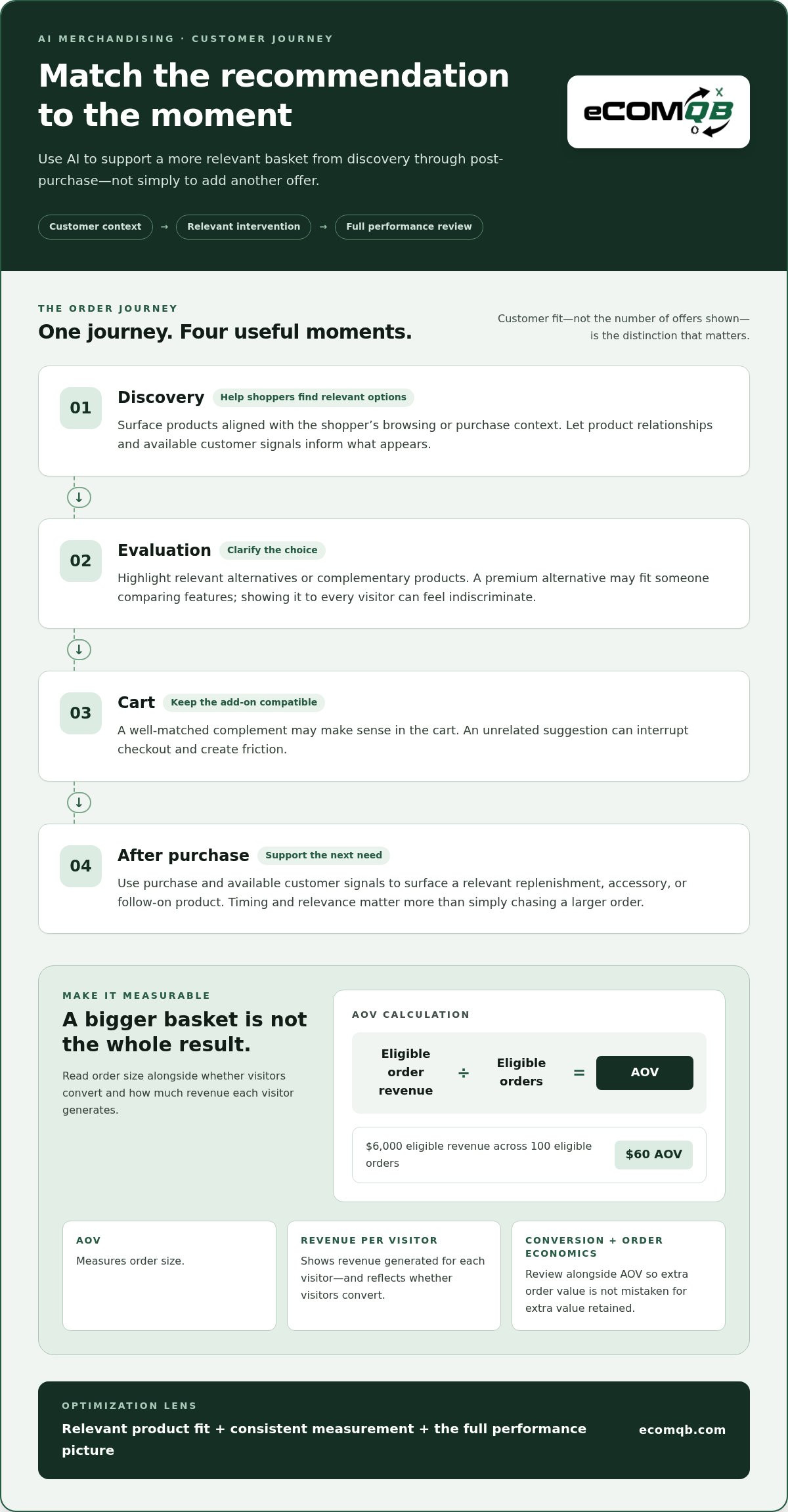
Average order value (AOV) is total order revenue divided by the number of completed orders in the same reporting group. Revenue per visitor answers a different question: how much revenue does the store generate for each visitor? AOV measures order size; revenue per visitor also reflects whether visitors convert. Read both to understand whether larger baskets are contributing to broader performance.
How to calculate AOV and read it in context
Use a consistent formula: eligible order revenue ÷ number of eligible orders = AOV. For example, $6,000 in eligible revenue across 100 eligible orders produces a $60 AOV. The arithmetic is simple, but the rules behind the inputs need to be clear too.
Define what counts as revenue, which orders or adjustments are excluded, how currencies are handled, and the reporting period. Apply those definitions consistently across comparisons. Otherwise, an apparent lift may reflect a reporting change rather than a change in customer behavior.
An overall average can also conceal meaningful differences. AOV may vary by product category, acquisition channel, or customer group. Segmenting the metric helps teams see where recommendations or merchandising changes may be relevant, rather than applying one broad tactic to every shopper.
Why a higher AOV does not automatically mean better performance
AOV is a diagnostic signal, not a complete measure of profitable growth. A discount threshold might encourage a shopper to add another item, increasing the basket while reducing the amount retained from the order. A costly incentive can have a similar effect. Measure the trade-off, not just the total.
Pair AOV with conversion performance and revenue per visitor. If average baskets rise while fewer visitors complete a purchase, revenue per visitor can show whether the change is helping or hurting overall results. Where possible, review order economics alongside these metrics so added revenue isn’t mistaken for added value.
AOV growth is useful only when the surrounding customer and revenue signals remain healthy. That principle gives AI a clear job: surface products that fit customer context, refine offers for the right shopping moment, or inform merchandising decisions. Then evaluate the result against the full performance picture, not a single rising metric.
Where AI Can Improve the eCommerce Order Journey
AI can support a stronger basket at several points in the shopping journey, but the right use case depends on what the customer is trying to do. A shopper browsing a category may need help discovering relevant options. Someone comparing products may need useful distinctions, while a customer building a cart may benefit from a well-matched complement. After purchase, a timely lifecycle message can support a relevant next order.
This is the practical lens for AI average order value optimization: match the intervention to the moment, rather than simply looking for another place to display an offer. Recommendation relevance depends on product relationships, customer context, and the quality and availability of the data used to make a suggestion. The U.S. Chamber of Commerce discusses AI's impact on the economy and business, a useful broader context for evaluating AI as an operating capability, not a shortcut around sound merchandising.
AI product recommendations and complementary items
During discovery, recommendations can surface products aligned with a shopper’s browsing or purchase context. During evaluation, they can highlight relevant alternatives or complementary products. In the cart, a compatible add-on may make sense; an unrelated suggestion can interrupt checkout and create friction. The distinction is customer fit, not the number of recommendations shown.
Separate individualized suggestions from merchandising rules. A recommendation model may rank products for a specific shopper, while rules determine which products can be paired, which complements to show, or when to present a premium alternative. Review recommendation accuracy over time, since product relationships, catalog changes, and customer behavior can shift. The Shopify personalization playbook offers a related view of shaping personalized experiences around the customer journey.
Personalized merchandising, bundles, and lifecycle offers
Bundles and complementary products work best when the combination reflects a real use case. Customer context can help determine which eligible bundle or add-on to present, while merchandising rules prevent combinations that don’t make sense. A premium alternative may suit a shopper comparing features, but showing it to every visitor can feel like an indiscriminate push. Let context guide the presentation.
After purchase, lifecycle messaging can surface a relevant replenishment, accessory, or follow-on product based on the purchase and available customer signals. Timing and relevance matter: an add-on message should support the customer’s next need, not simply chase a larger order. For examples of applying AI to retention messaging, see the agentic email marketing playbook.
Choose one journey moment where better relevance could remove friction or improve discovery, then review how the experience performs. If your team needs a structured way to assess that opportunity, discuss your growth priorities.
How to Compare AI AOV Tactics Without Losing Sight of Profit
There’s no universal winner among recommendations, bundles, upsells, and lifecycle offers. Each tactic targets a different customer moment and carries a different risk. Compare the intended benefit with the possible friction, then measure whether the change supports both the customer and the business. Intel’s overview of AI applications in retail provides broader context for applying AI to customer experiences and retail operations.
Use a comparison table to make the decision concrete. Choose the metric that matches each tactic’s purpose, and keep conversion and revenue per visitor in view alongside AOV.
| Use case | Customer moment | Intended benefit | Risk | Evaluation metric |
|---|---|---|---|---|
| Recommendations | Discovery or product evaluation | Help shoppers find relevant products | Irrelevant suggestions distract or reduce trust | Recommendation engagement, conversion, revenue per visitor |
| Bundles | Product evaluation or cart building | Present complementary items for a clear use case | Forced combinations or discount dependence | Bundle take rate, AOV, order economics |
| Upsells | Product evaluation or cart building | Show a higher-value option that better fits a need | Added friction or pressure to spend more | Upgrade rate, conversion, revenue per visitor |
| Lifecycle offers | After purchase | Encourage a relevant add-on or repeat order | Repetitive promotions weaken relevance | Repeat-purchase behavior, conversion, order value |
Choose the tactic by customer need and shopping context
Start with the shopper’s goal. A bundle should connect products that genuinely complement each other and serve a clear use case. An upsell should solve a real need with a higher-value option, not simply raise the basket total. Lifecycle offers belong at moments when the prior purchase or customer context makes the next suggestion relevant. Avoid sending the same promotion to everyone by default.
That discipline keeps AI average order value optimization focused on relevance rather than offer volume. A tactic can lift AOV and still underperform if it interrupts a purchase, trains shoppers to wait for discounts, or attracts clicks that don’t convert.
Set guardrails before comparing results
Before launch, define the audience, comparison period, offer conditions, and success metrics. Keep the comparison consistent: if one group sees a discount and another doesn’t, account for that difference when evaluating order economics. Record what changed so the result can be interpreted, not just reported.
Then read the signals together. Check whether AOV movement coincides with changes in conversion, revenue per visitor, and repeat-purchase behavior. If baskets grow while fewer visitors buy, scrutinize the trade-off. If an offer lifts order value but weakens order economics, it may not be a sound growth lever.
Compare AOV tactics against the customer and revenue outcomes they are meant to improve. That’s how teams choose based on evidence, preserve the customer experience, and avoid mistaking a bigger basket for better performance.
How to Test and Optimize AI for Higher Order Value
AI performance needs an operating rhythm, not just a launch date. Treat each use case as a hypothesis: identify a revenue or customer-journey issue, choose a focused intervention, compare results, then decide whether to refine, expand, or stop. This keeps AI average order value optimization connected to the growth system around it, rather than treating the model as a standalone engine.
Start with a revenue audit. Review AOV, revenue per visitor, conversion, recommendation performance, and repeat-purchase behavior. Together, these measures can reveal whether the opportunity sits in product discovery, cart building, or lifecycle messaging. A broader eCommerce AI growth system connects these decisions to acquisition, conversion, and retention instead of isolating one metric.
- Audit. Establish a baseline across revenue and customer signals. Check how recommendations currently perform and where merchandising or lifecycle activity may need attention.
- Prioritize. Rank potential use cases by business relevance, available data, customer impact, and implementation effort. Choose a focused opportunity the team can evaluate clearly.
- Implement. Define the audience, placement, offer conditions, and intended customer outcome. Document the baseline, expected change, and accountable owner before launch.
- Compare. Evaluate the experience against a suitable comparison group or prior baseline, keeping the audience and conditions clear. Track AOV alongside conversion and revenue per visitor.
- Review. Assess the results and inspect the system itself. Look at model performance, automation health, data quality, and whether recommendations remain accurate and relevant.
- Refine. Use the findings to adjust the inputs, rules, placement, or audience. Continue, scale, or pause based on the overall customer and revenue outcome, not an isolated AOV change.
A roadmap makes the sequence actionable. Record the use case, accountable owner, baseline, intended customer outcome, key metrics, and review cadence in one shared plan. For example, if product-page recommendations are the focus, define which audience sees them and what qualifies as a relevant recommendation before judging the result. This makes the eventual decision easier to reproduce and explain.
Monitoring shouldn’t stop after implementation. Catalog changes, incomplete data, or shifting customer behavior can affect recommendation quality and automated outputs. Review whether suggestions still fit the product context, workflows are operating as intended, and inaccurate or hallucinated content needs correction. Ongoing oversight helps teams respond to issues without assuming they can eliminate every error.
AI optimization requires recurring performance, accuracy, and data-quality reviews. If you’re ready to build a governed test-and-review process around your revenue priorities, book a conversation about your AI growth roadmap.
How eComQB Connects AI AOV Optimization to a Managed Growth System
AI can sharpen merchandising and customer experiences, but it doesn’t replace the growth system behind them. eComQB layers curated AI technology onto proven acquisition, conversion, and retention frameworks. That keeps AI average order value optimization tied to the wider customer journey, where order value must work alongside revenue per visitor, conversion, and repeat-purchase behavior.
The operating model has three stages: curate the stack, implement with a roadmap, then manage and optimize. Each stage has a clear role. The goal isn’t to add tools for their own sake, but to connect the right capabilities to a defined business opportunity and keep reviewing how they perform.
From AI stack curation to continuous operations
AI Stack Curation selects and integrates best-in-class platforms across the eCommerce ecosystem, with the brand’s priorities and existing systems in view. AI Implementation & Onboarding turns that selection into a working plan through an AI implementation roadmap, setup, integration, and configuration.
Then Managed AI Operations keeps the system under review. Model performance, automation health, and recommendation accuracy need recurring attention as products, customer behavior, and business priorities change. AI isn’t a set-it-and-forget-it system; governance and oversight help teams monitor its outputs and respond when performance or relevance shifts.
Connect AOV opportunities to the wider revenue picture
Revenue Optimization and Revenue Audits help place merchandising and lifecycle opportunities in context. A revenue audit assesses AOV alongside revenue per visitor, conversion, recommendation effectiveness, lifecycle marketing efficiency, and repeat-purchase behavior. That view helps identify where an AI-supported change may fit and which surrounding signals to monitor during testing.
For example, an increase in order value from a recommendation is only one part of the evaluation. The team also needs to understand how the experience relates to conversion and revenue per visitor, and whether lifecycle performance or repeat-purchase behavior shifts over time. This is how AI becomes an operating layer on proven growth systems, not a standalone growth engine.
Build the next move around proven growth systems
eComQB’s approach is grounded in a digital growth program launched in 2002, run for 15 years, and spun off into eComQB in 2017. The company describes its experience as almost 25 years. That foundation informs a disciplined sequence: assess the opportunity, match AI capabilities to the business, implement with a roadmap, and continue reviewing performance.
For brands, the next move is to connect the AOV opportunity to a broader revenue priority, then build the measurement and oversight around it. That’s how teams can pursue bigger baskets with clearer accountability and a more relevant customer experience.
Book a growth strategy conversation to discuss how a managed AI approach can support your eCommerce revenue priorities.
Make Your Next Optimization Decision Count
The next growth advantage may come from choosing one customer moment where a more relevant experience can make a difference. Start with a focused opportunity, name the outcome you want to improve, and decide how your team will judge the result before making a change. That discipline turns AI average order value optimization into a repeatable decision process, not a chase for a bigger basket at any cost.
From there, build a review rhythm that keeps customer fit and business performance in the same conversation. When the signals point in different directions, use them to refine the experience rather than forcing a win on one metric. Progress comes from deliberate tests, clear ownership, and consistent follow-through.
Ready to identify the right opportunity and shape a governed plan around it? Book a free consultation to discuss your eCommerce growth priorities with eComQB. Your next move can be focused, measurable, and built for sustainable growth.
Frequently Asked Questions
How much can AI increase average order value?
There isn’t a reliable universal percentage: results depend on your products, customers, and implementation. Treat AI average order value optimization as a testable business hypothesis, not a forecast. For example, if shoppers often view an accessory alongside a core product, test a relevant recommendation with a defined audience. Compare the result with a baseline, then examine conversion and revenue per visitor before deciding whether the tactic merits further investment.
Can AI increase AOV without discounts?
Yes. AI-supported merchandising can help shoppers find a useful complement, a fitting bundle, or a premium option without cutting the price. For example, a shopper comparing product tiers might benefit from seeing an upgrade that better matches their needs. Keep the offer optional and relevant. If shoppers ignore it or abandon more often, reassess its placement and usefulness rather than adding a discount to force uptake.
Is AI product recommendation better than traditional merchandising?
Neither approach is automatically better. AI recommendations can use available customer and product context to tailor suggestions, while merchandising rules give teams direct control over what appears and when. A store might compare personalized suggestions with a fixed, curated product pairing on the same type of product page. Review recommendation accuracy and customer response, then compare conversion, AOV, and revenue per visitor using the same audience and evaluation period.
What data does AI need to help optimize AOV?
The required data depends on the decision you want AI to support. Product attributes and compatible-item relationships can inform recommendations; order history and browsing context may help tailor them. Performance data can show whether suggestions are useful. Start by defining the customer problem, such as difficulty finding a compatible accessory. Then check whether the relevant information is complete, consistent, and suitable for that use case before relying on its outputs.
Should an eCommerce brand optimize AOV or conversion rate first?
Prioritize the constraint your store’s data reveals, not a metric in isolation. If visitors add products but leave before completing checkout, investigate conversion friction before pushing larger baskets. If shoppers convert but routinely miss relevant add-ons, a focused merchandising test may make sense. Review revenue per visitor and customer behavior alongside both metrics, then choose the initiative that best addresses the current bottleneck in your growth system.
How often should AI-driven AOV strategies be reviewed?
Set a review cadence that fits the use case and the volume of reliable data, then make recurring checks part of the operating plan. A high-traffic recommendation placement may provide useful signals sooner than a post-purchase offer with fewer interactions. Review whether outputs remain accurate, automations function as intended, and data inputs stay dependable. If product information changes or recommendations become less relevant, investigate promptly rather than waiting for a routine review.
Can small eCommerce brands use AI for AOV optimization?
Yes, brand size alone doesn’t determine whether an AI use case fits. A smaller store might begin with one clear product relationship, such as an accessory that complements a popular item, rather than personalizing every page. First assess whether the product data supports the idea and whether the team can monitor results. Keep the scope manageable, learn from the outcome, and expand only when evidence and operational capacity support it.