AI-Driven Product Recommendations for eCommerce: A Practical Growth Playbook

More recommendations don’t automatically mean more revenue. AI-driven product recommendations for eCommerce create measurable value when relevant products reach the right shoppers, the data behind those suggestions is reliable, and performance is measured against a clear baseline.
Smarter suggestions can help customers discover products and support conversion, repeat purchases, and a stronger shopping experience. But choosing an approach that fits your catalog is only the first step. Fragmented customer data can undermine relevance, while overlapping marketing and site changes can make it hard to tell what drove results.
This practical growth playbook explains how recommendation systems use customer and catalog data, how to compare options by customer experience, business impact, and operational fit, and how to launch with clear measurement and oversight. You’ll also learn how to review recommendation accuracy over time and connect this capability to a broader acquisition, conversion, and retention system. The goal isn’t to add another tool and hope for a lift. It’s to create a controlled path from implementation to continuous improvement, guided by evidence.
Key Takeaways
- AI-driven product recommendations for eCommerce work best as part of a coordinated growth strategy, not as a standalone feature.
- Learn how shopper signals and catalog data inform suggestions, from candidate selection to ranking and performance review.
- Compare rule-based, collaborative, content-based, and hybrid approaches by data needs, control, adaptability, catalog fit, and maintenance.
- Use a practical implementation workflow: audit data and goals, select a use case, launch a test, and measure against a clear baseline.
- Connect recommendation accuracy analysis and governance to ongoing revenue optimization across acquisition, conversion, and retention.
Why AI-driven product recommendations matter in an eCommerce growth system
A product recommendation is useful when it serves both the shopper and a clear business goal. AI-driven product recommendations for eCommerce use available product, session, and customer signals to surface items that fit a person’s shopping context. That context might be a product they’re viewing, a category they’re exploring, or a purchase they’ve already made.
The recommendation module is one feature. The growth system around it determines whether it helps. Catalog information needs to be usable, customer signals need to be interpreted carefully, and teams need clear priorities and oversight. Without that foundation, even a sophisticated model can surface poor matches, repeat items the shopper has already bought, or distract from a more useful next step.
What makes a product recommendation AI-driven?
An AI-driven system analyzes signals and ranks candidate products according to their apparent relevance to a shopper and situation. That differs from fixed, manually selected pairings, where a merchandiser chooses the same related items for every visitor. Adaptive recommendations can respond to changing interactions, while human oversight helps keep results aligned with merchandising priorities and the brand experience. For a broader introduction to recommender systems in e-commerce, see the underlying methods and applications.
Personalization is one application, not the full strategy. Recommendations should work alongside merchandising, site navigation, acquisition, and retention efforts. Define the job first: help shoppers discover relevant products, compare choices, or find a useful complement. Then decide which signals and safeguards support that goal.
Where recommendations fit across the customer journey
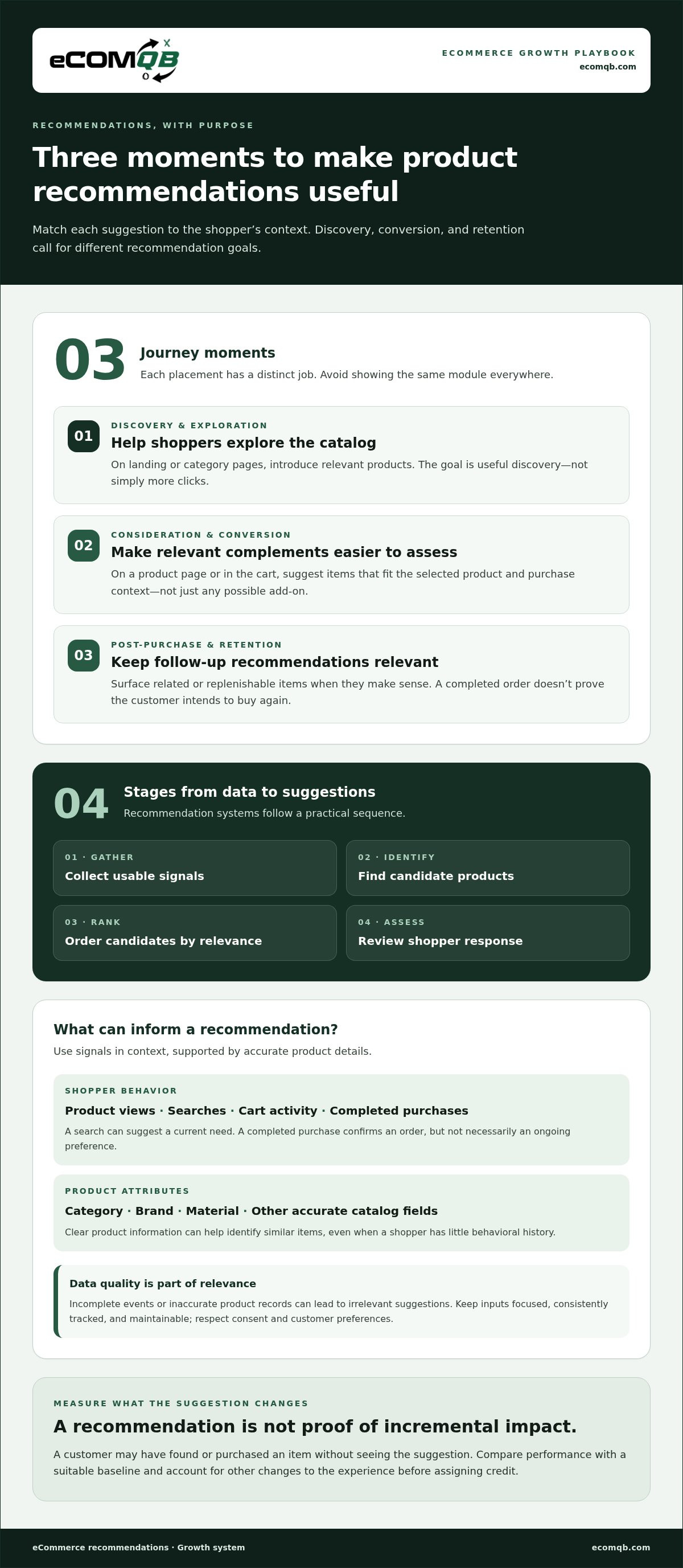
Recommendations can support several stages, but each placement needs a distinct purpose. Match the suggestion to the moment instead of deploying the same module everywhere.
- Discovery and exploration: On landing or category pages, suggestions can introduce relevant products and help shoppers explore more of the catalog. The goal is useful discovery, not simply more clicks.
- Consideration and conversion: On a product page or in the cart, complementary items may help a shopper assess a complete solution. Keep suggestions relevant to the selected item and purchase context rather than treating every add-on as an appropriate upsell.
- Post-purchase and retention: Follow-up recommendations can surface related or replenishable items when they make sense. A completed order doesn’t prove a customer intends to buy again, so timing and relevance matter.
These placements connect recommendations to acquisition, conversion, and retention, but they don’t prove incremental impact on their own. A customer may have found or purchased an item without the suggestion. Compare performance with a suitable baseline and account for other changes to the experience before assigning credit.
Results from competitors or individual businesses are context-specific examples, not forecasts for your store. Catalog depth, traffic mix, customer signals, placement, and measurement design all affect outcomes. Treat recommendations as a capability to test and govern, not a guaranteed growth lever. The strategic advantage comes from fitting them into a coordinated system and learning which suggestions genuinely help customers progress.
How AI recommendation systems turn customer and catalog data into suggestions
AI-driven product recommendations for eCommerce follow a practical sequence: gather usable signals, identify possible products, rank those candidates, and assess how shoppers respond. The system can only work with the information it receives. Start with signals your store can collect consistently and product details your team can keep accurate.
Which signals can inform product recommendations?
Behavioral signals may include product views, searches, cart activity, and completed purchases. Each offers a different clue. A search can suggest a current need; a completed purchase confirms an order, but not necessarily an ongoing preference. Use signals in context instead of treating every interaction as equally meaningful.
Product attributes add another layer. Category, brand, material, and other accurate catalog fields can help identify similar items when a shopper has little behavioral history. A first-time visitor may still receive relevant alternatives if the catalog is structured clearly.
Keep the input set focused. Don’t build a recommendation strategy around signals that are incomplete, inconsistently tracked, or difficult to maintain. Respect consent and customer preferences when collecting and using data. If key events are missing or product records are inaccurate, the system may rank irrelevant items with confidence.
How recommendation methods differ
Collaborative filtering looks for patterns across interactions among shoppers and products. If shoppers who viewed one item often viewed another, the system may recommend that second item to someone with similar activity. This can help surface unexpected discoveries, but it depends on enough useful interaction history to identify meaningful patterns.
Content-based filtering compares product attributes with a shopper’s observed interests. If someone browses several products in the same category or with similar characteristics, the system can find other catalog items with those traits. This is useful when behavioral history is limited, provided product attributes are complete and consistently labeled.
Hybrid approaches combine behavioral patterns with product information. For example, a system might use interaction data to identify promising candidates, then use catalog attributes to refine their fit. A hybrid method isn’t automatically better. Its value depends on whether both data sources are reliable and whether the combination suits the use case.
Once a method identifies candidates, ranking determines which suggestions appear first. The store’s rules and business priorities should shape that decision alongside predicted relevance. Then assess outcomes: check whether recommendations are accurate and useful, not just whether they receive clicks. Review weak matches, missing catalog fields, and tracking gaps before expanding the experience.
Strong inputs, clear permissions, and ongoing review give recommendations a firmer operating foundation. If you’re mapping that foundation to your broader eCommerce growth system, discuss your AI implementation roadmap.
How to compare AI-driven product recommendation approaches
There’s no universal winner. The right approach depends on your catalog, available data, merchandising priorities, and capacity to maintain the system. Use the comparison below to narrow the options, then test one against a specific customer need. AI-driven product recommendations for eCommerce should fit your operating reality, not just look advanced on a feature list.
Rule-based
Data: Requires product rules and merchandising input, not extensive interaction history. Control: High, because teams define which items appear. Adaptability: Low to moderate, unless rules are actively updated. Catalog fit: Useful for smaller or newer catalogs and clearly defined pairings. Maintenance: Rules need review as products and priorities change.
Collaborative filtering
Data: Relies on sufficient shopper-product interactions. Control: Less direct, since suggestions emerge from behavioral patterns. Adaptability: Can reflect changing interactions as data accumulates. Catalog fit: Often more useful when a store has meaningful activity across its products. Maintenance: Teams need to monitor data coverage and relevance.
Content-based filtering
Data: Depends on accurate, consistent product attributes and observed shopper interests. Control: Moderate, with results shaped by attribute quality and chosen signals. Adaptability: Can respond to observed interests, but may keep suggestions within familiar product traits. Catalog fit: A fit where products have useful descriptive fields. Maintenance: Catalog attributes need to stay current.
Hybrid
Data: Uses behavioral interactions and product information. Control: Varies with how the inputs and business rules are combined. Adaptability: Can draw on both sources, but only if each is reliable. Catalog fit: Useful when a store has adequate interaction history and structured attributes. Maintenance: More inputs can mean more coordination and monitoring.
Match the method to catalog and data maturity
Assess the foundation before expanding scope. A smaller or newer catalog may not have enough interaction history for collaborative filtering to produce useful patterns, so start with clear rules or dependable product attributes. A broad catalog with consistent attributes can support content-based matching; richer interaction data may make collaborative or hybrid approaches worth testing. Let data readiness determine the scale of the first implementation and what you can fairly evaluate.
Compare placements by shopper intent
Method choice is only part of the decision. Placement should answer a specific need. Related products can support exploration on a product page. Complementary items may suit a cart when they genuinely add value to the selected product. Recently viewed suggestions can help shoppers return to items they considered during their browsing journey. These are different jobs, not interchangeable widgets.
Post-purchase touchpoints need their own rationale. A related suggestion may aid discovery, but a purchase alone doesn’t establish interest in another item. Keep the presentation clear, avoid crowding the page, and prioritize relevance over the number of modules. Choose one placement and purpose to evaluate first, then expand only when customer experience and performance evidence support the next move.
How to implement, test, and optimize recommendations responsibly
Strong implementation is a controlled operating process, not a switch you flip. For AI-driven product recommendations for eCommerce, define the goal, establish a baseline, and test one clear use case before expanding. This makes it easier to learn what the system contributes and where it needs adjustment.
- Audit goals and data. Decide which customer need to support, then review available signals, catalog accuracy, consent practices, and tracking gaps.
- Choose one use case. Select a placement and purpose, such as helping shoppers explore related products on a product page.
- Implement with safeguards. Configure the experience, define relevant exclusions or merchandising priorities, and confirm that product details display accurately.
- Test against a baseline. Where feasible, compare the recommendation experience with a control group or a comparable period. Keep other changes as consistent as possible.
- Review and refine. Assess performance and accuracy, address issues, and expand only when evidence supports the next step.
Choose metrics that show business contribution
Set a baseline before launch. Revenue per visitor measures sales against store visits; conversion performance tracks the share of visitors who complete a purchase. Recommendation effectiveness assesses whether suggestions are relevant and how shoppers respond. Clicks and views can signal engagement, but they don’t prove revenue impact. Compare outcomes with a control where possible, and don’t attribute every performance change to recommendations.
Interpret results in context. Seasonality, promotions, assortment changes, traffic mix, and other site or marketing updates can shift performance at the same time. Document what changed and when. If a controlled comparison isn’t feasible, use a consistent measurement window and treat the result as directional, not definitive.
Build review and governance into the operating model
Assign clear owners for recommendation accuracy, data quality, and automation health. Reviews should catch mismatched products, stale catalog details, unexpected outputs, and tracking failures. Monitor for inaccurate suggestions and hallucination risk, then define how teams will investigate and correct problems. Oversight helps manage risk, but it can’t promise that errors will never occur.
Govern the technology stack, too. Keep an inventory of platforms and their roles, check for overlapping capabilities or conflicting outputs, and plan when to adopt, consolidate, or retire tools. For a broader framework, the AI transformation playbook connects implementation with oversight and coordinated growth systems.
Make performance review part of ongoing operations, not a one-time launch task. To shape a measured recommendation program around your store’s goals, plan your AI implementation approach.
How eComQB connects AI recommendations to continuous revenue optimization
Recommendations work best as one layer in a coordinated growth system. eComQB layers AI onto proven acquisition, conversion, and retention frameworks. This keeps the focus on the customer journey and business priorities, rather than adding technology without a plan.
AI Stack Curation selects and integrates AI platforms across the eCommerce ecosystem to fit business objectives. An AI Implementation roadmap then guides setup, integration, and configuration around a defined use case. The plan considers data quality, platform fit, and oversight alongside the recommendation experience. AI-driven product recommendations for eCommerce can then play a defined role in the broader strategy instead of operating as an isolated feature.
From recommendation setup to managed optimization
Launch is the start of the operating cycle. Managed AI Operations include recommendation accuracy analysis, helping teams review whether suggestions remain relevant as products, customer behavior, and business priorities shift. Revenue Optimization connects that review to merchandising improvements, lifecycle flow optimization, and campaign performance analysis, so recommendations can be assessed in the context of other activity rather than in isolation.
Revenue Audits assess recommendation effectiveness alongside revenue per visitor, conversion performance, lifecycle marketing efficiency, and repeat-purchase behavior. This creates a broader performance view: Are recommendations relevant? Are customers responding? Does the experience align with the store’s growth objectives? The audit also helps separate observed changes from assumptions about what caused them.
Why governance and proven growth systems matter
Governance & Oversight provides executive-level direction for AI architecture, data quality, and platform decisions. Clear ownership helps teams manage how recommendation systems fit with other tools, spot conflicts, and decide when a platform should be adopted, consolidated, or retired. That discipline helps limit technology sprawl and keeps implementation tied to business priorities.
AI isn’t a “set it and forget it” system. Teams need ongoing review of recommendation accuracy, system performance, and business alignment. The operating model should make clear who evaluates outputs, who addresses data issues, and how learnings shape the next optimization cycle. Continuous oversight supports responsible use without assuming every suggestion will be right.
eComQB’s original digital growth program launched in 2002, operated for 15 years, and spun off into eComQB in 2017. The company describes its experience as almost 25 years. That foundation informs an approach connecting implementation with governance and ongoing revenue optimization. The eCommerce AI growth system offers a wider view of how coordinated capabilities can support a growth strategy.
To connect recommendation strategy, implementation, and measurement, book a consultation with eComQB.
Make your next recommendation move count
Your next move isn’t to place recommendations on every page. Identify the customer decision you most want to support, then design a focused test that can earn broader adoption. That keeps the work anchored in shopper intent and gives your team a clear basis for deciding what to refine, scale, or retire.
Think of AI-driven product recommendations for eCommerce as an evolving capability, not a one-time deployment. As your catalog, customer behavior, and growth priorities change, the experience should keep pace. A deliberate strategy turns each review into a better-informed next move while keeping relevance and business performance in view.
Ready to map a recommendation strategy around your growth system? Book a consultation with eComQB to plan your next step. Start with a focused objective, build from what your data can support, and move forward with confidence.
Frequently Asked Questions
Can AI product recommendations work for first-time or anonymous visitors?
Yes. A first-time or anonymous visitor can still receive suggestions based on the active session, such as a product page they opened or a category they searched. The available signals depend on what the store can collect and the visitor’s consent settings. With little interaction history, recommendations have less evidence to draw on, so don’t expect the same relevance as suggestions informed by richer, longer-term activity.
How many products does an eCommerce store need for AI recommendations?
There’s no universal minimum; suitability depends on catalog structure, product attributes, traffic, and intended use. A focused catalog might support a narrow goal, such as showing alternatives within one category. A broader assortment can offer more discovery paths, but it also raises the need for clean product relationships and useful interaction data. Define the shopper problem first, then select an approach you can maintain and evaluate.
What happens if a recommended product is out of stock?
Treat availability as a merchandising constraint, not an afterthought. Review the product feed and rules that determine which items are eligible for recommendations, including how unavailable products are handled. For example, if a popular size or variant sells out, the suggestion may no longer help the shopper. Include stock status in implementation checks and routine catalog reviews.
Is AI product recommendation the same as personalization?
No. AI-driven product recommendations for eCommerce are one way to personalize a shopping experience, but personalization can also shape content, timing, and customer interactions beyond product selection. A recommendation system selects or ranks items; the broader practice adapts the experience to context. For example, a returning shopper might see different page content as well as product suggestions. Both require relevant inputs and a defined customer or business objective.
How often should an eCommerce business review its recommendation system?
Set the review cadence around how quickly your catalog, campaigns, data quality, and performance signals change. Check accuracy and business metrics regularly, then review after a meaningful event such as a catalog restructure, campaign shift, or tracking change. Frequent monitoring can surface issues early, while periodic performance reviews help assess broader trends. There’s no universal schedule; consistency and clear ownership matter most.
Can product recommendations be used in email as well as on a website?
Yes, recommendations can inform multiple customer touchpoints when the data, consent, and channel experience support their use. Website suggestions respond to browsing context; lifecycle messages need separate decisions about timing, relevance, and whether a product fits the message’s purpose. For instance, a recent purchase may inform a follow-up, but it doesn’t automatically make another product appropriate. Assess each channel on its own terms.