How to Build a Business Case for eCommerce AI and Estimate ROI

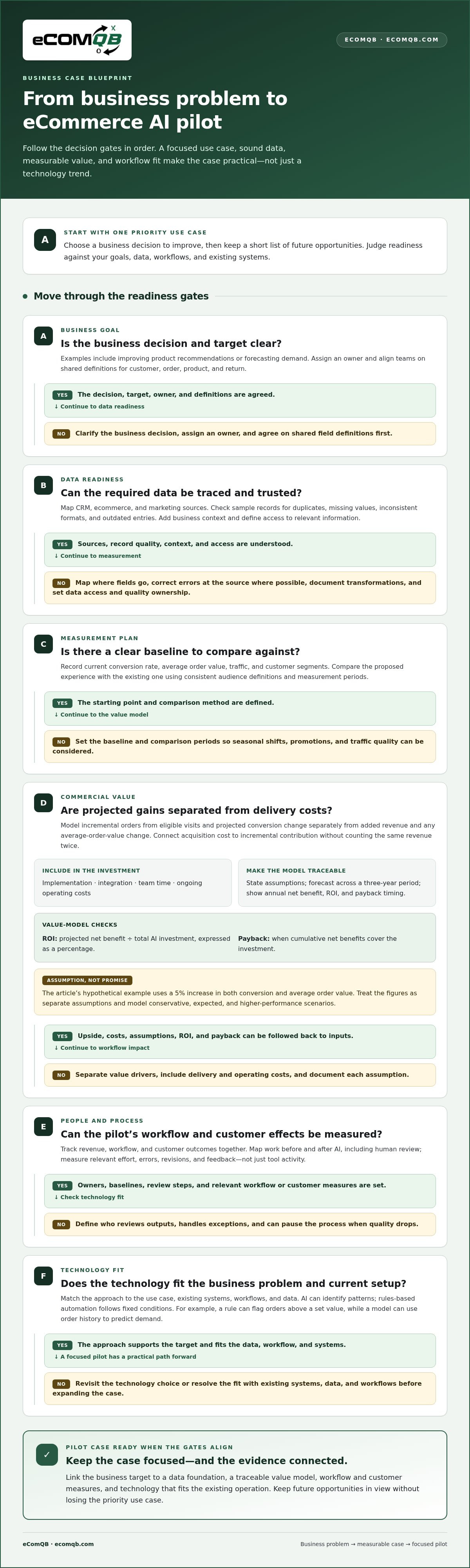
Build your case around one priority use case, then map a short list of future opportunities. This keeps building a business case for eCommerce AI focused on a measurable business problem, not a technology trend. Choose a use case that fits your goals, data readiness, workflows, and existing systems.
It’s easy to focus on what AI can do. A stronger approach is to decide what your business needs it to do and how you’ll measure the result. A sound business case connects commercial potential to the real costs and operational changes needed to deliver it.
Learn how to choose a use case, assess your data, estimate potential gains, and track effects on people and workflows. You’ll also see how to match technology to your systems, giving your business case a practical path from a focused pilot to broader adoption.
Key Takeaways
- Bring customer, commerce, and marketing data into a consistent foundation before judging whether an AI use case is ready to scale.
- Estimate commercial upside from a clear baseline, then separate projected conversion and order-value gains from the costs of delivering them.
- Track how a pilot changes team effort, process steps, and customer experience, not just its headline revenue metric.
- Choose technology around the business problem and its fit with your existing systems, workflows, and data.
Data quality and centralized data foundations
AI identifies patterns in data, while rules-based automation follows fixed conditions. For example, a rule can flag every order above a set value, while a model can use order history to predict demand.
- Set a shared target. Name the business decision the data must support, such as improving product recommendations or forecasting demand. Assign an owner from ecommerce, marketing, and operations. That team should agree on definitions for fields like customer, order, product, and return before combining reports.
- Map the data flow. List each source, including your CRM, ecommerce platform, and marketing tools. Document which fields enter the system, how they’re validated and standardized, and where they go next. For example, a submitted order record might be checked for a product ID, matched to a customer record, and then made available for analysis.
- Audit and prepare records. Review sample data for duplicates, missing values, inconsistent formats, and outdated entries. Compare product IDs and customer records across systems. Correct errors at the source where possible, then document transformations so teams can trace how an input becomes a usable AI feature.
- Organize knowledge with the data. Pair datasets with business context, such as catalog definitions, promotion rules, and return reasons. Ask category managers and customer service teams to explain exceptions that raw records can’t show. This context helps distinguish a genuine trend from a reporting artifact.
- Protect the business idea and customer information. Define who can access each dataset, what information the AI use case needs, and how outputs will be reviewed. Limit inputs to relevant fields, separate sensitive records where practical, and assign an owner to monitor data quality, access, and governance as the strategy evolves.
Estimating conversion and average-order-value gains
Calculate ROI by dividing projected net benefit by total AI investment, then express it as a percentage. Estimate payback by identifying when cumulative net benefits cover the investment. Building a business case for eCommerce AI means connecting these calculations to a business objective.
- Choose the value driver. Tie the use case to a defined target, such as more completed purchases, larger baskets, or lower acquisition costs. Show how that target supports company strategy. Don’t treat a metric like recommendation clicks as business value unless it connects to a customer action.
- Set a baseline and test. Record current conversion rate, average order value, traffic, and customer segments. Compare the proposed AI experience with the existing one, using consistent audience definitions and measurement periods. This helps distinguish incremental gains from seasonal shifts, promotions, or changes in traffic quality.
- Model conversion and basket value separately. Estimate incremental orders from eligible visits and the projected conversion-rate change. Then estimate added revenue from those orders and any change in average order value. A hypothetical example uses a 5% increase in both measures. Treat these as distinct assumptions, not a promised result, and model conservative, expected, and higher-performance scenarios.
- Connect acquisition cost to customer value. Compare current acquisition costs with projected incremental contribution from customer purchases. Use observed repeat-purchase behavior to estimate lifetime value. Avoid counting the same revenue as both conversion gains and customer value. Document the attribution method so finance and marketing can follow the logic.
- Build the complete value model. Include implementation, integration, team time, and ongoing operating costs. Forecast benefits across a three-year period, then show annual net benefit, ROI, and payback timing. Project costs based on scope and scale, and state each assumption clearly. Building a business case for eCommerce AI is stronger when leaders can trace every projection to a defined input. A value-model discussion can help pressure-test those assumptions.
Measuring effects on people, processes and workflows
Implementation costs include data preparation, system integration, tools, staff time, and ongoing monitoring. The scope determines the work involved. Measure revenue, workflow, and customer outcomes together.
-
Define Measurable Business Outcomes
Set a business outcome before choosing an AI tool, then assign an owner and establish a baseline. For example, an order-entry use case could target fewer manual corrections while tracking processing time and error rates. Document the metric, data source, review cadence, and accountable team. Avoid a broad goal such as “improve commerce” without a measurable target.
-
Measure Revenue Uplift and Cost Reduction
Track changes against the baseline, then separate added revenue from avoided costs. For a catalog-maintenance workflow, compare staff hours spent updating product details before and during the pilot. For a customer-facing use case, monitor conversion and average order value alongside returns or service contacts. Tie each metric to one outcome to avoid double-counting benefits.
- Measure workflow and people effects. Map each process before and after AI, including human review steps. If AI drafts product descriptions, record editing time, approval time, and the share requiring revisions. Gather employee and customer feedback during the pilot to identify friction that revenue metrics miss. Compare workflow versions, not just tool activity.
- Set responsible-use controls. Define who reviews AI outputs, handles exceptions, and pauses a process when quality drops. For inventory updates, retain a human approval step for unusual changes and log corrections. Monitor data quality, prediction accuracy, edge cases, and system latency. Assign owners to review results and governance, then refine controls before expanding the use case.
Matching AI technology to business needs and existing systems
Choose AI to solve a defined business problem, not to add technology for its own sake. Match the use case to system fit, operational impact, and measurable value.
- Define the decision or task first. Specify what should change and who benefits. For example, a demand forecast predicts likely product needs; an agent can use the model’s output to trigger an action. Separate prediction from execution, then decide whether your team needs a model, an agent, or both.
- Map the systems the use case must touch. Identify where relevant information lives and where an AI output must go. A customer-service agent may need CRM and ERP context to respond using a customer’s relationship history. A merchandising use case may depend on product, inventory, or storefront data. List each connection before selecting a platform.
- Score the use case against practical constraints. Compare business value with workflow impact, creative complexity, and legal considerations. Factor in data privacy, technical integration, resourcing, and brand risk where relevant. For example, an AI-generated campaign may need art direction and human review, while a back-office forecast may affect inventory operations instead.
- Test integration and control points. Trace how inputs enter the tool, where outputs appear, and who approves consequential actions. Check whether teams can review exceptions and correct errors within their existing process. A storefront recommendation that can’t use current product data or be measured against customer behavior is a poor system fit, even if its demo looks compelling.
- Stage adoption around evidence. Start with a contained use case, define success criteria, and expand only after reviewing pilot results. Keep future opportunities in the roadmap, but don’t bundle them into the first deployment. To align an AI initiative with your eCommerce technology strategy, map the business problem, platform connections, and rollout priorities.
EComQB: Revenue Generating AI Tools
eComQB provides Revenue Generating AI Tools and AI transformation for eCommerce brands. Turn to eComQB when your business case identifies a growth opportunity and you need a clear path from use case to execution. For brands focused on paid acquisition, Agentic Media Buying and Meta Advertising Execution connect AI strategy with advertising operations. The next step depends on your target, systems, and the business outcome you’re measuring. Keep the scope focused: define the priority, align the technology, and track performance against your baseline.
Contact eComQB to discuss how its AI offerings fit your eCommerce growth priorities.
Turn Your AI Case Into a Clear Next Move
Make the next move a decision, not another deck. Assign an owner, define the first review point, and state what evidence will trigger expansion, revision, or a pause. This turns strategy into an operating choice your team can act on.
A disciplined approach to building a business case for eCommerce AI connects ambition with accountable execution. Keep the focus on the business outcome, the people responsible, and the evidence that will guide the next decision. The aim isn’t to adopt more technology. It’s to build a repeatable advantage with the right use case.
When you’re ready to put that plan into motion, eComQB can help connect your AI priorities to eCommerce growth execution. Contact eComQB to discuss your AI case and map a practical next step. Your team can move forward with focus, discipline, and a stronger case for action.
Frequently Asked Questions
How many use cases should you define?
There’s no fixed number. Identify enough opportunities to compare credible options, then give one a clear owner and evaluation criteria. For each candidate, note the business decision it changes, who uses the result, and what evidence would justify moving forward. This keeps leadership reviews focused on choices and trade-offs, rather than a long list of disconnected AI ideas.
What is AI in e-commerce?
AI in e-commerce refers to systems that analyze information, generate outputs, or support actions across online retail. A search tool might interpret a shopper’s natural-language query, while a recommendation system may use browsing and purchase patterns to suggest products. The practical distinction is what the system contributes: insight for a person, generated content, or an action within a commerce process.
What business problems can AI solve in eCommerce?
AI can help address product discovery, demand planning, pricing decisions, and customer-service context. For example, natural-language processing can interpret a shopper’s technical query or synonym to help surface relevant products. A service agent connected to CRM and ERP information can use customer relationship history to make responses more relevant. Choose a problem by identifying where decisions or tasks currently constrain customer experience or operations.
What are the highest-ROI eCommerce AI use cases?
No use case delivers the best ROI for every brand. Prioritize opportunities that link directly to a business outcome and have a practical path to implementation. Product recommendations may suit a store seeking larger baskets; workflow automation may matter more when repetitive tasks absorb team capacity. Compare options by expected value, required effort, system fit, and maintenance needs.
How much can eCommerce AI increase conversion rates, average order value, or revenue?
Results vary by use case, audience, and implementation. One large pet supplies retailer increased cart value by 94% using applied AI models, but that example doesn’t predict another store’s results. Estimate potential impact against your own baseline and isolate the AI experience from other changes, such as promotions or traffic shifts. Track conversion, order value, and revenue as distinct measures.
What data, integrations, and technical resources are needed for eCommerce AI?
Requirements depend on the use case. A recommendation tool needs usable product and customer behavior information; an inventory use case needs reliable stock and order records. Integrations may connect the ecommerce platform with CRM, inventory management, or ERP systems. Assign people to manage business decisions, technical connections, and ongoing output review so the system fits real operations rather than running as an isolated experiment.